


Published by: Elise Caradec — Editor specializing in stock exchange
Searching for a date for a ETF Solana refers to two distinct realities: already rated products, like some European ETFs, and US spot ETFs subject to the ESA calendar. For the investor, the real question is therefore simple: what product is concerned, what market it is available and with what features, in particular the staking ?
Key dates for Solana ETFs
The Solana ETF calendar was built in stages: applications, regulatory deadlines, possible postponements, and then effective launch. The most concrete date on the American market is the 18 November 2025, with the launch of FSOL by Fidelity on the New York Stock Exchange. This stage reported the arrival of a large asset manager in the regulated exposure in Solana.
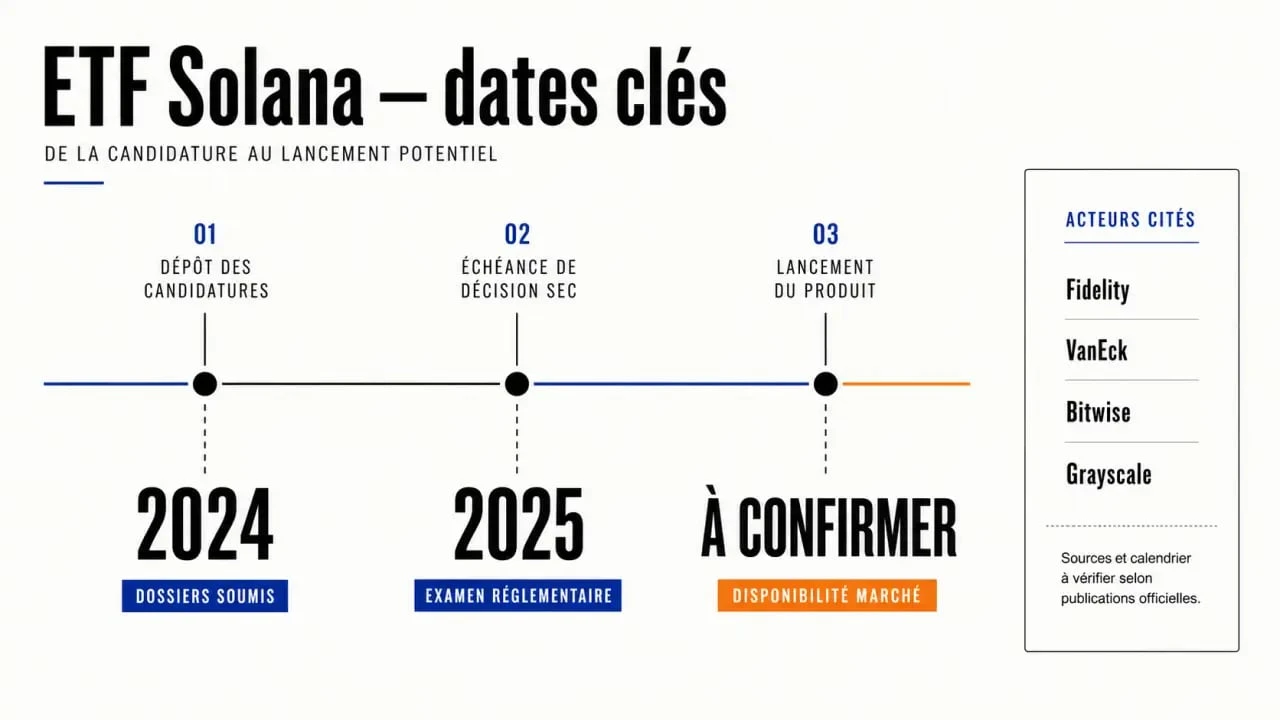
| Date | Event | Why it's important |
|---|---|---|
| 28 January 2025 | Submission of applications for Solana ETFs | Starting point of the regulatory review process |
| 16 October 2025 | Time limit associated with the ESA decision | Maturity of investors to anticipate approval or deferral |
| 18 November 2025 | Launch of FSOL by Fidelity | Availability of a Solana product worn by a major institutional player |
These dates are not just a chronology. They also give a market reading: a file is filed, the regulator examines the structure and then the product can be quoted via financial intermediaries. Between these stages, a carried forward, a change in conditions or a difference between ETF, EFN and trust remains possible. This is what makes reading ads sometimes misleading if one only looks at the final date.
SEC, approval and availability: what the date really means
The central role of the regulatory process
In the United States, the arrival of an ETF Solana spot depends on the examination of the ESA. The regulator does not only validate an underlying asset. It also looks at the structure of the fund, asset retention, market surveillance, liquidity, manipulation risks and investor information. Therefore, a deadline does not mean that the next day is put online immediately.
The deadline for 60 days mentioned in the approval process illustrates this logic. It covers a review phase, but does not remove supplementary applications or adjustments. In order to follow a Solana ETF correctly, we must distinguish three markers: date of filing, the date of decision and date of listing. This is often where confusion begins.
ETF, EFN and related products: do not confuse
The term "ETF Solana" is often used broadly, but not all products work in the same way. An ETF is a publicly traded fund. A NTE is generally a debt instrument that replicates exposure to an asset or index. In Europe, for example, VanEck proposes EFN Solana identified by ISIN DE000A3GSUD3. This product gives an exposure to Solana, but its legal structure is not that of an American ETF spot.
This grade is important to the investor. Legal documents, issuer risk, taxation, listing and replication may vary. Before buying, it is best to check the prospectus, summary, final conditions and actual availability at your broker. The same trade name may hide different mechanisms, with concrete consequences for the risk and the monitoring of the product.
Main actors: Fidelity, VanEck, Bitwise, Grayscale and others
Several managers are positioned on the regulated exposure in Solana. Fidelity draws particular attention with FSOL, in particular because the group manages $6,400 billion of assets under management. This size sends a strong institutional signal. Solana is no longer only observed by native crypto investors, it also attracts actors in traditional management.
| Actor | Product or role | Point to watch |
|---|---|---|
| Fidelity | FSOL | Launch, liquidity, costs and possible integrated staking |
| VanEck | ETN Solana, ISIN DE000A3GSUD3 | ETN structure, product documentation, access via broker |
| Bitwise | Applications and crypto funds | Positioning Against Bitcoin and Ethereum ETFs |
| Grayscale | Crypto exposure products | Possible transformation of existing vehicles |
| 21Shares and Canary Capital | Transmitters involved in the ecosystem | Rating methods and product differentiation |
Competition between issuers can be useful if it improves the readability of fees, liquidity and the quality of documents. It can also blur reading. Two products exposed to Solana can have very different mechanisms, risks and trading schedules. That is why the name of the fund is not enough. We need to look at its structure, replication policy and how it works.
Integrated Staking: the specificity that changes the analysis
Why staking counts in a Solana fund
Solana works with a mechanism of Proof of stakeOr PoS. Staking consists of immobilizing tokens to help secure the network and receive rewards. In a Solana ETF or near product, the integration of the staking can therefore change the potential performance profile, but also the operational constraints of the fund.
One integrated staking should not be read as a guaranteed yield. It depends on network rules, validators, fees, manager choices and market conditions. It can improve the economic efficiency of a product, but it also adds a technical layer that the investor must understand before buying. On this point, marketing promises are rarely sufficient.
The right reflex: look at what is actually distributed or capitalized
Two funds can announce an exhibition in Solana with staking while treating rewards differently. Some products capitalize rewards in the value of the fund, others distribute or use them to reduce certain costs. So the right question is not just "is there staking?", but "where are the rewards going, how are they calculated and what fees are levied before they benefit the investor?".
To read this type of product, it is necessary to rely on the official documents: prospectus, policy of staking, method of valuation, retention of assets and fees. They are the ones that allow you to compare one fund to another without being guided by a catchy title or a launch announcement. In such a fast market, reading is the best way to avoid confusion.
ETF Solana facing Bitcoin and Ethereum ETFs: opportunity or additional risk?
Compare Solana to Bitcoin and Ethereum helps set the level of risk. Bitcoin ETFs have paved the way for a more institutional crypto exhibition. ETF Ethereum added a dimension related to programmable networks and decentralized applications. Solana is part of this continuity, with a positioning often associated with speed, low costs and an ecosystem of active applications.
But this promise goes with marked volatility. For example, the SOL course showed a 4.5% decrease over 24 hours while remaining 10% increase over the week. This contrast sums up the subject. An ETF simplifies access, but does not make the underlying asset less fluctuating. The product changes the investment medium, not the nature of the market risk.
Bitcoin ETF : exposure to the main crypto active, often perceived as more established. ETF Ethereum : exposure to a programmable network, with an ecosystem logic. ETF Solana : exposure to a PoS network with high usage, with staking and adoption potential, but a high sensitivity to cryptic cycles. This comparison helps to place Solana in the hierarchy of available products.
For a particular investor, the most prudent approach is to check three points before positioning itself: the exact type of product, its rating place and its handling of the staking. For a professional investor, it is also necessary to integrate liquidity, price differentials, retention, internal compliance rules and regulatory risk. The date of a Solana ETF is never enough to make a decision.
In the end, the date ETF Solana serves mainly as an entry point. The real subject is to link this date to the specific product, its issuer, its structure and its use in a portfolio. It is this complete reading that makes it possible to distinguish a simple market announcement from a truly exploitable opportunity.