


Published by: Elise Caradec — Editor specializing in stock exchange
Investing in French luxury raises a recurring question: Does the global leader, LVMH, remain a portfolio value or a securities that has become too volatile? With a portfolio of 75 prestigious houses, the Moët Hennessy Louis Vuitton (MC) action remains the barometer of CAC 40. However, between slowing consumption in Asia and valuation adjustments, opinions diverge. This article examines the group's financial situation, sets out the consensus of the experts and assesses the risks for your investment strategy.
Stock market performance analysis: a giant faced with new cycles
LVMH functions as a financial conglomerate whose capitalization often dictates the trend of the Place de Paris. After years of post-pandemic growth, the title underwent notable corrections. A decline of more than 15 per cent over recent periods reminds investors that luxury is not immune to global economic cycles.
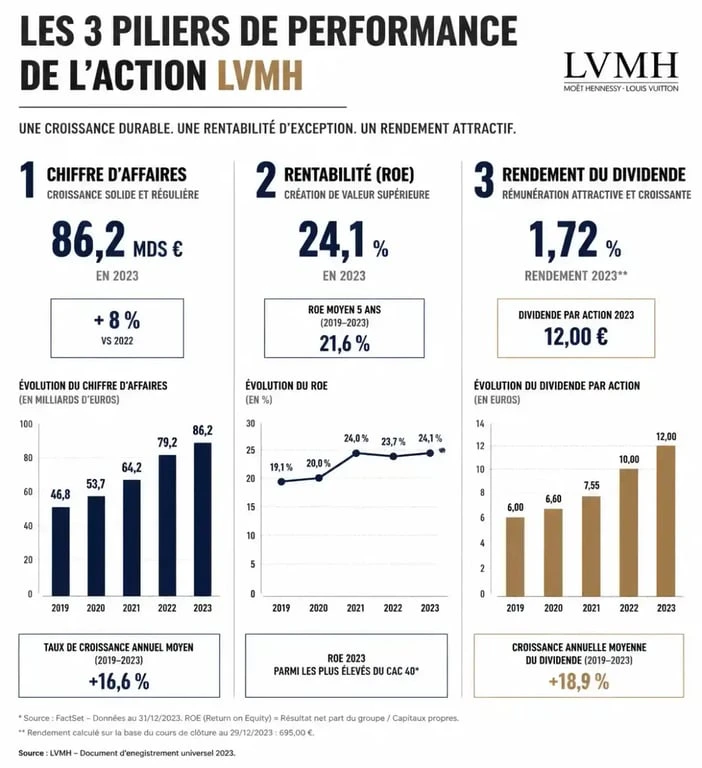
The historical performance of the action is based on a diversification strategy. Unlike competitors like Hermès, LVMH relies on five pillars of activity that respond differently to crises. This structure smoothes incomes: when division Wines & Spirits is experiencing a logistic slowdown, the Selective distribution or Fashion & Leather Goods offset the margin decrease.
Key indicators for the investor
To forge an objective opinion on LVMH, one must look beyond the daily course. The following are the basic indicators that structure the analysis of professionals:
The turnover reached about 84.7 billion euros, with a marked dominance of the Mode branch which includes Louis Vuitton and Dior. The profitability, measured by a Return on Equity (ROE) of more than 10%, demonstrates an efficient use of equity. The strength This reduces dependence on bank interest rates. Finally, the dividend offers a yield ranging from 1.5% to 2.5%, supported by a steady historical growth of the coupon.
Analyst opinions: what does consensus say?
The consensus of financial analysts remains a tool to measure market sentiment. Currently, the majority of international firms like Goldman Sachs, JP Morgan or UBS maintain a positive opinion on the title. However, price targets were revised downwards to incorporate more moderate organic growth.
The FactSet consensus shows confidence in the group's ability to maintain its operating margins. LVMH has a pricing power exceptional. In times of inflation, the ability of Louis Vuitton or Tiffany & Co. to increase their prices without losing customers is a bulwark for the shareholder. This criterion justifies the recovery premium in relation to the rest of the market.
For the particular investor, it is crucial to observe the dispersion of opinions rather than the simple target price. The more unanimous analysts are, the more the risk of surprise is integrated into the course. A divergence of opinion often indicates uncertainty in a specific market, such as the resumption of Chinese demand.
Strengths and weaknesses: why does action divide?
Investing in LVMH is about betting on the sustainability of the desire for exceptional. This bet has shadow zones that each investor must weigh before making an order.
A diversification that acts as a shield
LVMH's main force lies in the depth of its offer. The group not only sells handbags, but a global lifestyle. This diversity captures growth where it is located: if the American market saturates on spirits, the group reallocates its marketing efforts on jewellery in Europe or cosmetics in Asia. This Strategic agility is rare for a company of this size and constitutes an entry barrier for new competitors.
Risks identified
The main point of vigilance concerns geographical dependence. Although global, LVMH growth is linked to the economic health of the upper middle class and the very rich in China. Any slowdown in Chinese GDP or geopolitical tensions directly impact the stock market price.
Another risk is the Standardization sector. After the fat years of 2021-2023, luxury returns to more historic growth rates, around 5 to 7%. Investors who have purchased at the top of the wave can find time before returning to their latent gains.
Should we buy, store or sell LVMH today?
The answer depends on your investment horizon and risk tolerance. LVMH is not a speculative action to achieve a quick gain, but a portfolio fund asset.
| Investor profile | Model recommendation | Justification |
|---|---|---|
| Long term (5-10 years) | Purchase / Accumulation | Solidity of fundamentals and growth of dividend. |
| Prudent Profile | Keep | Regular yield and low risk of bankruptcy. |
| Trader Short Term | Vigilance / Sale | Correlation to Chinese indicators and sectoral volatility. |
The dividend return is one of the safest in CAC 40. The distribution rate is maintained above 50%, leaving the group a comfortable margin of manoeuvre to invest in its shops while paying its shareholders.
In summary, the general opinion on LVMH remains constructive. The recent drop in the price may be a gateway for those who wish to expose themselves to luxury at a more reasonable price. However, future quarterly results should be monitored, including the operational margin Mode branch, group performance engine.