


Published by: Elise Caradec — Editor specializing in consulting
Choosing a heritage management firm is not about finding the most visible name. The right choice depends mainly on three points: independence of the Council, the transparency of costs and the advisor's ability to build a strategy tailored to your situation. The ranking below therefore favours accompaniment models rather than mere commercial awareness.
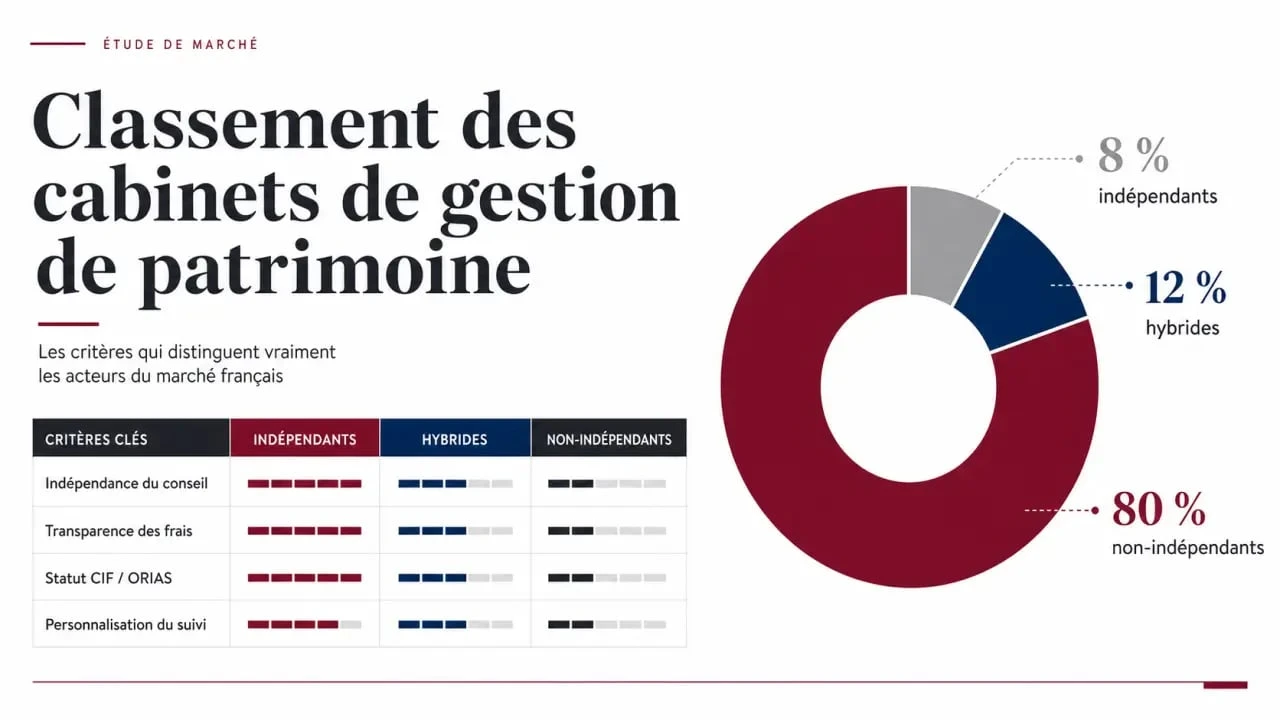
Classification of wealth management firms according to their model of advice
The French market is vast. There are approximately 7,000 financial investment advisors, CIFs. But not all work with the same degree of independence. About 80% are independent, 12% hybrid and only 8% can be considered truly independent. This distinction changes a lot for savers, especially on proposed products, fees and the risk of conflict of interest.
| Rank | Type of actor | Examples or benchmarks | Adapted profile | Point of vigilance |
|---|---|---|---|---|
| 1 | Independent firms remunerated for fees | Transparent CIF cabinets, absence or limitation of retrocommissions | Investors seeking advice aligned with their interests | Fees sometimes more visible from the start |
| 2 | Hybrid cabinets with digital accompaniment | Optivest, accessible from 149€, construction costs at 549€ or 299€ under 26 years | Young workers, managers, savers looking for clear and modern follow-up | Check details of recurring charges, including units of account |
| 3 | Digital heritage solutions | Platforms with custom algorithms and recommended allocation | Independent savers wanting to compare multiple scenarios | The human council may be more limited according to the formulas |
| 4 | Non-independent firms or partner-backed networks | Members paid in part by commissions | Customers looking for a quick and easy implementation | Risk of bias in product selection |
This ranking voluntarily puts independence first, not because it guarantees better performance, but because it makes the board more readable. A firm that clearly explains whether it is invoiced honoraria, commissions or both already allows the client to understand what he pays and why.
The criteria that really matter before choosing
Independence, CIF status and ORIAS registration
A serious firm must be able to present its status, authorizations and registration in the ORIAS register. The CIF status, for Advisor on Financial Investment, governs the investment advisory activity. LORIAS makes it possible to check that an intermediary is registered. For example, Prosper Conseil provides an ORIAS number, 22004238, which gives a concrete control point before any contact is made. In MIF 2, this transparency is not a detail.
Check your insurance intermediary's approval · Use this official tool to confirm with a few clicks that your insurer or broker is well registered and authorized to exercise.
Membership in a professional association, such as ANACOFI when indicated, can also be a reassuring signal. It is not a magic label, but it shows that the firm operates within a regulated framework. Before signing a mission letter, always ask for the contact document, compensation policy and the exact nature of the board: independent, non-independent or hybrid. This is the best way to check whether the commercial discourse corresponds to the actual service.
Transparency of costs and conflicts of interest
The costs can take several forms: consultancy fees, strategy building costs, management fees, entry fees, feedback on distributed products. The problem is not that a firm is paid; the problem arises when the remuneration is unclear or influences the recommendation.
Optivest gives an example of legible pricing with accessibility from 149€, construction costs of 549€ and a tariff of 299€ for under 26s. Management fees in units of account of 0.5% are also a useful benchmark for comparison. This type of information facilitates competition, provided that it also looks at what is included in the accompanying information, the quality of the monitoring, the depth of the tax analysis and the relevance of the proposed materials.
Monitoring quality and customisation
A good wealth manager does not just offer life insurance or IPS. It must include your taxation, investment horizon, risk tolerance, family plans, retirement and estate. Two clients with the same capital can receive very different recommendations if one prepares a transmission and the other wishes to finance a principal residence. The value of the council can be seen in this ability to connect the subjects among themselves.
Customization is also measured over time. A firm that makes an initial assessment and then disappears does not offer the same service as an advisor who adjusts the strategy in the event of a professional change, birth, marriage, business transfer or retirement. Follow-up is as important as the initial recommendation.
Which firm for which heritage profile?
Young asset or first asset
For a young asset, the challenge is often to lay the foundations: precautionary savings, PEA, life insurance, ETF, start of real estate investment or preparation of a first purchase. Costs must remain proportionate to capital. Offers accessible from a few hundred EUR, such as those mentioning 149€ or a reduced tariff for children under 26, may be relevant if they provide a real pedagogy. A good firm also helps to avoid paying too soon for services that are still useless.
Professional, professional or entrepreneur
High income profiles generally need a more comprehensive approach: tax optimisation, compensation and dividend arbitration, spousal protection, foresight, financial investments, rental real estate, sometimes Private Equity. The firm must be able to work with the client's accountant, notary or tax lawyer. It is often here that consulting fees are meaningful, as tax savings or risk reduction can far exceed the cost of the mission.
A good advisor does not build the same strategy for everyone. It adjusts each parameter to the right place, without unnecessarily weighing a single post. Solid assets must be held together: cash, taxation, investments, real estate, retirement and transmission. If a party is neglected, e.g. the life insurance beneficiary clause or the matrimonial regime, the whole can be distorted at the most sensitive time.
Retirement, succession and transmission
For a future retired person or a family preparing a transmission, the classification must be read differently. Gross performance becomes less central than security, taxation, availability of capital and clarity of beneficiaries. Firms capable of coordinating investment, donation, dismemberment, life insurance and estate organization are then to be preferred. In these situations, the accuracy of the advice counts more than the volume of products proposed.
Read customer reviews without being impressed
Customer reviews are useful, but they must be interpreted with methodology. A Google note of 5/5, such as the one mentioned for Optivest, is a positive signal, especially if the comments are detailed and evoke the pedagogy, responsiveness or clarity of fees. But an excellent note does not replace the analysis of contractual documents.
Trust must also be built on verifiable elements: seniority of the firm, regulatory status, quality of the first appointment, ability to explain risks and transparency on remuneration. Beware of speeches that are too perfect, promises of high returns without compensation, or recommendations focused on a single product. A credible advisor talks about both limits and opportunities.
Another figure deserves attention: 21% of firms manage 88% of clients, or about 420,000 people. The median is around 20 clients per firm, while the average is approaching 100 clients. This means that the market is very dispersed, with some very visible actors and many more confidential firms. A small firm can provide excellent follow-up, but it needs to check its availability, operational strength and ability to deal with complex issues.
The simple way to compare before making an appointment
Before contacting a firm, prepare a comparison in four columns: status, remuneration, services, fit with your profile. This grid avoids choosing only about notoriety or a commercial promise. It also helps to ask the right questions from the first exchange. Keeping this structure in mind saves time and quickly identifies gaps between two firms.
- Check the regulatory framework CIF status, ORIAS registration, contact documents.
- Ask how to pay : fees, commissions, retrocommissions or hybrid model.
- Analyze the services offered : tax optimization, retirement, estate, investments, SCPI, PEA, ETF, life insurance.
- Evaluate customization Does the advisor ask specific questions or does he quickly propose a product?
- Compare costs over time Initial costs, management costs, support costs and annual monitoring costs.
The best wealth management firm is therefore rarely the same for everyone. For an independent investor, a well-built digital platform may suffice. For an entrepreneur or a family with transmission issues, an independent fee firm, able to interact with other councils, will often be more suitable. In any case, the right decision is a simple sign: you clearly understand what is recommended, what it costs and what risks you accept.