


Published by: Elise Caradec — Editor specializing in consulting
Updated on 28 June 2026
French taxation of savings products is complex. Choose between the progressive scale of income tax (IR) and lump-sum options such as the lump-sum exemption (LFP) or the single lump-sum levy (SFP) directly changes the net amount collected. This choice depends on your Marginal tax bracketthe length of detention and, above all, the date of your payments.
Tax mechanisms: PFL, PFU and progressive scale
In order to arbitrate effectively, one must distinguish the three forms of taxation that coexist. Each responds to a different calculation logic that impacts the return on your investments.
Test your knowledge of saving taxation
The LFP
Used before 2018 for life insurance, the PFL consists of a fixed deduction from earnings at the time of withdrawal. This levy relieves the taxpayer of any additional taxation on such income. Today it concerns premium products paid before 27 September 2017. Rates are degressive according to the age of the contract: 35% before 4 years, 15% between 4 and 8 years, and 7.5% after 8 years, excluding social contributions.
The Single Single Unit (PFU) or Flat Tax
Established in 2018, the UFP is the standard for most income from movable capital. Its overall rate is 30%, consisting of 12.8% of income tax and 17.2% of social contributions. Unlike the PFL, it does not depend on the length of detention, except for life insurance after 8 years where a specific discount applies.
Taxation on the progressive scale
This option is to add your financial gains to your other income (wages, pensions, rents). The whole is subject to income tax brackets (0%, 11%, 30%, 41% or 45%). If you opt for this solution, it applies to all your year's income from movable capital; you cannot choose the scale for one placement and the package for another.
Arbitration: when do you prefer income tax over package?
The choice between the package (PFL or PFU) and the progressive scale is based on your Marginal Imposition (TMI), the rate at which the last euro of your income is taxed.
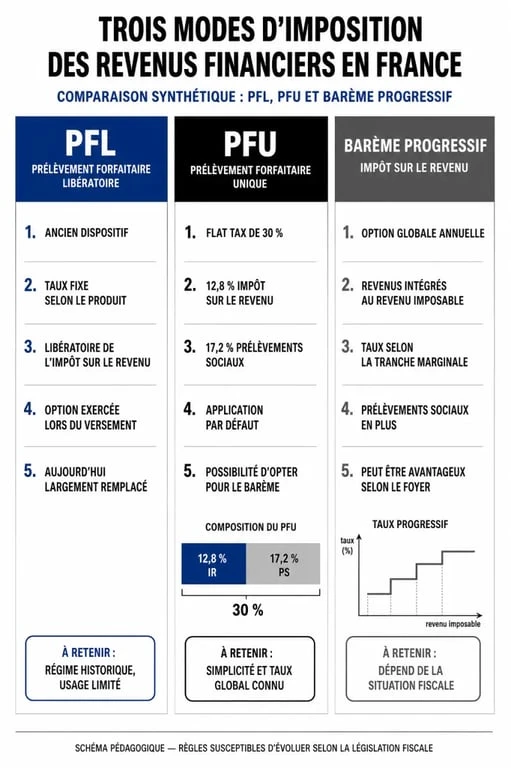
If you are not taxable or if your MIT is 11%, the progressive scale is generally more advantageous. Paying 0% or 11% of tax is preferable to the flat rate of 12.8% of the UFP or higher rates of the LFP. If you are in the 30%, 41% or 45% tranches, the lump sum levy becomes a shield to limit the taxation of your interest and dividends.
The progressive schedule option also allows you to deduct part of the CSG (6.8%) from your total taxable income. This technical point can favour taxpayers at the boundary between two instalments.
Summary of recommended options:
For a non-taxable taxpayer (TMI 0%), income tax allows for almost total avoidance of tax, excluding social contributions. With an 11 per cent MIT, income tax is often preferable because the rate is lower than the 12.8 per cent package and the CSG is deductible. For an IMT of 30 % or more, the flat-rate levy (UTP or PFL) is recommended to cap tax at 12.8% or to benefit from a reduced rate.
Life insurance: variable geometry taxation
Life insurance benefits from an exception scheme where the date of payment and the length of service of the contract dictate the rules. Each payment carries its own tax rule depending on when it was incorporated into the contract.
Life insurance taxation: understanding the taxation of your earnings · Discover the tax rules applicable to your life insurance earnings based on the length of your contract and the possible exemptions.
Your contract works like a tank powered by several sources. Gains from payments made before September 2017 follow the old legislation (possible LFP), while those from recent payments are subject to Flat Tax. The insurer must disaggregate the share of gains associated with each period to apply the correct rate on redemptions.
The 8-year threshold
Holding a contract of more than 8 years remains the major tax advantage. You get an annual discount on winnings of 4,600 € for one person alone and 9 200 € for a couple. This allowance applies regardless of the tax method chosen.
The ceiling of 150,000 €
For payments made after September 27, 2017, a reduced rate of 7.5% PFU applies to proceeds from contracts over 8 years of age, but only for outstanding amounts of less than 150,000 € per insured person (300,000) € for a couple). In addition, the rate of 12.8% applies to the surplus.
Exercise option and avoid errors
The timing of the option differs according to the device. For the flat-rate levy, the election is irrevocable and must be made to the financial institution at the latest on receipt of income or redemption. If forgotten, the default option applies.
For the PPU or Schedule Tax, the decision is made on the annual income tax return by checking box 2OP. Attention: this box gives up the PPU for all your year's financial income. A global simulation is therefore necessary.
A few points of vigilance for your choices:
Check your overall income, as a salary increase can make you switch to a higher band and make the UFP more attractive. Don't forget that 17.2% of social contributions are due in almost all cases, whatever your choice. Finally, if you are planning a significant withdrawal from life insurance for more than 8 years, spread it over two calendar years to double the annual discount.
The choice between flat-rate tax and income tax is never final from year to year. It must be reassessed with each change in personal situation or legislative amendment. The key to successful optimization lies in knowing your IMT and your payment history.