


Published by: Elise Caradec — Editor specializing in stock exchange
Choosing between Coinbase and Binance is like comparing two distinct approaches to crypto-actives. On the one hand, Coinbase relies on simplicity and strict regulation to reassure newcomers. On the other hand, Binance dominates the market by its volume of transactions, the depth of its catalogue and its advanced technical tools. For the investor, the decision is based on a precise equation between costs, security and performance objectives.
Transaction costs: the difference between Coinbase and Binance
The cost of use directly influences the profitability of your investments, especially if you multiply purchase and sale orders. On this ground, the two platforms adopt opposite strategies.
Binance: cost optimization
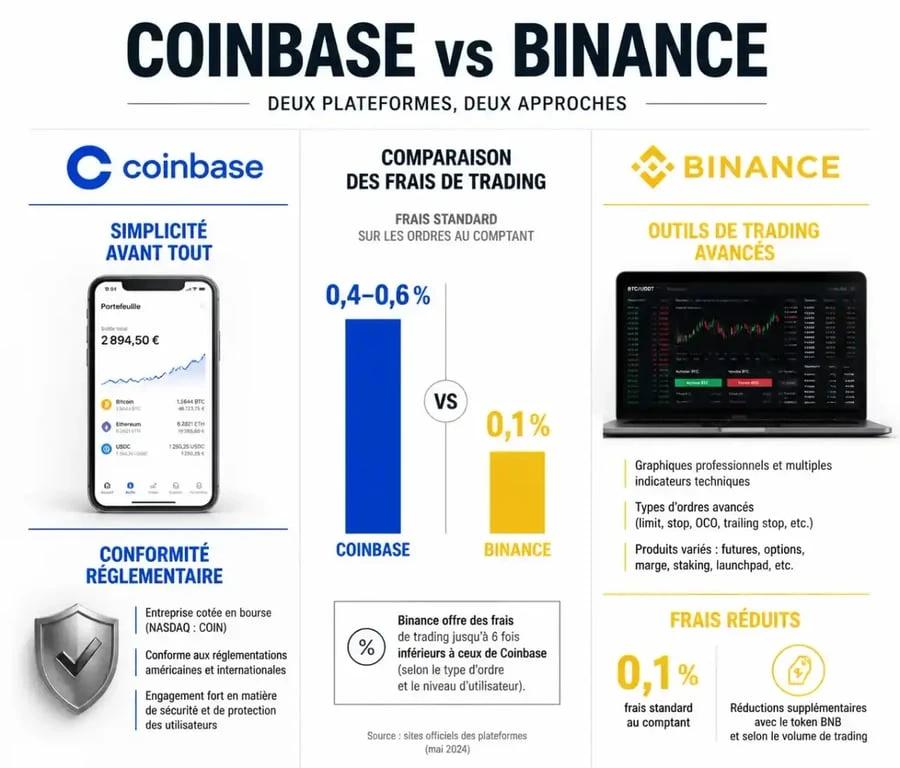
Binance built his success on an aggressive cost structure. For spot trading, the platform applies a standard fee of 0,1 %. This rate decreases by 25% if you use the BNB, the native token of the ecosystem, to settle your commissions. For active traders, this economy is substantial.
Coinbase: simplicity at a price
Coinbase's standard interface charges high fees, often ranging from 1.5% to 3% depending on the payment method. Although Advanced Coinbase offers more competitive rates — about 0.40% for « makers » and 0.60% for « Takers » — It remains more expensive than its competitor. Coinbase is intended primarily for users who prefer an experience without technical friction.
| Type of operation | Binance | Coinbase (Standard) | Advanced Coinbase |
|---|---|---|---|
| Trading Spot (standard) | 0,1 % | ~1.49% to 3.99% | 0,40 % / 0,60 % |
| Reduction via native token | Yes (-25% with BNB) | No | |
| Purchase by Bank Card | ~1.8% to 2 % | ~3,99 % |
Security and regulation: protecting its assets
Security of funds is an imperative. Both platforms deploy robust measures: 2-factor (2FA) authentication, cold storage of a large portion of assets, and rigorous KYC verification procedures.
Coinbase cultivates an image of exemplary compliance. Based at Nasdaq, the company undergoes regular financial audits. In France, it is registered as PSAN This reassures institutional investors and individuals concerned with legal transparency.
Binance, a global leader, has had to strengthen its compliance with international regulatory requirements. To offset the risks, the platform created the fund SAFU (Secure Asset Fund for Users), an emergency insurance reserve with a portion of trading costs. In case of piracy, this fund is intended to reimburse users, offering an additional security guarantee.
Catalog of advanced cryptos and functionality
The choice depends on your ambitions. If you limit yourself to Bitcoin and Ethereum, both platforms are suitable. If you are looking for specific assets or derivatives, the landscape changes.
The diversity of assets: the binance advantage
With over 350 cryptocurrencies, Binance is the preferred land to diversify a portfolio. There are Altcoins low capitalisation, DeFi and Coinbase's absent emerging assets. The platform also offers complex tools such as levers, future contracts and an OTC (P2P) market.
Staking and income generation
The two platforms offer options for staking to make your assets grow. Coinbase simplifies the process: you hold your chips and activate the rewards with one click. Binance, via its section « Earn », offers superior granularity with flexible or blocked staking over defined durations. YPA rates are often more attractive on Binance, but require more active management.
Ergonomics: two visions of user experience
Accessibility is Coinbase's strong point. The interface is refined, the graphics are simplified and the buying process looks like a classic e-commerce site. It's the right tool for those who want to own crypto without manipulating complex order books.
Binance has long been perceived as complex. However, the Binance Lite its mobile app hides professional tools to leave only the essential. Despite this, navigation in the global ecosystem (Launchpool, NFT, Academy) remains dense and can intimidate beginners.
Customer support
Customer support remains a point of vigilance. Coinbase has been criticized for its slowness, although the introduction of a live cat has improved responsiveness. Binance has an extended help centre and multilingual support on social networks, but the quality of support varies according to demand.
Verdict: Which platform to choose according to your profile?
The final choice depends on your priorities:
Choose Coinbase if: You start, you focus on simplicity, you invest in the long term without frequent trading, and you attach the utmost importance to institutional regulation and clarity.
Choose Binance if: You want to reduce your trading costs, you want to explore a wide range of altcoins, you are interested in active staking or derivatives, and you master an interface rich in options.
Many investors use both: Coinbase as a secure access ramp for euro transfers, and Binance for active trading and access to a wider diversity of assets. Whatever your decision, do not leave all of your funds on an exchange platform and use a hardware wallet portfolio for your long-term investments.