


Published by: Elise Caradec — Editor specializing in consulting
Investing in real estate to reduce its tax burden is a classic strategy, but it often faces a binding reality: tenant management, renovation work and administrative uncertainties. The SCPI tax (Société Civile de Placement Immobilier) offers a turnkey alternative. By purchasing shares of « Paper stone », you access powerful defiscalization devices while delegating all operational management to certified professionals.
How does a defiscalization SCPI actually work?
Unlike the return SCPIs for regular dividend distribution, the primary objective of the tax SCPIs is to generate an immediate tax benefit. The management company collects funds from individuals to acquire a residential real estate asset meeting the criteria of a specific law, such as Pinel, Malraux or Denormandie.
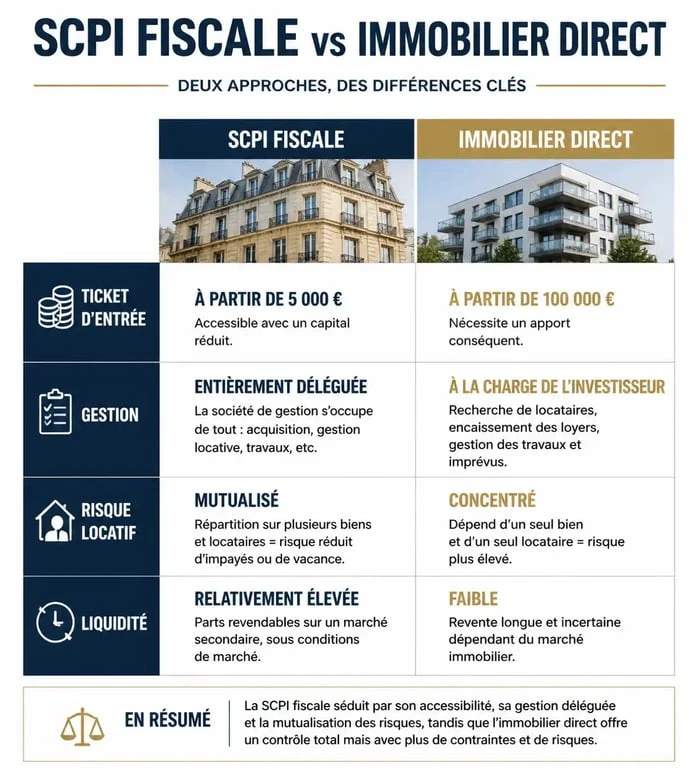
As a shareholder, you benefit from the tax reduction in proportion to your investment, exactly as if you held the property on-line. You enjoy a risk pooling. Instead of relying on a single tenant, your investment is spread over dozens of housing units located in different geographical areas. This diversification strengthens the stability of your heritage.
An immediate or spread tax reduction
Depending on the scheme chosen, the tax advantage takes two forms. Either a tax reduction spread over several years, as for Pinel, or an advantage attributable from the year of subscription for certain installations such as the property deficit or Malraux. The tax advantage is acquired upon signature, even if not all the buildings are rented, which is a saving of time compared to an on-line purchase.
The flagship devices to optimize your taxation
Each tax law meets a specific need and a specific tax bracket. Choose the wrong one SCPI tax can be counterproductive if the benefit does not match your actual tax burden.
The SCPI Pinel: the classic of the new residential
The Pinel scheme allows for a tax reduction calculated on the amount invested. SCPI purchases new or future completion housing (VEFA) for rent at capped rents. The investor undertakes to retain its shares for a minimum period, usually 6, 9 or 12 years. This is the right tool for those looking for a linear and predictable tax reduction.
SCPI Malraux and Denormandie: the asset of renovation
These two devices target old real estate to be renovated. SCPI Malraux focuses on buildings located in protected areas or degraded old neighbourhoods. The tax reduction is powerful, reaching up to 30% of the amount of work, and is not subject to the tax niche cap of 10,000 €. The Denormandie, for its part, applies to the areas of revitalization of the territory, with a functioning close to Pinel but focused on heavy rehabilitation.
Land deficit: for high land incomes
It is not a direct tax reduction but a deduction. The SCPI's land deficit acquires property requiring significant work. Renovation expenses are deducted from your existing property income without a cap and, if this is not enough, from your total income up to 10,700 € per year. This is an effective strategy for taxpayers in the 41% or 45% marginal tax brackets.
The heritage anchor concept: securing its strategy
In an asset portfolio, the tax SCPI plays an anchor role. Where financial markets are subject to brutal volatility, residential real estate under state control offers structural stability. This anchor stabilizes the basis of your assets while freezing a certain tax saving. SCPI's share is based on tangible assets, often located in historic city centres where land is scarce. This rarity acts as a natural stabiliser for the long-term withdrawal value, offsetting the least liquidity of this type of investment.
Benefits, costs and vigilance points
Investing in a defiscalization SCPI must not be done solely for tax gain. It is necessary to analyse the assembly as a whole, as the costs and duration of immobilization are decisive factors.
| Characteristics | SCPI Tax | Real estate Direct |
|---|---|---|
| Entry ticket | From 5,000 € about | Often > 150,000 € |
| Management | 100 % delegated | Charged by the owner |
| Rental risk | Mutualized from 20 to 50 properties | Focus on 1 property |
| Liquidity | Low | Average |
| Subscription fees | 8% to 12% | ~ 7-8 % (notary) |
The crucial question of the length of the blockage
A tax SCPI is a long-term investment, often between the ages of 15 and 17. This delay is explained by the time it takes for the management company to collect the funds, acquire the buildings, carry out the works, and then resell the entire housing stock to liquidate the SCPI. Resale of shares before liquidation is extremely difficult and often leads to the loss of the tax advantage.
Management fees and performance
The cost of managing a tax SCPI is generally around 8% to 12% of the rent collected. The pure yield, i.e. the dividend paid, is often lower than that of a conventional return SCPI, between 1% and 2%. The main objective is the defiscalisation and valorisation of the heritage, not the immediate distribution of cash. It is therefore necessary to calculate the overall profitability by integrating the annual tax saving.
Steps to Success Your Tax Paper Stone Investment
In order not to turn a fiscal opportunity into a heritage disappointment, a rigorous methodology is required. Don't sign anything without checking these key elements.
Focus on historical actors who have already liquidated tax SCPIs in the past. The end-of-life resale phase of the SCPI is the phase in which real performance is crystallised. Also make sure that the SCPI invests in areas of high rental tension, such as Greater Paris or dynamic regional metropolises. A tax advantage never compensates for an extended rental vacancy.
Keep in mind that most tax benefits, excluding Malraux and Deficit Land, fall within the overall tax niche ceiling of 10,000 € per year. If you are already using home help or have other investments, check your available margin. Finally, invest only money you will not need for the next 15 years. The tax SCPI share is not a savings booklet.
In conclusion, defiscalisation via SCPI is a tool of formidable efficiency for highly taxed taxpayers who do not wish to suffer the constraints of rental management. By choosing the right system and accepting the necessary time horizon, you transform your tax into a sustainable and diversified property.