


Published by: Elise Caradec — Editor specializing in consulting
It is better never to arbitrate without visibility: any SME then exposes itself to risks that go far too often under radar. This is why one strategic diagnosis remains, today, the most pragmatic way to anticipate, arbitrate and boost the performance your company. This 2026 guide, designed for demanding leaders, brings together proven methods, models to download and concrete examples to structure your decisions and accelerate your growth – without losing yourself in complexity or timing.
Strategic Diagnosis: Guide 2026 for managing, deciding and performing (with downloadable templates & tools)

Looking for a truly operational tool to take a step back, arbitrate effectively and secure the evolution of your SME? Strategic diagnosis acts as a compass to analyze your environment, anticipate challenges and align your resources with performance. From the outset, it is generally found that: a well-built diagnosis is based on an examination of your internal strengths/weaknesses and your external environment, an alert about threats and opportunities, and leads to a usable, non-theoretical action plan. In concrete terms, firms assisted through a structured approach show an increase in 20 to 30 % growth after their first diagnosis (source: Medicen, 2019-2023). Take action with our models available to download, free simulators, and join a strong community of experts 450 members.
Some executives had already heard of the diagnosis, but how can they make it a real business lever without losing weeks? Here we give you the winning combination: clear steps, resources designed for decision makers who don't have time to waste, illustrated methods (PESTEL, SWOT, Porter...), free models available as well as a "ready to deploy" approach detailed below. Be proactive – don't let the competition take too much lead or your margins decrease. In 2026, the method is no longer reserved for giants: everything starts now, in less than twenty minutes of reading or via our simulator.
Summary of key points
- ✅ Strategic diagnostics can anticipate, arbitrate and boost SME performance.
- ✅ A pragmatic approach to aligning resources with external and internal challenges.
- ✅ Available models and tools for quick action with a community of experts.
What is a strategic diagnosis? The basics to know (and what it's not)
Make key decisions without having a clear vision of your assets or brakes? It's the daily life of many leaders – that said, nothing prevents it from changing. The strategic diagnosis aims to scrutinize every facet of your business and its environment to lock lucid choices, carrying lasting value.
Common definition and simplified terminology
The strategic diagnosis is not just a business plan or a forecast grid of figures. It's a dynamic analysis that positions you on three main axes – What's your status? What risks or opportunities concern you? How can you improve the competitiveness of your SME in its market? It is often recommended that:
- Internal analysis (forces, weaknesses, resources, skills, room for manoeuvre).
- Through external analysis (threats, opportunities, competition, sector trends).
- By synthesizing all these elements using the SWOT matrix, to identify the most relevant strategy.
Keep in mind: diagnosis is not the business plan. While the business plan presents a future projection, the diagnosis starts from the ground to identify what can and should evolve. It is sometimes called strategic GPS, but it does not replace vision: it makes it pragmatic and activating.
Difference with business model, business plan and audit
To remove confusion – the business model presents how you generate value. The business plan outlines how you run your project (finance, HR, marketing). The audit, for its part, checks the conformity of the processes.
Behind the strategic diagnosis, we find a critical analysis to reveal new levers of progress. This is where any strategy that is aligned with the realities of the field begins.
A trainer recently mentioned that in her 450-member community, this starting point allows each week to avoid the "deep tracks" that slow growth.
Good to know
I recommend that you not confuse strategic diagnosis with business plan: the first analyses the present to identify levers and risks, while the second describes the future implementation of the project.
Why make a strategic diagnosis in 2026? (And what you might ignore)
Major changes on the horizon: digitalisation, rapid change in AI, new consumption patterns... Strategic diagnosis becomes the way to adjust the course, quickly rotate or detect unexpected opportunities.
A business context under high pressure
The market is constantly evolving: competition is diversifying, regulation is modernizing, and prices are becoming more volatile (e.g. ecological transition or commodity inflation). To carry out a strategic diagnosis similar to a « 360° photo » of your situation and the terrain, never losing sight of the essential.
The figures are revealing – a Medicen study shows that out of over 90 SMEs, those who have followed a structured analysis show 20–30 % growth 12 months – while the rest cap close to 8 %. Many professionals recognize themselves in this scheme: they have found that this initial framing avoids sinking into risky choices.
What risks without diagnosis? (Example lived)
A SME tech leader explains: "We thought we were ahead of our market... But without a diagnosis, we completely missed the arrival of an Asian competitor. Fortunately, the SWOT and PESTEL analysis at the right time prevented a disaster. We were able to quickly redirect our offer."
- Undetected threat (e.g. emerging competitor or sudden regulatory change)
- Rated opportunity (launching a digital channel, unexpected partnership)
- Significant investment on an unidentified weak point
- Disoriented teams for lack of shared vision
Another point to remember: the diagnosis protects against blind spots, which experts sometimes call "invisible traps in SMEs".
The 5 key steps of strategic diagnosis (with examples and tools)
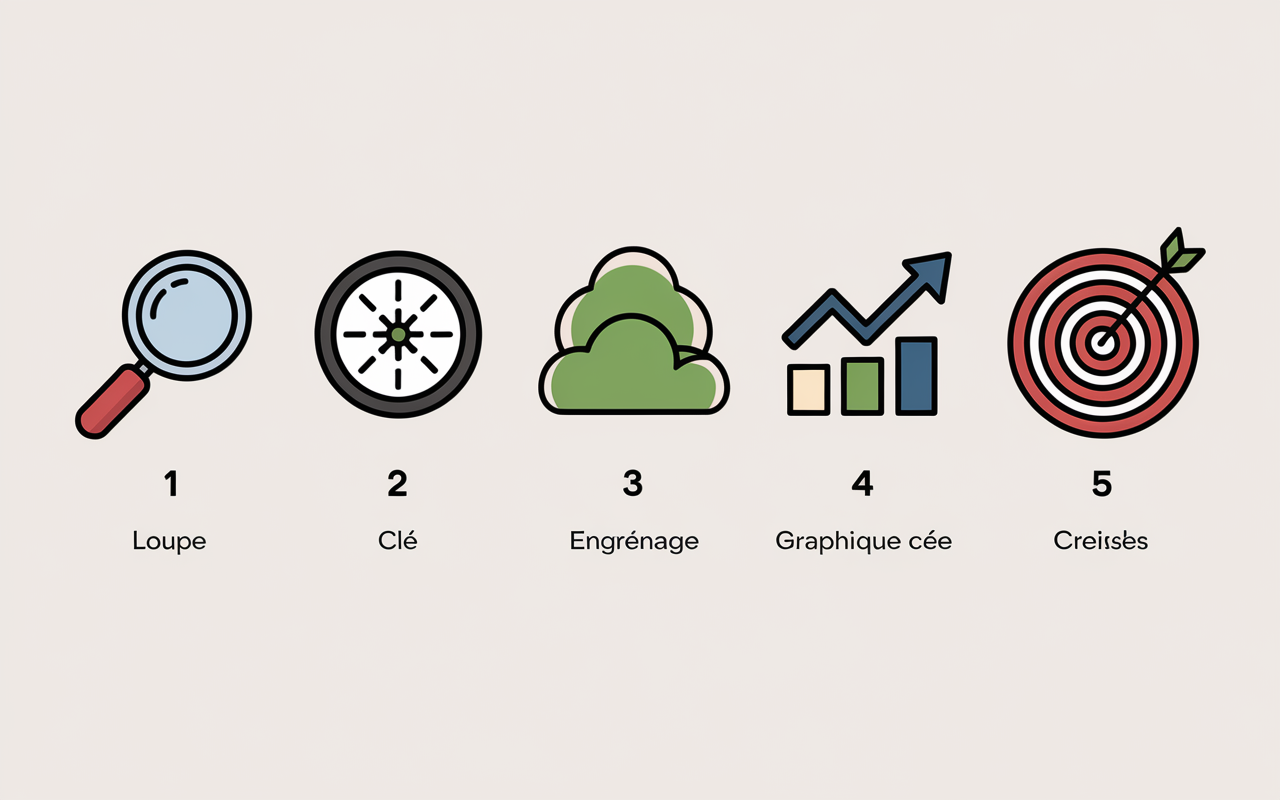
Are we looking for a concrete method, applicable without consulting? The next five steps are validated by professionals (even those of the top SERP SME) but also illustrated in our downloadable models.
1. External analysis: context, PESTEL and 5 Forces de Porter
Everything starts here: sweep macro trends, regulatory changes and competitive dynamics. The PESTEL analysis (Policy, Economic, Sociocultural, Technological, Environmental, Legal) offers a reading of the great changes to come, regularly over 24 to 36 months.
- Anticipate regulations (common in health, technology or CSR)
- Observe the evolution of customer expectations
- Make sure you're ready for the rise of AI or e-commerce...
In 2026, 72% of SMEs accompanied already see the impact of artificial intelligence on their value chain. The Porter approach details the pressures of the market: who are the real rivals, the entrants, the structuring partners? Some consultants report that discovering a new actor can sometimes upset a strategy in less than 3 months.
2. Internal analysis: resources and skills (and their blind spots)
It is better to examine its "internal engines": assets, fragility, hidden dependencies. The VRIO matrix (Value, Rareness, Imitability, Organization) allows you to check whether your resources (human, technological, commercial) represent a lasting advantage, or just a precarious balance.
Case real: an SME business thought it had a unique customer relationship. The VRIO showed that the competitors had already caught up with the delay... This is also why regular analysis is needed to avoid unpleasant surprises.
It is noted that any internal analysis wins has been conducted collectively. It often takes three meetings, says one HR expert, to gather all the actionable information.
3. Matrix SWOT: the synthesis that changes everything
The SWOT matrix (forces, weaknesses, opportunities, threats) summarizes observations on a single page. It's the center of diagnosis. By crossing internally and externally, one emerges the lines of decision: should one capitalize on a force or quickly remedy a weakness?
Some professionals report that a shared SWOT with shareholders has prioritized two urgent measures: +18% margin over a quarter by reallocating two commercials on the e-commerce channel. In practice, the SWOT PDF/Excel model is available for download here.
4. Advanced tools: BCG matrices, value chain, simulators
To structure several business units or deepen reasoning, the BCG matrix (stars, milk cows, dilemmas, deadweights), Porter's value chain or digital simulators facilitate resource targeting and the preparation of strategic decisions.
Digital tools (SEMrush, Power BI, etc.) make the diagnosis and analysis of internal data accessible, even in free or trial versions. Moreover, the list is at the bottom of the page.
Some feedback points out that the 450 leaders Each month discusses the "most profitable" methodology according to the sector. Is this the most suitable approach for your SME? The question deserves reflection.
5. Concrete recommendations: prioritizing, arbitrating and taking action
Diagnosis is only useful if it triggers decisions. List three to five priority actions, assign them leaders (and realistic deadlines). Then follow the progress with a mini dashboard (Excel or other). These recommendations, coming out of the theoretical framework, make all the difference: according to Medicen, 80% of managers having implemented at least three post-diagnostic actions achieve their growth targets in less than nine months.
Little terrain anecdote: perfection does not exist – it is sometimes better to decide on a reliable "80 %" basis than to wait indefinitely for "ideal on paper".
Examples and concrete cases: before/after an SME in 2026
Nothing is worth a real example to see the impact of a well-conducted diagnosis. This is the course of a French SME of services (80 employees) which started in early 2026.
Before/after illustration (synthetic course)
Before diagnosis: drop order book, eroded team spirit, identified dangers with wet finger (for example, an imminent departure never anticipated).
After the process (with the tools available in this guide):
- +12 % market share in 6 months
- Succession plan activated as a priority
- Digital offer launched faster than competition
- Improved team engagement (satisfaction rate +19%)
Some professionals believe that the impact depends mainly on the degree of objectivity and the ability to federate afterwards... It's not always obvious. However, with a sound methodological framework, it is much more accessible than is believed.
Free practical tools and resources: SWOT models, simulators, checklist
It's better to go on concrete. Here are the free or trial access tools to deploy immediately to switch from theoretical diagnosis to action.
Instant download or simulators online
In particular, you can:
- Download the SWOT model (PDF or Excel)
- Try the external/internal analysis simulator (including tutorial video)
- Register your business to the driver community: personalized returns included
- Use the actionable checklist: 5 essential points to finalize your diagnosis
Already, 450 active members share their sectoral action plans and benchmarks – join them for free and access all downloadable templates.
Do you doubt the tool or the method? Our interactive comparator is available at the bottom of the page to slice calmly.
Frequently Asked Questions and Errors to Avoid (Strategic FAQ & Expert Advice)
A reflex too widespread exists: minimize the impact of a well-designed FAQ. An unanswered question mark, and the whole process can be delayed for six months... That's why here are the concrete answers and the field returns to avoid current blockages.
Quick FAQ (based on your most common questions)
Duration of diagnosis? For an SME, it is better to plan about 10 days internal, or 2-3 days with expert or digital accompaniment.
Strategic Diagnosis or Business Plan: One lays the foundations, the other structure the next phase (financing, HR, operations).
Free tools for SMEs? The SWOT and PESTEL models can be downloaded here, accompanied by a video tutorial of 6 minutes.
Frequency of execution? It is regularly recommended that all 12 to 24 months or at a major event (crisis, merger, new market).
Typical mistakes? Stay on the surface (diagnosis) « quickly »), forget to consult the teams, neglect weak signals, or overestimate its assets.
- Priority: think "ground reality" above all
Want to get back to your situation? The experts of our community answer for free under 24h via the dedicated form.
Being accompanied or joining a community of experts: how does it work?
Are you afraid to be wrong, look outside or dream of sharing your methods? Accompaniment by specialists or engagement with a sector community fosters a step back, and the ability to compare your results objectively.
Why join this type of structure?
Joining a band or being coached is actually 50% additional shares implementation – and +30 % success (source: Medicen, 2023). Through regular exchanges as well as sectoral benchmarks, you benefit from feedback and avoid the mistakes already experienced by other entrepreneurs.
- Advanced models, Q/R sessions, rich feedback
- Reception of a checklist adapted to your area
- Benefit from tariff advantages (up to 15 % on the support package and premium tools)
Some participants point out that the richness of peer-to-peer exchanges is often underestimated: sometimes it is enough to have an idea "at the turn of a conversation" to trigger a decision that has been waiting for months.
Go to action: download, simulate and exchange (simultaneously)
Want to measure your strategic position objectively? Download the SWOT matrix and business plan (100% free), test the decision simulator or ask an expert your questions via the integrated form. Community (450 members, more than 90 live cases) welcomes you: each sector finds its place.
Last point to remember: a member entrepreneur often recalls: "Strategic diagnosis is never time lost. It's the shortcut to win battles that we don't always see."