


Published by: Elise Caradec — Editor specializing in stock exchange
Investing in the world's luxury leader, LVMH, is not just about the growth of the stock market. For many shareholders, the dividend income component is a performance indicator essential. While the reported yield may seem modest compared to other more mature sectors, it hides a growth dynamic that deserves further analysis. Understanding the return of the LVMH dividend requires looking beyond the simple instant percentage to observe the group's ability to pay its shareholders over the long term.
Calculation and status of LVMH's current performance
The dividend return is the ratio between the annual dividend paid per share and the stock price of the same share. For LVMH, this figure generally varies between 1.5% and 3% depending on the market cycle. Although this rate may appear to be below the CAC 40 average, it must be interpreted in the light of the company's valuation. A lower return is often a sign of an action whose price has risen faster than the coupon, reflecting strong investor confidence in future growth.
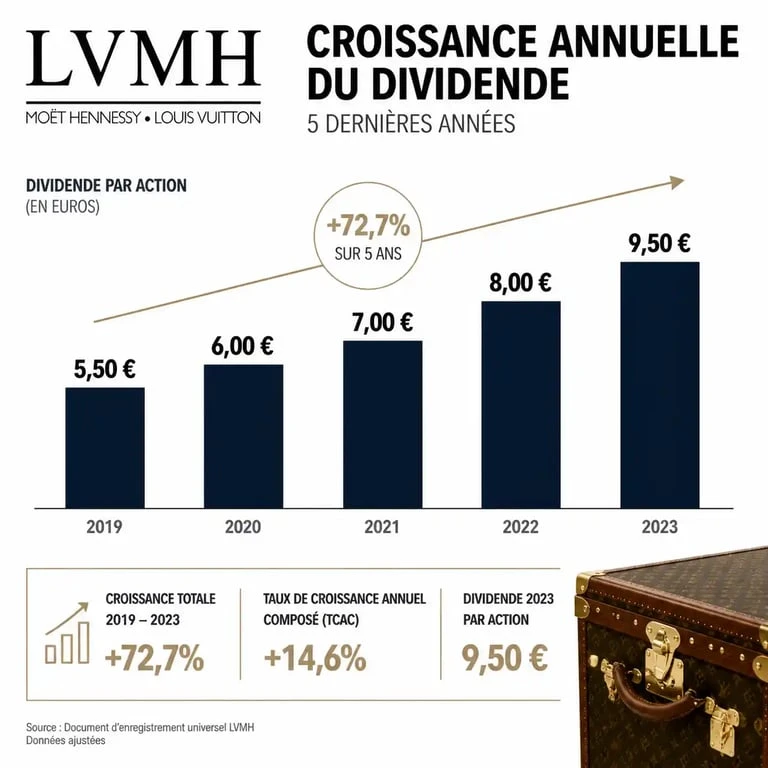
Analysts expect a forecast return close to 1.8% to 2.2% for the coming fiscal year, depending on price fluctuations. This figure is supported by strong financial performance, with revenue continuing to grow. The dividend per share (DPA) has grown steadily, from 6 € in 2019 to 13 € for fiscal year 2023, illustrating the willingness of management to share the fruits of growth.
| Indicator | Value (Estimation N) | Forecast (N+1) |
|---|---|---|
| Dividend per share | 13,00 € | 14,50 € |
| Annual performance | ~1,9 % | ~2,1 % |
| Distribution rate (Payout) | ~45 % | ~47 % |
Distribution history: double-digit growth
The true strength of LVMH is not its immediate yield, but its compound annual growth rate (CAGR). Over the last ten years, the dividend has increased on average by more than 13% per year. This regularity transforms a modest initial investment into a substantial source of income for the long-term shareholder. This is what we call the Yield on Cost : the return calculated on the initial purchase price of the share.
Resilience to the test
Even during periods of global turbulence, LVMH maintained a prudent but generous distribution policy. Unlike other sectors that had to cut their dividends in the face of instability, the luxury group was able to preserve its financial structure. This resilience is explained by the diversification of the brand portfolio (Louis Vuitton, Dior, Moët & Chandon, Sephora) which compensates for geographical or sectoral slowdowns.
The management of the distribution of dividends at LVMH is calculated so as not to weaken the overall structure of the company. Management ensures that the payment never punctuates the self-financing capacity needed to buy new houses or to renovate iconic shops. This approach ensures that the dividend is the healthy reflection of a surplus cash controlled.
Payout Ratio: a guarantee of security
Distribution ratio (or payout ratio) LVMH is generally around 40% to 50%. The company distributes only half of its profits to its shareholders, retaining the other half to reinvest in its development. This is a major safety indicator: even in the event of a temporary decline in profits, the group has a comfortable margin of manoeuvre to maintain its dividend without endangering its financial health.
Sectoral comparison: LVMH against luxury giants
To judge the relevance of LVMH's performance, it must be compared to its peers. The luxury sector is heterogeneous, with very different performance profiles depending on the maturity of companies and their capitalization strategy.
Hermes usually has a lower return, often below 1.5%, as the title benefits from a rarity premium and a very high market valuation. Kering Often offers a higher yield, sometimes greater than 3% or 4%, but with greater volatility and strong reliance on the Gucci brand. Richemont is within a range similar to LVMH, with a stable dividend policy focused on watchmaking and jewellery.
LVMH is positioned as the middle: higher yield than Hermès with much greater safety and diversification than Kering. For an investor seeking a balance between capital growth LVMH often appears to be the most structured choice within CAC 40.
Practical terms: when and how to collect the dividend?
The payment of the LVMH dividend is traditionally made in two stages, allowing the income for the shareholder to be smoothed in the year.
Payment schedule: down payment and balance
LVMH usually pays dividend deposit December. The amount of this advance payment shall be decided by the Board of Directors. The dividend balance is then paid in April or May, after approval by the Joint Shareholders' Meeting. To collect the dividend, it is sufficient to hold the shares the day before the date of secondment (ex-date). Payment usually takes place two working days after the secondment.
Taxation and optimization
For French tax residents, the dividend is by default subject to the Single Unified Flat rate (SPF) levy of 30%, including social contributions. However, the holding of LVMH shares in a Share Savings Plan (ESP) allows for an income tax exemption after five years of holding, with only social contributions remaining due on withdrawals. For foreign investors, withholding tax may apply, often modulated by international tax treaties.
Factors influencing future performance
Several factors vary the return on the LVMH dividend. The first is the exchange price: if the share is corrected while the dividend remains stable, the mechanical yield increases. On the other hand, a surge in securities reduces the yield in percentage, even if the shareholder's overall wealth increases.
Another key factor is expansion in emerging markets, particularly in Asia. LVMH's ability to maintain its high operating margins in these regions directly conditions the net profit per share and therefore the distributable envelope. Finally, the group's acquisition strategy plays a role: major buybacks, such as Tiffany & Co, can leverage short-term cash, but eventually boost the long-term cash flow (Free Cash Flow), thus supporting future dividend growth.
The performance of LVMH must be analysed as a component of an overall performance. It is an action of dividend growth, ideal for those who favour the quality of fundamentals and the constant progression of income rather than a high but potentially risky immediate return.