


Published by: Jean Bogle — Editor in Chief
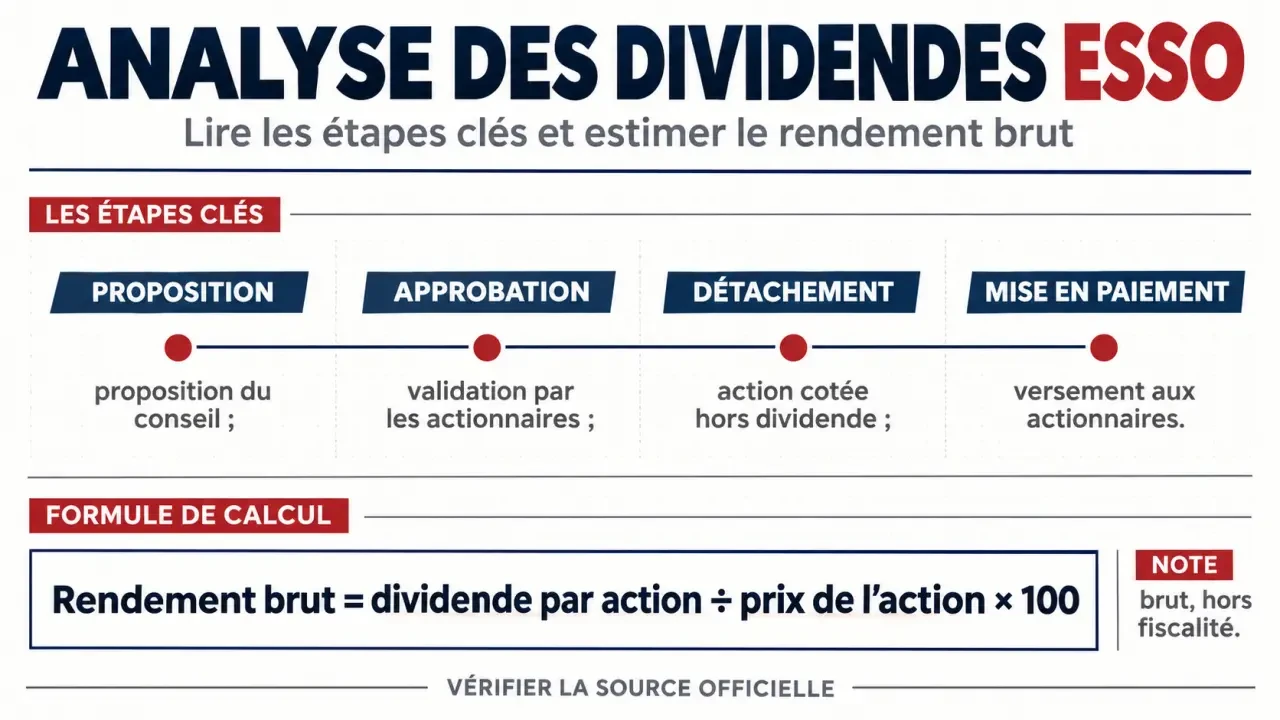
To assess the Esso dividendsA distinction must be made between the amount announced, the conditions for collecting it and the ability of the undertaking to renew its distribution. A large dividend is neither a guaranteed income nor a purchase signal alone. Before making any decisions, check the last official release: a distribution proposal, a voted dividend and a payment made are three different steps.
What Esso dividend to take into account for your decision?
The search for an amount calls for a dated answer. A figure found in a history may relate to an old fiscal year, have been paid the following year or include an exceptional component. Without a recent and verified official announcement, it would be misleading to present an amount such as the next payment.
Also start by accurately identifying the title concerned. Research on Esso may lead to information on Esso SF. Or on ExxonMobil. Their distributions are not interchangeable: the name of the issuer, the ISIN code and the listing space must correspond to the line held in your portfolio.
Proposal, approval and payment: three separate statutes
The board of directors may propose a distribution for a financial year. The annual dividend is then submitted to shareholders at a general meeting. The timetable for secondment and payment shall specify the terms of payment. A mention like « Proposed dividend » therefore should not be read as an amount already acquired from your account.
- The financial year concerned indicates to which accounts the distribution is linked.
- Date of announcement verify that the information is still relevant.
- Gross amount per share used for calculation before taxation and possible costs.
- The nature of the payment makes it possible to distinguish ordinary and exceptional distribution, when specified.
Prioritise the issuer's financial communications, general meeting documents and notices of securities transactions. The tables of financial intermediaries are practical but may include a forecast or an old amount.
Dates that determine your entitlement
To collect a dividend, it is not enough to hold the share on the day the money arrives. The schedule distinguishes between secondment, registration of entitlement positions and payment. These dates serve different functions.
| Benchmark | Meaning | Point of vigilance |
|---|---|---|
| Detachment | The share begins to negotiate without the right to the dividend concerned. | A purchase from that date does not normally qualify for this payment. |
| Registration | Eligible positions shall be identified in accordance with the applicable rules. | The settlement must be taken into account. |
| Payment | The dividend shall be paid by the issuer. | The display on the account may depend on the processing by the broker. |
Buy just before detachment does not offer an automatic gain
At secondment, the reference course is adjusted for the amount distributed, all other things being equal. The observed price also changes with market movements. Buying a share only to cash its dividend does not mechanically create wealth: part of the value leaves the company to join the shareholder's treasury.
If a transaction is planned near this deadline, check your broker's official schedule and terms and conditions before issuing the order. Do not deduct the purchase deadline from the only payment date.
Calculating return without confusing income with performance
Gross return returns the dividend per share to the price chosen. The formula is simple: gross dividend per share ÷ share price × 100. The difficulty is to choose a coherent numerator and denominator and then to understand what the result actually measures.
For illustrative purposes, a dividend of €5 for a share purchased €100 represents a gross return of 5%. This calculation does not describe a payment announced by Esso. It only shows that a return depends on both the distribution and the price paid.
Historical performance and expected performance do not say the same thing
A financial site can display the last dividend paid divided by the current price. This performance is retrospective. If the next distribution declines or disappears, it will not match future income. Conversely, a forecast yield is based on an estimate, which remains uncertain until the distribution is confirmed.
A fall in the price can also raise the yield without improving the company's outlook. To judge your placement, observe the total performance : change in the value of shares, dividends received, fees and taxes. Distributed income may coexist with a higher loss of value.
Finally, keep two separate measures: the return calculated on your cost price, useful for tracking your investment income, and the return calculated on the current price, useful for comparing investment possibilities today.
The strength of the next dividend depends on the industrial cycle
For a company exposed to refining, the results may vary significantly depending on refining margins, demand, energy costs and plant availability. The price of oil alone is not sufficient to explain profitability: the difference between the cost of supplies and the value of products sold plays a key role.
A high profit on a fiscal year therefore does not guarantee an equivalent distribution the following year. The Esso dividend analysis must cover several exercises and events likely to affect distribution capacity.
The items to read behind the net profit
- Cash generated by the activity: it helps to assess the resources actually produced.
- Investments: maintenance, security and industrial adaptation mobilise liquidity.
- The financial situation: Debt and financing needs may limit distributions.
- Non-recurring elements: an exceptional assignment or result does not necessarily occur.
The distribution rate, which returns the dividend to profit, provides a benchmark, but is not sufficient in isolation. An accounting profit may be affected by items without immediate receipt. Conversely, a distribution can mobilize accumulated reserves, and its justification and reproducibility must be examined.
Think of the dividend as a cash relay, not as a monthly salary. If you use these payments to finance regular expenses, plan a separate reserve: it takes over between two payments and absorbs a possible reduction. This organization avoids the need to sell shares urgently to settle a deadline.
Before purchasing, verify net amount and concentration risk
The amount announced is generally gross. The amount actually available depends on your tax residence, the holding envelope and the rules applicable at the time of payment. For a French tax resident, a securities account and a PEA do not work in the same way; The eligibility of the title and the conditions of the plan must be verified.
Therefore, do not directly compare a gross share return with that of a net tax-based savings product. Also include brokerage fees and any fees associated with the processing of securities transactions.
Before strengthening a position, gather this five information:
- The amount officially announced and its status.
- Detachment and payment dates.
- The possible exceptional part of the payment.
- Financial capacity to support future distributions.
- The weight of this action in your financial assets.
The right criterion is not the most spectacular dividend, but income compatible with the accepted risk and your investment horizon. For Esso as for any cyclical action, it is better to build its budget on a conservative assumption than to automatically extend a past payment.