


Published by: Elise Caradec — Editor specializing in stock exchange
Investing in energy is no longer about betting on the price of the barrel. With ecological transition and market volatility, the ETF energies have become accessible diversification tools. These index funds make it possible to expose dozens of companies, from oil giants to hydrogen pioneers, in one click. Between immediate yield and growth potential, choosing the right financial vehicle requires the method.
Understanding the functioning of ETFs in the energy sector
An energy ETF is an investment fund that replicates the performance of an energy-related stock index. Unlike buying shares online, where the investor carries the specific risk of a single company, the ETF mutualizes this risk on a basket of securities.
Index replication and management costs
Most of these funds use physical replication: they actually hold the index shares. The major advantage lies in the cost structure. Where an actively managed fund often collects high costs, ETF energies display costs between 0.08% and 0.45%. This economy is a long-term driver of performance.
The typical composition of an energy basket
The composition varies according to the index chosen, such as MSCI World Energy or S&P Energy Select Sector. There are generally three types of actors: « Supermajors », integrated exploration and distribution companies (ExxonMobil, Shell, TotalEnergys); on equipment manufacturersspecialized in infrastructure such as turbines or pipelines; and pure producers, focused on a single source such as solar or natural gas.
The Strategic Duel: Fossil Energy Against Renewables
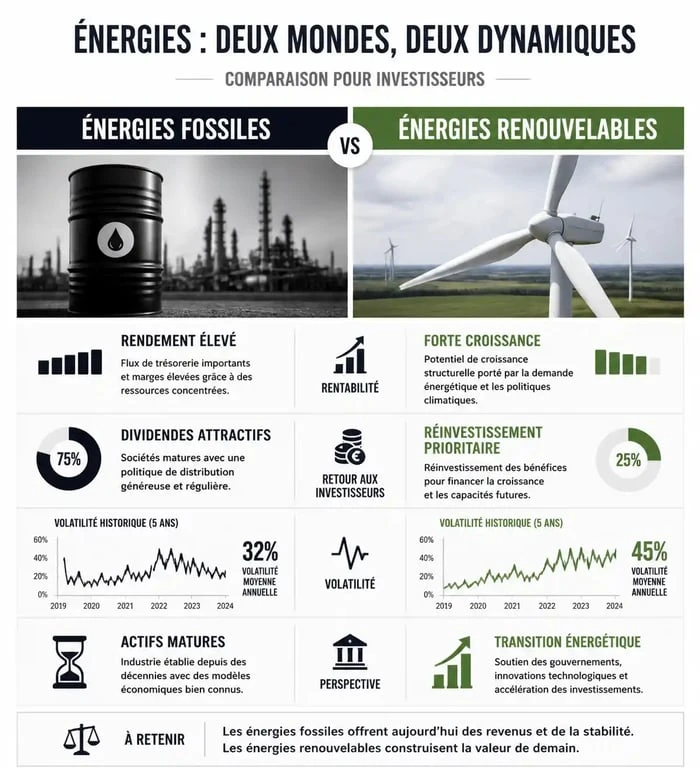
The ETF energy market is divided into two philosophies that meet distinct heritage logics. It is necessary to understand this distinction before making a scholarship order.
Fossil energy asset: Return and dividends
Oil and gas based ETFs, often referred to as ETFs Old Energygenerate significant cash flows. These mature companies redistribute a large part of their dividend profits. In 2025, the average return for these funds was between 3 per cent and 4.5 per cent. They offer protection against inflation, as energy prices directly influence consumer price increases.
Green energy ambition: Growth and theme
Renewable energy ETFs focus on solar, wind, hydrogen and storage. Here, logic favours growth linked to the global energy transition rather than the immediate dividend. These funds are more volatile: they may experience sharp increases, but they are subject to severe corrections during interest rate hikes, which raise the cost of large infrastructure projects.
The market operates as a complex matrix where geopolitical and technological variables intersect. The prudent investor identifies the most robust intersection. For example, a petroleum service company that is turning to offshore wind farms is strategically hybrid, often undervalued by conventional selection algorithms.
Comparison of the main ETF energies on the market
To help you choose, here is a selection of funds representative of each category, accessible via a securities account or a PEA.
| Name of ETF | Ticker | Sector focus | Annual expenses |
|---|---|---|---|
| Energy Select Sector SPDR | XLE | US Oil and Gas Giants | 0,10 % |
| iShares Global Clean Energy | INRG | Solar, Windy, Renewable | 0,65 % |
| Lyxor MSCI World Energy | WNRG | Global energy (majority fossil) | 0,30 % |
| L&G Hydrogen Economy | HTWO | Hydrogen value chain | 0,49 % |
How to integrate these funds into your investment strategy?
Adding an ETF energy depends on your risk tolerance and your investment horizon.
Diversification to limit volatility
The energy sector is cyclical and closely dependent on global growth and OPEC+ decisions. For a balanced portfolio, an exhibition of 5 to 10 % the sector is often recommended. This makes it possible to take advantage of the phases of increasing raw materials without endangering capital in the event of market reversal.
The importance of ESG criteria and labels
Many investors favour ETFs benefiting from the label ISR (Socially Responsible Investment). These funds exclude the most polluting companies or those that do not meet certain governance standards. Investing in a labeled ETF allows to reconcile financial performance with environmental impact, while protecting against the risk of « stranded assets »These fossil reserves, which could lose their value as a result of new climate regulations.
Choose the right support: PEA or Account Titles?
Taxation is a major lever. While most international ETFs are housed in an ordinary securities account, some issuers offer eligible versions of the ETF. PEA Thanks to synthetic replication. This is a tax opportunity to make your investments grow with a capital gains tax exemption after five years.
Risks and alert points
ETF energies have specific risks. The risk of concentration is common: some indices are dominated by more than 40% by only two or three companies. If one of them encounters a problem, the whole ETF suffers.
It is also necessary to monitor the foreign exchange risk. Many of the ETFs are denominated in US dollars. If the dollar weakens against the euro, your investment performance is reduced. Finally, the theme of renewable energy is very sensitive to interest rates: a rise in rates directly affects the market valuation of companies in the sector.