


Published by: Elise Caradec — Editor specializing in stock exchange
FTSE 100, nicknamed « Footsie » by financial professionals, goes beyond the mere figures scrolling on the City screens. This index includes the 100 largest companies listed on the London Stock Exchange. Its daily performance influences institutional portfolios and serves as a thermometer for global financial health, given the international reach of its member companies.
Origins and definition of Footsie
Name « Footsie » results from the pronunciation of the acronym FTSE, for Financial Times Stock Exchange. This index results from a collaboration between the Financial Times and the London Stock Exchange. Launched on 3 January 1984 with a 1,000-point base, it offers a true picture of the British stock market.
Test your knowledge of FTSE 100
The FTSE 100 represents approximately 80% of the total stock market capitalization of the London Stock Exchange. Its particularity lies in its global nature: about 75% of the revenue generated by its enterprises comes from abroad. It is therefore less sensitive to the UK domestic economy than to world trade and currency fluctuations, especially the pound sterling.
Calculation mechanism: floating market capitalization
The evolution of Footsia is based on the Floating-weighted market capitalization. In contrast to simply adding prices, this method gives importance to the real size of each company in the market.
The role of the float
The « floating » means the share of the shares of a company actually available for purchase and sale. Securities held by the State, founders or retained for long-term control purposes are excluded from the calculation. This rule ensures that the index reflects the reality of trade and avoids distortion by fixed securities.
Real-time update
The index is calculated during the opening hours of the London Stock Exchange from 8 a.m. to 4.30 p.m. A new value is published every 15 seconds. This frequency allows traders to react instantly to new economics, making Footsie a precision tool to analyze the volatility of the UK market.
For the investor, Footsie acts as a benchmark. By observing the movements of the hundred largest capitalizations, it becomes possible to detect invisible background trends in the analysis of isolated actions. This clarity helps navigate international finance cycles.
Revisions and composition of the index
FTSE 100 is not a fixed structure. FTSE Russell's Steering Committee quarterly review its composition in March, June, September and December.
Everything about FTSE UK stock market indices · Access the official data and detailed composition of the major British stock market indices, including the famous FTSE 100.
Entry and exit criteria
To integrate Footsie, a company must meet strict liquidity and capitalization criteria. If a company in FTSE 250 has its value surpassed that of the last members of FTSE 100, it is promoted. On the other hand, a company whose capitalisation is declining risks relegation. This system ensures that the index represents the economic elite of the moment.
FTSE 100 heavy goods vehicles
The index includes giants from various sectors, ensuring natural diversification:
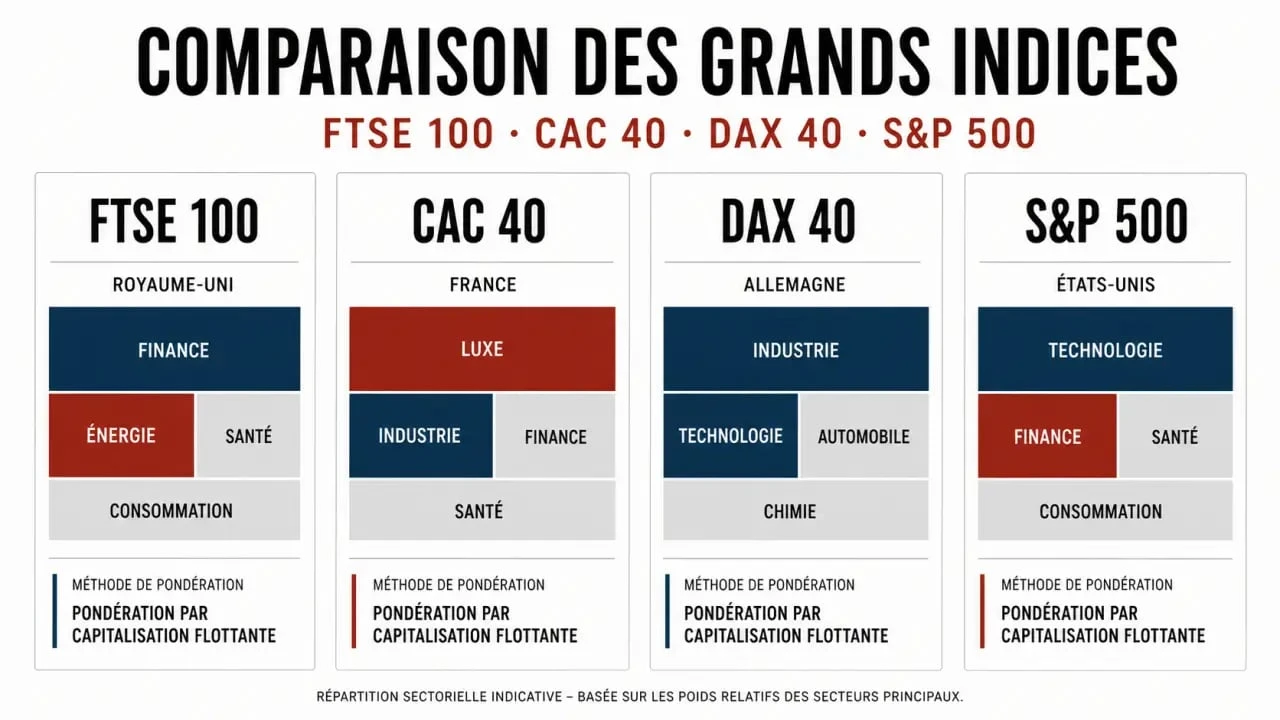
The sectorEnergy is represented by mastodons such as BP or Shell. The finance relies on HSBC, Barclays and Lloyds Banking Group. The health based on AstraZeneca and GSK. The consumption is carried by Unilever and Diageo, while the Mines, with Rio Tinto and Glencore, link the fate of the index to commodity prices.
Comparison with international indices
It is useful to situate the FTSE 100 with other global locations to understand its dynamics.
| Index | Number of enterprises | Main specification | Weight type |
|---|---|---|---|
| FTSE 100 | 100 | International exhibition and raw materials | Floating capitalization |
| ACC 40 | 40 | Luxury and industry | Floating capitalization |
| DAX 40 | 40 | Automobile and technology | Capitalization |
| S&P 500 | 500 | Global benchmark, strong technological component | Floating capitalization |
Footsie is distinguished from CAC 40 by its size and its least dependence on the luxury sector. Compared to S&P 500, it is often perceived as an index « Value », as it contains fewer high-growth technological values and more companies paying regular dividends.
How to invest in FTSE 100
Since the index is a mathematical construct, it is not possible to buy a part of it directly. There are, however, several instruments that can be used to expose them.
ETFs and trackers
Listed index funds (ETFs) are the easiest way to invest in Footsie. An ETF physically or synthetically replicates the movement of the index. By purchasing a share, the investor holds an exposure to 100 index companies with reduced management costs.
Derivatives
Futures contracts (Futures) and options allow experienced investors to speculate on the rise or fall in the index. These tools provide leverage, multiplying both gains and losses. They are mainly used for portfolio cover or short-term trading.
Return on dividends
The dividend return is a major aspect of Footsie. British companies are known for their generosity towards shareholders. For a complete vision, the index « Total Return » re-integrates dividends paid into the calculation of final performance, providing a more accurate picture than the simple closing price.
History and resilience of Footsie
Since 1984, FTSE 100 has experienced major crises. Its journey reflects the economic history of the last four decades.
The 1987 crash, the Internet bubble of the late 1990s and the 2008 subprime crisis marked phases of high volatility. More recently, the Brexit referendum in 2016 and the 2020 pandemic have also tested the strength of the index. The weakness of the pound sterling after Brexit often supported the FTSE 100, as the profits made abroad by the multinationals of the index increased mechanically when converting to books. This adaptability makes Footsie a pillar of diversified investment strategies in Europe.