


Published by: Elise Caradec — Editor specializing in stock exchange
The management of funds is based on mutualization. Instead of investing alone, savers entrust their capital to professionals who bring them together to build diverse portfolios. This approach, « on behalf of third parties », allows access to asset classes that are inaccessible to individuals while benefiting from technical expertise. Whether you're trying to optimize your heritage or structure a financing vehicle, understanding this ecosystem is essential to safe navigation.
What is fund management and how does it work?
Financial management involves delegating financial decision-making to a Portfolio Management Corporation (PMS). This entity defines an investment strategy, selects assets and controls risk on behalf of its clients. Unlike an individual management where the investor buys his own securities, collective management allows to share costs and opportunities within a dedicated legal structure.
The legal framework: UCITS and AIF
The world of management is divided into two regulatory families. The UCITS (Collective Securities Investment Organizations) are highly regulated and intended for the general public, investing mostly in listed shares and bonds. The FIA (Alternative Investment Funds) bring together more specific strategies such as real estate, risk capital or private debt.
Trust and management mandate
The management mandate or the settlement of the fund sets the limits of the manager's intervention: geographic areas, sectors, level of risk and investment horizon. This architecture ensures that money is used in accordance with the expectations of policyholders, under the constant supervision of an independent custodian who verifies the reality of the assets held.
The different types of investment funds
There is a wide variety of funds, each meeting distinct performance, risk and liquidity objectives. Choosing your support effectively involves understanding the nature of the underlying assets.
The securities funds (shares and bonds) seek performance in traditional financial markets. The Real estate funds (SCPI, OPCI) allow the holding of tertiary or residential real estate without rental management constraints. The Private Equity funds (FCPR, FPCI, FCPI) finance unlisted companies, from start-up to SMEs in transmission. Finally, the thematic funds focus on specific issues such as energy transition, health or artificial intelligence.
The choice of a fund must never be based solely on past performance. Analyze exit strategy and the duration of the fund freeze. A venture capital fund can block your capital for 8 to 10 years, while a money UCITS offers daily liquidity. This temporality creates a loop between the investor and the real economy: fixed money allows companies to develop over the long term, generating the redistributed value to subscribers.
The role of the management company
The management company is the Fund's conductor. It does not own the capital, but has the power to make it grow. Its role revolves around analysis, execution and control.
Obtaining AMF accreditation
In France, no company can manage funds without the approval of theFinancial Markets Authority (AMF). This sesame demonstrates that the company has sufficient equity, a robust organisation and executives whose good repute and experience are verified. This is the first security for the saver: make sure the intermediary is properly regulated.
Risk management and reporting
The mission of the GSP goes beyond simply selecting investments. It shall continuously monitor market, liquidity and counterparty risks. It has an obligation of transparency to its investors, reflected in reports detailing the composition of the portfolio and the fees charged.
| Type of expense | Description | Performance impact |
|---|---|---|
| Entry fees | Discounted at subscription (0% to 5%) | Reduces initial capital invested |
| Management costs | Annual GSP remuneration (1% to 3%) | Recurring impact on net performance |
| Performance costs | Commission if the target is exceeded | Alignment of the interests of the manager and the investor |
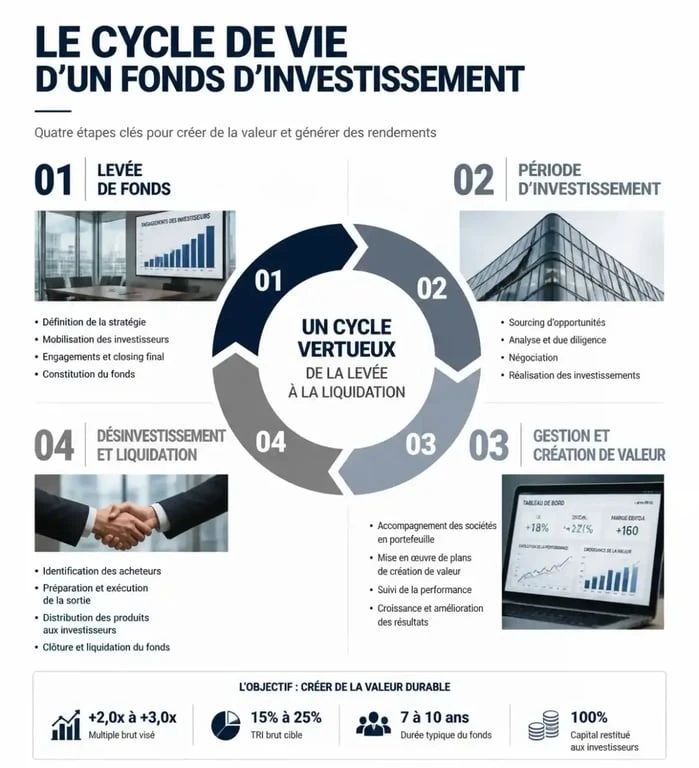
The life cycle of a fund: from raising to leaving
An investment fund follows a structured path, particularly visible in the area of risk capital or real estate, divided into four stages.
1. The fundraising phase
The management company is seeking investors to raise the necessary capital. This phase usually lasts 12 to 24 months. Investors sign a subscription commitment, but the money is not always paid in full from day one.
2. The period of investment (Deployment)
Once the funds are secured, the managers deploy the capital. They analyze hundreds of files to retain only a few. Each investment is subject to an in-depth audit (due diligence) to validate the financial, legal and strategic aspects.
3. The Management and Value Creation Phase
Active management involves supporting companies or portfolio assets. The GSP may serve on the Board of Directors, assist in restructuring or finance new growth projects. The objective is to increase the intrinsic value of the asset before resale.
4. Disinvestment and liquidation (Exits)
This is the final stage in which the fund sells its holdings through an introduction to the stock exchange, a sale to an industry or another fund. Initial capital and any capital gains are redistributed to investors. Once all assets have been transferred, the fund is liquidated.
How to choose your investment fund?
The selection of a management medium must be based on objective criteria. See Chione (Key Information Document), a standardized document that summarizes the essential characteristics of the product.
Analyse the history of the management team. A stability of managers over several years is often a guarantee of strategic coherence. Check the match between the recommended placement horizon and your own life plans. If you need your savings for a short-term real estate purchase, avoid risk capital funds with a long lifespan. Finally, consider taxation: some funds such as the FCPI or the FIP offer tax reductions on entry, while others benefit from an exemption from capital gains on exit after a minimum holding period.