


Published by: Jean Bogle — Editor in Chief
Updated on 23 March 2026
Are you looking to invest for the first time and want to build a solid method from the start? This structured guide is intended for those who want to understand the fundamentals of investment, from objectives to risk management, diversification and discipline. The proposed approach is based on practical experience and analytical rigour to help you advance self-reliance and make truly informed decisions.
Understanding its motivations and defining its investment objectives

The first step in any investment project is to analyse its own motivations and to formulate its financial objectives clearly. Distinguish horizons short term, medium-term and long term brings clarity and consistency to your approach, and limits the risks of inappropriate or impulsive decisions.
In the short term, focus on secure media for quick liquidity needs (work, travel, unforeseen). For the medium term (real estate contribution, business reorientation), the key will be to balance performance and prudence. A long-term horizon allows you to integrate dynamic media able to cope with volatility thanks to their growth potential over several years.
- What is your investment horizon?
- What are your liquidity needs?
- What level of risk are you willing to assume?
Example: A 35-year-old investor with a livret emergency fund A can aim to purchase real estate in five years (a diversified PEA/ETF) and prepare for retirement over 25 years (life insurance, units of account).
Conducting this preliminary reflection guarantees a management discipline and allows the integration of market hazards into a relevant strategy, adapted to its personal constraints and heritage ambitions.
Major types of financial products and their functioning
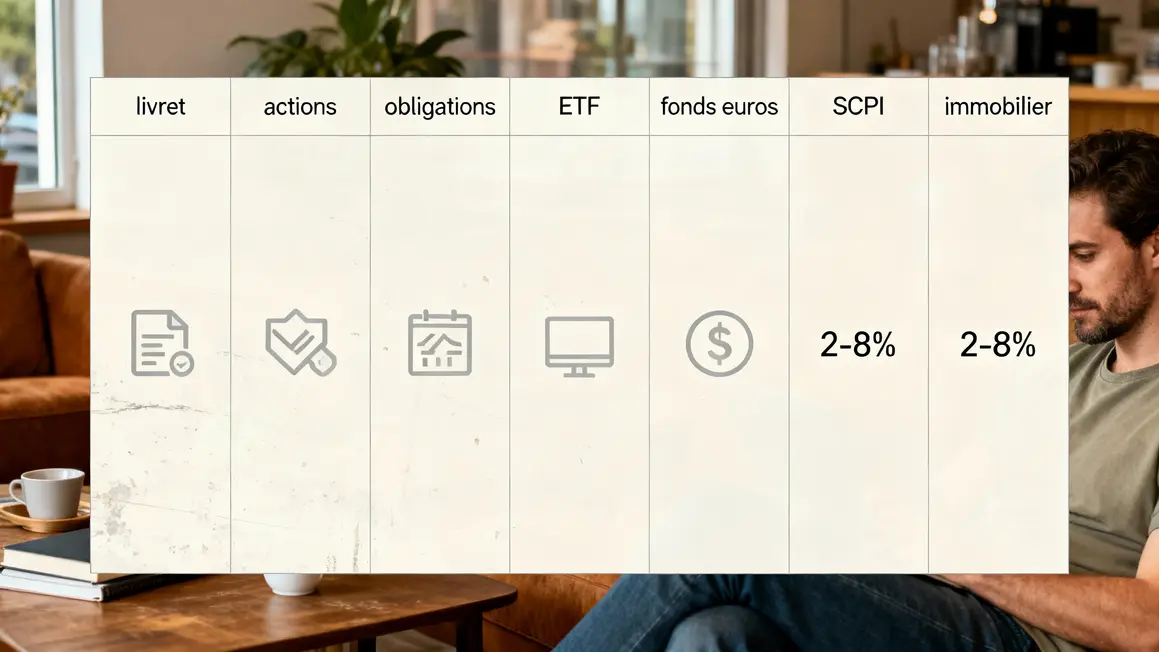
Investing means choosing from a range of products where each vehicle has its risk-to-return ratio. The following are the main categories to know:
- Savings books : limited yield, but immediate liquidity and guaranteed capital.
- Funds in euro : adapted to prudent diversification with tax advantages after 8 years of life insurance.
- Listed shares - expose to high volatility, but offer higher yield potential over the long term.
- ETF : diversify at low cost, by replicating an entire index.
- Obligations : stability and moderate return, ideal for reducing portfolio volatility.
- SCPI and real estate rental: expose to real estate, mutualizing or not management to collect rental income.
| Product | Operation | Risk | Average yield | Conditions of access | Ideal if... |
|---|---|---|---|---|---|
| Savings books | Guaranteed capital, regulated rate | Low | 2-3 % | Free opening | Secure a cash bag |
| Euro funds | Capital guarantee, life insurance contract | Low | 2-3 % | 100 €, benefits from 8 years | Stability over time |
| Actions | Share of company listed | High | 6-8 % | PEA or CTO from 50 € | To accommodate market fluctuations |
| ETF | Replies a stock market index | Medium | 7 % | PEA or CTO from 50 € | Diversify at low cost |
| Obligations | Debt securities | Low to medium | 2-5 % | From 1,000 € | Stabilize the portfolio |
| SCPI | Real estate mutualised, rental yield | Average | 4-6 % | Initial contribution ~5,000 € | Exposing savings to real estate without management |
| Rental property | Purchase of property for rent | High | 4-6 % (net according to taxation) | Major contribution, real estate loan | Long-term commitment |
The combination of these products according to your needs and profile is the key to a relevant allocation. Diversifying primarily reduces systemic risk and adapts your strategy to your personal constraints.
Assessing risk-tolerance and fitness
Risk reflects performance uncertainty. His perception is individual, linked to experience and the placement horizon. Some investors prefer the preservation of capital, others accept more volatility to maximize their return.
- Prudent : Capital preservation, exposure to stable media, low volatility.
- Moderate : Acceptance of a share of risk to aim for balanced growth over 5 to 10 years.
- Dynamics : Long-term recovery research, ability to absorb strong fluctuations.
Practical illustration: Pauline invests mainly in euro funds and bonds. Marc allocated half of his portfolio to ETF World and a share to SCPI. Emilia, dynamic, favours actions and crowdfunding. Each profile must be adjusted according to the situation and personal developments.
Your risk appetite changes with time, your goals, or at major events. Always align your investment choices to the level of fluctuations you are really ready to handle.
To diversify its portfolio
Diversification remains the structuring strategy to limit the impact of a sectoral or geographical crisis. Distributing its investments to different asset classes, areas and sectors minimizes the effects of market hazards.
| Active class | Apportionment (€) | Reason for allocation |
|---|---|---|
| Actions (ETF World) | 4 000 | Global coverage, diversification sector/geography |
| Obligations | 3 000 | Stability and absorption of declines |
| Real estate | 2 000 | Regular income, less market sensitivity |
| Cash | 1 000 | Security, flexibility in the event of unforeseen |
Maintaining this diversification requires regular adjustments: monitor the proportion of each asset class and rebalance as soon as your portfolio deviates too much from its original structure.
How to choose a financial platform or intermediary
Choosing one's intermediary conditions your fees, your access to certain products, and the security of your funds. Comparing the fee schedule, checking regulation, evaluating the quality of the tools and customer support is essential to invest calmly.
| Criteria | Traditional banks | Online banks | New brokers |
|---|---|---|---|
| Transaction costs | High (0.5%-1 %) | Moderate (0.2%-0.5 %) | Low (often 0% in standard ETFs) |
| Proposed products | Wide choice | Mediumly diversified | ETF, cryptos, foreign shares |
| Analysis tools | Traditional advice | Advanced portals, simulators | Interactive graphics, but sometimes limited in depth |
| Customer support | Present but slow | Often satisfactory | Reactive, live chat |
| Data security | Rugged | EU standards | Security but limited history |
Keep an eye on hidden costs and focus on a balance between cost and overall quality. User experience should facilitate management, not complicate it.
Understanding ETFs and why they are popular with beginners
ETFs are a simple and efficient vehicle for diversification. Following an index (e.g. MSCI World or CAC 40), they aggregate tens or hundreds of assets available from a few dozen EUR, with very competitive management costs.
Systematically analyze the TER (Total Expense Ratio), the volume exchanged and the method of replication (physical or synthetic) of the product before purchase. A World ETF brings global diversification and reduces dependency on a region or sector.
Over a decade, a World ETF has produced yields close to 7% annually on average – an example of a powerful tool for self-sustaining savers ready to engage in the long term.
Build and follow a disciplined investment strategy
Building a strategy means keeping a clear course. Set your goals (regular income, specific projects, long-term valuation) and adjust your portfolios accordingly. Investing gradually (method dollar-cost averaging) allows to smooth the effects of volatility and avoid falling into the trap of « perfect timing ».
Plan regular balance sheets (quarterly or semi-annually), rebalance allocations as soon as the proportions differ too much from your original structure, and record your intentions and decisions in an associated journal.
To lay a solid foundation as a new investor, discover our practical tips on How to start when you want to invest in a stock exchange.
To generate sustainable passive income, learn how to achieve EUR 500 dividend per month: how to build a portfolio for regular passive income.
To finance your first investments, find out how to use the Investor credit cards: strengths and limitations safe.
Discipline in dealing with the cycles of fear and euphoria of the market is essential. Base your arbitrations on facts and your own goals, never on short-term market feelings.
Investment tax bases for beginners
Anticipating the tax impact of your investments improves their real profitability. French financial taxation is based on the flat tax (PFU, 30%), the PEA (tax exemption after 5 years except social contributions),life insurance (deductions and tax advantages after 8 years), and the SCPI (subject to the progressive scale of land income).
Always weigh the tax impact before validating a decision, and check the actuality of the rules on official websites such as the AMF or impots.gouv.fr.
Cognitive biases and frequent investment errors
Confirmation Bias
Tendency to focus on analyses that support your opinion: compare your views and challenge your beliefs systematically, especially in search of contradictory arguments.
Overconfidence effect
Repeated success leads to overestimate its capabilities: set objective rules (profit taking, exposure limits, minimum diversification) to remain factual, and agree to adapt your strategy.
Aversion to loss
The fear of losing leads to keeping a position too long: use automatic stops and take a step back to dissociate emotions and rational decisions.
Keeping a detailed diary of choices and objectives helps identify these recurring biases and improve your discipline over time.
Monitor portfolio performance and adjust strategy
Monitoring its results involves analysing progress in relation to the Reference indices (benchmarks: CAC 40, MSCI World, etc.) and centralize its operations on reliable tools (Portfolio Performance or Google Sheets).
Adjustments are reasoned on the basis of the initial objectives – diversification, accepted risk, investment horizon – and not on the emotional basis of the moment. Calibrate your rebalancing over time to control the consequences on your portfolio, and keep an investment log to consolidate your method.
You are armed with fundamentals to invest with method and clarity. Each stage of this journey calls for discipline and individual reflection: defining your objectives, identifying your risk profile, building a solid diversification, and adopting discipline and retreat in the face of the uncertainties of the market. What points do you want to deepen? Share your questions or experiences in the comments to help the community advance collectively. If this guide is useful, don't hesitate to share it around you to disseminate good practices. Finally, what aspects of financial analysis do you want to explore in your next readings? Your reflection helps us improve our content and best meet your expectations. Sources : AMF, impots.gouv.fr, BlackRock studies, Morningstar reports. Article written by Jean Bogle. (Date: June 2024)