


Published by: Elise Caradec — Editor specializing in consulting
The Popular Savings Book (SARA) is the preferred placement of eligible French people thanks to a higher remuneration than that of Book A. Beyond the annual performance, a question arises for savers: how much does a completed SARA actually earn at its 10,000 limit? € over a decade? Through the compound interest, the final result is often higher than it seems.
Simulation: The yield of a full 10-year SARA
To assess the evolution of your capital, it is not only necessary to multiply interest from one year to ten. The secret lies in capitalization: each year, the interest generated adds to your capital and in turn generates new interest. This is the effect snowball.
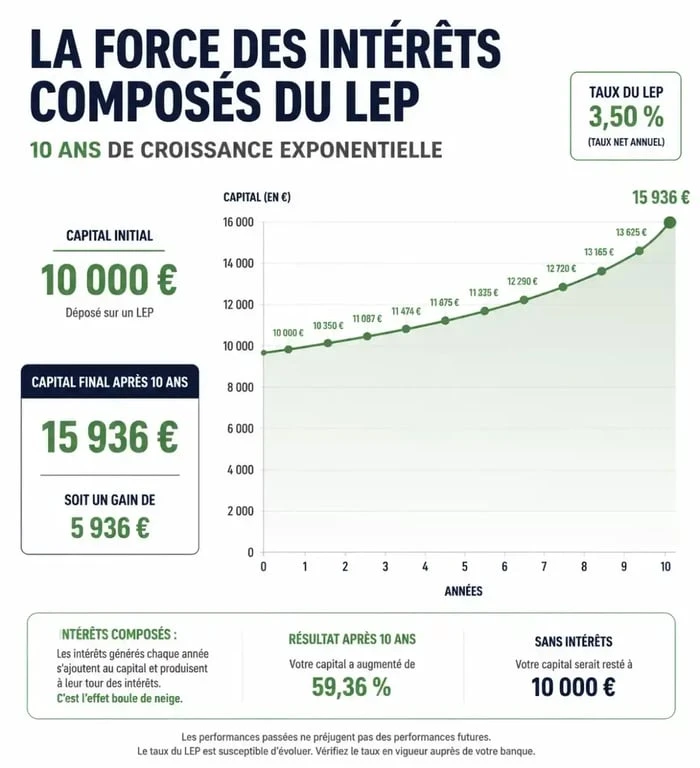
Scenario with a stable rate at 2.5%
Let us assume a rate of pay maintained at 2.5% net per year. If you drop 10,000 € and that you let this amount grow, here is the theoretical evolution of your savings:
| Year | Capital at beginning of year | Interest generated (net) | Balance at end of year |
|---|---|---|---|
| Year 1 | 10 000,00 € | 250,00 € | 10 250,00 € |
| Year 2 | 10 250,00 € | 256,25 € | 10 506,25 € |
| Year 5 | 11 038,13 € | 275,95 € | 11 314,08 € |
| Year 10 | 12 488,63 € | 312,22 € | 12 800,85 € |
After 10 years, with a constant rate of 2.5%, your initial capital of 10,000 € achieved 12 800,85 €. You won 2 800.85 € net interestwithout risk and taxation. This gain represents 28% of your starting bet.
Impact of rate changes over a decade
The rate of SARA is reviewed twice a year by the public authorities, depending on inflation. Over 10 years, this rate fluctuates. If inflation rises, the SARA rate increases, which mechanically increases your earnings. If inflation declines, the yield adjusts, while remaining contractually higher than that of Book A at least 0.5 points.
The operation of the ceiling and capitalised interest
A common confusion concerns the SARA ceiling of 10,000. €. Many think that once this amount has been reached, the booklet no longer returns anything. It is a mistake to understand banking rules.
Payment ceiling vs. Total balance
The ceiling of 10,000 € is a ceiling for payment. You can no longer make voluntary deposits as soon as the cumulation of your payments reaches this limit. However, annual interest is added beyond this ceiling. If your SARA is full, the 250 € interest in the first year raise your balance to 10 250 €. The following year, interest is calculated on these 10 250 €and so on.
The saving on a SARA works as a reservoir: once full, interests continue to accumulate there without regulatory obstacles. There is no theoretical limit to the final amount that a SARA can achieve through capitalization, as long as you remain eligible.
The 15 rule to optimize your earnings
To maximize performance, master the 15 rule. Interest is calculated on the 1st and 16th of each month. Make your payments before the 16th of the current month or before the 1st of the following month to avoid losing any day of interest. Conversely, if you have to withdraw money, do it right after these dates. Over 10 years, rigorous date management optimizes your final gain.
Why does SARA surpass other booklets?
In the regulated savings sector, SARA occupies a unique position. Let's compare its performance over 10 years with other risk-free solutions.
Comparison with Booklet A and LDDS
Book A and LDDS generally have a rate of at least 1% lower than SARA. Over 10 years, this difference is significant. For a capital of 10,000 € 2 per cent versus 3 per cent for SARA, the final gain gap may exceed 1,200 €. SARA is therefore the most effective tool for protecting purchasing power for modest and intermediate incomes.
Unbeatable taxation
In contrast to futures accounts or bank statements submitted to the Single Package Collection (SPF) of 30%, SARA is totally tax exempt on income and social contributions. The rate announced is a real rate. To obtain a net return equivalent to a 2.5% SARA on a taxed investment, a product with a gross rate of 3.57 per cent would be required.
Conditions for conserving SARA 10 years
The main challenge to keeping SARA open for a decade is administrative. This booklet is reserved for taxpayers whose Reference Tax Revenue (RFR) does not exceed certain thresholds.
Annual eligibility check
Each year, your bank checks with the tax administration if you still meet the income requirements. If your RFR exceeds one year, you do not lose your booklet immediately. You have one year of grace: it is only if your income exceeds the two consecutive years limit that the bank closes SARA and transfers the funds to another account.
Strategies for households with fluctuating incomes
If you are close to the ceilings, monitor your RFR. For a single person, the ceiling is set around 22,419 €. This amount varies according to the number of tax shares. If you lose eligibility, the trick is to saturate your Book A or LDDS until you become eligible again, as SARA remains the most efficient cash investment.
Place 10,000 € on a SARA and allowing that money to grow for 10 years is a rational financial decision to secure its savings while generating substantial net profit. With a gain projection around 2,800 € for a zero risk, SARA confirms its status as a savings pillar in France.