


Published by: Elise Caradec — Editor specializing in consulting
In the face of inflation and market volatility, investing money is no longer simply a matter of geographical proximity. It is an asset management strategy that requires an arbitration between immediate availability, capital protection and net performance. Whether you're looking for a precautionary savings or a long-term project, the choice of the institution and financial support determines the real growth of your capital.
The pillars of bank savings: books, accounts and plans
The French banking system offers a variety of products tailored to specific needs. To choose well, it is necessary to distinguish regulated investments from market offers.
Regulated booklets: the basis of security
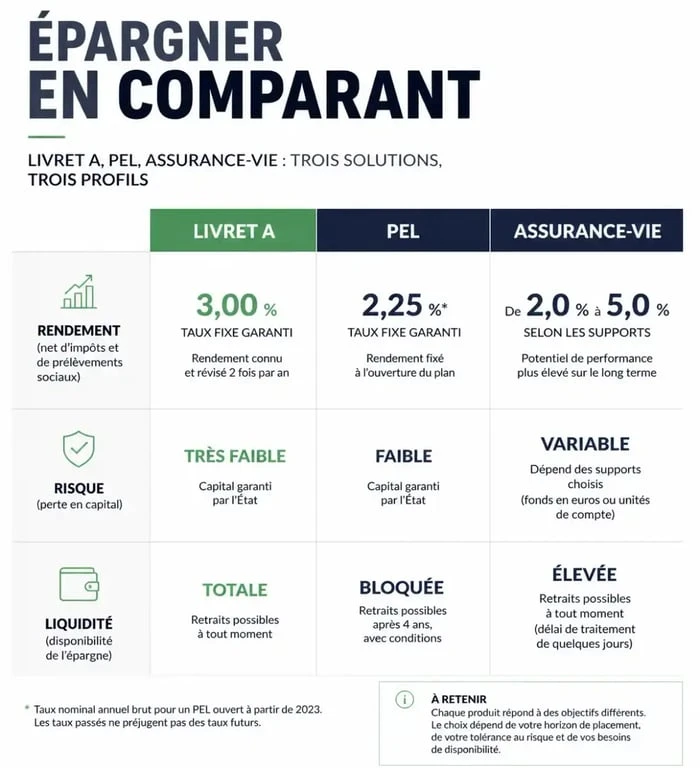
The Booklet A and the LDDS (Livret de Développement Durable et Solidaire) remain the preferred products for their Total tax exemption and social levies. With respective ceilings of 22,950 € and 12,000 €, they form the basis of any precautionary savings. For low-income households, the LEP (Livret d'Epargne Populaire) offers a much higher rate than Book A.
The Housing Savings Plan (LSP): a projection tool
ELP is a hybrid product. It imposes a minimum savings phase of four years with regular payments of at least 45 € per month. In return, it allows to block an interest rate for a future mortgage. This is a relevant solution for a purchase project, although its current performance is subject to the taxation of the One-Specific Lending (SFP) of 30%.
Futures accounts (CAT) and super booklets
Online banks often offer booklets with rates boosted over a short period of time. The futures accounts consist of blocking a sum for a defined period (6 months, 1 year, 2 years) in exchange for a fixed remuneration known in advance. This option is suitable for placing a cash surplus that you will not need immediately.
| Placement | Ceiling | Taxation | : 24/7 customer support is ideal, especially if you trade at unusual times. |
|---|---|---|---|
| Book A | 22 950 € | Exemption: | Immediate |
| PEL | 61 200 € | 30 % (PFU) | Blocked (4 years) |
| Term Account | Unlimited | 30 % (PFU) | Blocked |
Online banks vs traditional banks: where are the best rates?
The choice of the establishment is the second most efficient. Historically, traditional banks relied on proximity, while online banks favoured fee reduction.
Commercial aggressiveness of neobanks
Online banks are no longer limited to removing account fees. They propose life insurance contracts without entry fees and competitive securities accounts. To maximize its efficiency, savers access these platforms to an open architecture, allowing to invest in a variety of funds often absent from network bank catalogues.
The value of network banking consulting
Mutual or national banks retain an advantage: global support. When it comes to structuring a complex heritage involving real estate or transmission, the expertise of a dedicated advisor compensates for sometimes higher management costs. The best bank is one that aligns with your need for financial autonomy.
Multibanking strategy
Multibanking is common. You can keep your current account and regulated booklets in a historical bank for day-to-day management, while opening an EAP (Epargne Savings Plan) or life insurance in an online bank to benefit from reduced management fees.
Optimize your savings: beyond the simple booklet
In order to exceed the modest returns of traditional booklets, more efficient tax envelopes must be considered while managing risk.
Life insurance, the Swiss knife of placement
Money placed in life insurance is not blocked. Taxation becomes optimal after eight years of detention. By choosing a bank that offers a solid euro funds for the guarantee of capital and diversified units of account for performance, you build a reservoir of value adaptable to each stage of your life.
Consider your savings as a dynamic flow rather than as watertight compartments. In low-rate periods, this reservoir accumulates more risky but more remunerative assets. When markets are volatile, it helps secure gains to guaranteed media. This management avoids letting money sleep on unpaid current accounts, which lose value every day as a result of inflation.
Retirement Savings Plan (PER) to reduce taxes
If you are heavily taxed, the best bank is one that offers a high-performance PER. Payments made under this plan are deductible from your taxable income, resulting in an immediate tax saving proportional to your marginal tax bracket (MI). It is a long-term investment, blocked until retirement, except in cases of early release as the purchase of the main residence.
How to choose your institution in practice?
Before signing, three technical criteria must be checked to ensure that the offer meets your expectations.
Check hidden fees and exit conditions
An attractive interest rate can be cancelled by high management fees or arbitration commissions. For futures accounts, check penalties for early exit. Some banks apply degraded rates of pay if you recover your funds before the due date.
Financial strength and deposit guarantee
In France, the Deposit and Resolution Guarantee Fund (FGDR) protects your assets up to 100,000 € by client and institution. If you have more capital, it is prudent to allocate your funds between two separate banks to benefit from a double guarantee.
Digital interface and accessibility
Placing your money requires effective steering. A bank with an ergonomic mobile app, allowing instant transfers and a clear view of capital gains, changes the user experience. Customer service responsiveness is also a major choice criterion, especially in times of rapid market movements.
In summary, the best bank depends on the balance you want to achieve between your precautionary savings, your real estate projects and your long-term investment strategy. Systematicly compare management fees, as they remain the parameter on which you can act to improve your final net return.