


Published by: Elise Caradec — Editor specializing in stock exchange
In the volatile financial market arena, making an investment decision is not random. Trading signals act as a compass, indicating buying or selling opportunities based on specific criteria. These alerts, generated by algorithms or experts, aim to simplify the analysis and optimize the timing of entry into position. However, navigating among the multitude of services available requires a fine understanding of their operation so as not to turn valuable help into a costly trap.
What is a trading signal and how is it generated?
A trading signal is a suggestion of action on a financial asset at a given price and time. It is not a guarantee of profit, but a statistical probability or contextual analysis translated into operational instruction. To evaluate the value of a signal, it is necessary to identify its source.
Technical analysis: the strength of algorithms
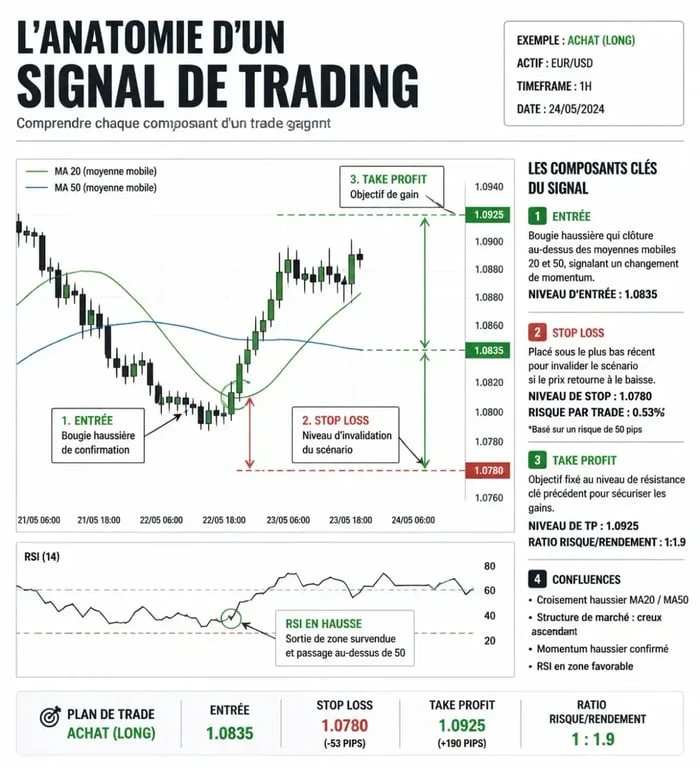
The majority of modern signals are based on technical analysis. Algorithms monitor graphics to detect specific configurations. These systems use mathematical indicators such as RSI (Relative Strength Index) to identify over-purchase or over-sales areas, or moving averages to spot trend reversals. When a crossing of moving averages occurs, a purchase signal is issued.
Basic analysis: the impact of the real world
Some signals come from the fundamental analysis. They are triggered by economic events: a decision on interest rates, the publication of company results or geopolitical tensions. A fundamental signal may suggest the sale of the euro following an inflation announcement below expectations, anticipating a fall in the currency.
Manual vs. automatic signals
There is a distinction between machine-generated signals and those produced by human analysts. Automatic signals offer immediate reactivity and a total absence of emotion. Manual signals, shared via channels such as Telegram or specialized platforms, incorporate a human judgment dimension, such as the ability to ignore a technical signal during a major announcement that would make the market erratic.
Different types of signals according to your investor profile
Not all signals adapt to all strategies. The choice depends on your time horizon and risk tolerance.
| Type of Signal | Key Indicator | Horizon | Objective |
|---|---|---|---|
| Scalping | Stochastique / RSI | A few minutes | Micro-profits |
| Day Trading | Points Pivots / VWAP | A few hours | Daily closure |
| Swing Trading | Bollinger Bands / MACD | Several days | Major movement |
| Trend | Averages Mobiles 50/200 | Weeks / Month | Dominant flow |
The momentum signal: surfing the wave
The momentum signal identifies an active that accelerates in one direction. Using tools such as CCI (Commodity Channel Index)the signal indicates that the purchasing force is sufficient for the movement to continue. This is the ideal type of signal to enjoy a dynamic already in place.
The turn signal: bet on the pivot
More risky, the reversal signal intervenes on psychological price levels or historical supports and resistances. He uses figures such as the double top or differences on the RSI to indicate that the current trend is slowing and that a correction is imminent.
The importance of the structure: the anchor of your strategy
Using signals without a rigorous frame is like navigating without ballast. For a signal to be effective, it must act as a stabilizer within a global plane. Too many traders perceive the signal as an absolute truth, while it is just an additional validation. By integrating the signal into a money management strict, you avoid impulsive decisions. This approach makes it possible to set clear limits: if the signal is not aligned with your maximum permitted exposure or your risk/return ratio, the opportunity must be ignored. This discipline transforms a simple indicator into a tool to preserve capital.
How to assess the reliability of a signal provider?
The market is full of services promising high success rates. A systematic assessment is needed to avoid unrealistic promises.
Backtesting and historical performance
A serious supplier has a verifiable performance history. The backtesting consists of testing the strategy on past data. If a service claims to have 90% success without providing a detailed report or having been tested on several market cycles, caution should be exercised. Search for statistics such as the drawdown maximum rather than total gross profit.
Parameter transparency: Stop Loss and Take Profit
A complete trading signal must include a Stop Loss (lossing output level) and one Take Profit (level of output gain). Without these two safety anchors, the signal is dangerous. Transparency on the method of calculating these levels is a guarantee of professionalism.
Management of false signals
No system is 100% reliable. False signals are inherent in trading, especially in low volatility phases. A good service communicates his failures and explains why a signal was invalidated. The ability to filter these wrong alerts, for example while waiting for confirmation on a higher unit of time, separates the winners from the losers.
Integrate alerts into an operational routine
Receiving a signal is one thing, running correctly is another. The speed and platform used play a key role.
For highly volatile assets, a few seconds of delay can turn a good signal into a late entry at an unfavourable price. Focus push alerts on mobile or direct integrations on MetaTrader or TradingView. Never take a signal in isolation. Check if the technical indicator is in line with the overall market trend and if no major economic announcements are expected within the next hour. Finally, a signal does not dictate the size of your position. Calculate your lot based on the distance between your entry point and the proposed Stop Loss, so that you never risk more than 1 or 2 % of your total capital on a single transaction.
Trading signals are productivity tools to filter opportunities into an incessant flow of information. However, they do not replace financial education. The successful trader uses the signal as an expert suggestion, while keeping his hand on the run button after a final check of consistency with his own risk strategy.