


Published by: Elise Caradec — Editor specializing in consulting
As soon as it was launched, Revolut shook the banking sector by promising exchange rates close to those used by banks. For the traveller or expat, this promise allows real savings. However, neobank pricing has evolved, introducing nuances according to the day of the week, the converted amount and the type of subscription. Understanding how the Revolut exchange rate is essential to prevent unforeseen costs from nibbling your budget.
How Revolut calculates daily exchange rates
Revolut uses real-time data flows from third-party sources in financial markets. Unlike traditional banks that often have a large fixed margin on a single rate, Revolut adjusts its tariffs continuously. The rate displayed in the application at 14:02 may differ from that of 14:05, as it reflects the real volatility of the currency market.
Internal exchange rate vs interbank rate
Revolut uses a internal exchange rate extremely competitive. In most cases, this rate is the same or very close to the average market rate, the one you visit on Google or Reuters. The major difference is the absence of a hidden commission during the opening hours of the markets, which guarantees transparency on the real value of your money.
Real-time update
The application interface is designed for reactivity. When you make an international transfer or conversion, the final amount is recalculated each second. This precision allows users to place automatic exchange orders : you set a target rate, and Revolut executes the transaction as soon as the market reaches that value. It is an effective lever to optimize its finances without constantly monitoring the graphics.
Fees and limits according to your subscription
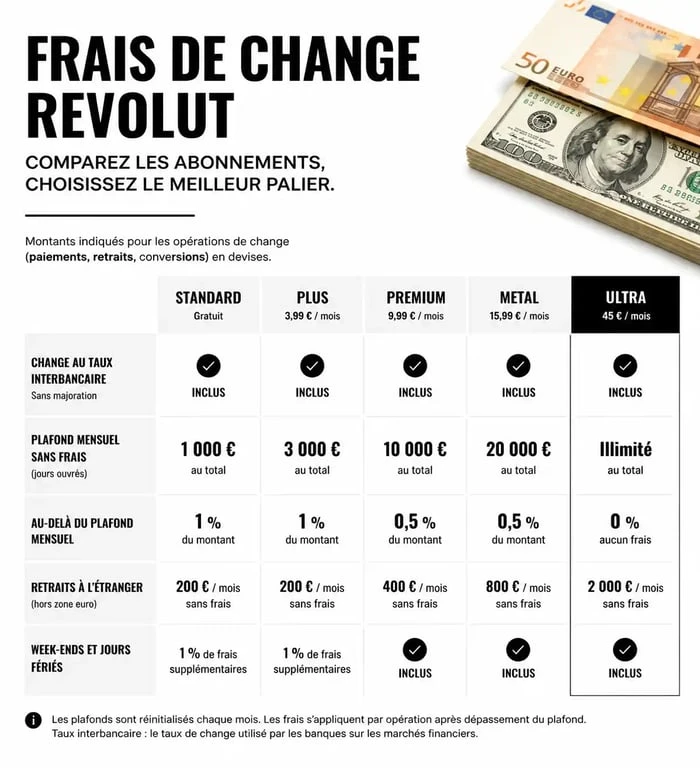
Market access is fluid, but free access has limits. Revolut segmented its offer to encourage frequent users to opt for paid packages. The cost of your transactions depends directly on your card and the monthly volume of your transactions.
| Subscription type | Free exchange limit (monthly) | Costs beyond limit |
|---|---|---|
| Standard (Free) | 1 000 € | 1,0 % |
| More | 3 000 € | 0,5 % |
| Premium | Unlimited | 0 % |
| Metal | Unlimited | 0 % |
| Ultra | Unlimited | 0 % |
For users of the Standard Plan, it is necessary to monitor the consumption gauge in the parameters. Once the ceiling of 1,000 € a 1 % commission applies on each conversion. For an expatriate who transfers 2,000 € per month, the cost is 10 €, which often makes Premium subscription profitable.
Weekend Trap: Why Rates Increase
The currency market (Forex) closes on Friday night and only reopens on Sunday night. During this interval, world rates are fixed, but the risks of sudden fluctuation at the opening on Monday morning force the bank to take precautions.
Security margin of 1%
To protect against sudden currency devaluation during the closing of markets, Revolut applies a fixed fee on all conversions made on weekends. This margin is generally 1 % for major currencies (EUR, USD, GBP, etc.). It applies regardless of your subscription, including Metal or Ultra members. If you pay by card at the restaurant on a Saturday night, Revolut converts the amount by applying this supplement.
In managing your finances, the application must be used as a strategic tool. Anticipate your liquidity needs before the market freezes for Sunday rest. By changing your currencies on Friday afternoon, you keep control over your budget and avoid the 1% penalty. This discipline transforms a simple payment tool into a lever of financial optimization.
Tips to avoid weekend expenses
Anticipate your needs: If you travel on Saturdays, convert an estimated amount on Friday morning directly into the app. Create sub-accounts: Revolut allows to hold more than 30 currencies simultaneously. Store your dollars or pounds in advance. Use alerts: Schedule a notification on Friday noon to remind you to check your foreign currency balances.
Comparison: Revolut against banks and Wise
Revolut remains one of the most attractive options, but it is not always the cheapest according to your usage. Traditional banks remain largely distraught, with foreign exchange margins often ranging from 2% to 5%, and sometimes adding fixed charges.
Revolut vs Wise
The duel is often played between these two actors. Wise systematically uses the average market rate and charges a transparent commission that varies by currency, often between 0.4% and 0.7%. Revolut's advantage is free on weekdays under the ceiling of 1,000 €, ideal for daily expenses. Wise's advantage its competitiveness for very large transfers or for conversions during the weekend, as their fixed commission remains stable.
The case of foreign currencies
For certain currencies that are less liquid or subject to capital controls, such as Thai Baht or Ukrainian Hryvnia, Revolut may charge additional fees even on weekdays. These fees are displayed before you validate the transaction. Always check the details in the confirmation screen to avoid any surprises about these specific currencies.
Practical tools for controlling foreign exchange
To make the most of the platform, use advanced features to manage exchange rates as a professional.
The integrated currency converter
Accessible without being connected, Revolut's web and in-app converter allows you to simulate transactions. It is useful to compare in real time the cost of a purchase on a foreign site compared to the price displayed in euros. The tool automatically includes fees if you have provided your subscription type, providing a clear view of the actual cost.
Limit and Stop orders
Few users exploit them, yet they are the key to optimization. Order Limit allows you to buy a currency only if it goes below a certain threshold. Conversely, the order Stop can be used to convert your assets if a currency starts to fall, thus protecting your purchasing power. These options turn your current account into an international cash management tool, accessible in just a few clicks.