


Published by: Elise Caradec — Editor specializing in stock exchange
Alstom action attracts investors because it combines a theme, rail transport, and a financial file still in reconstruction. In order to make a public announcement, two points must be considered at the same time: the actual operational improvement and the Risk which can still affect the price, including debt, cash generation and volatility of the sector.
An improved stock exchange record, but not yet completely derisqué
Alstom remains a cyclical industrial value. Its business book, margins and working capital requirements have a strong influence on market perception. The positive point is that the latest figures are in the right direction. Revenue reached EUR 18.5 billion, up by +4,9 %, with an increase of +3,6 % rolling stock +5,2 % services.
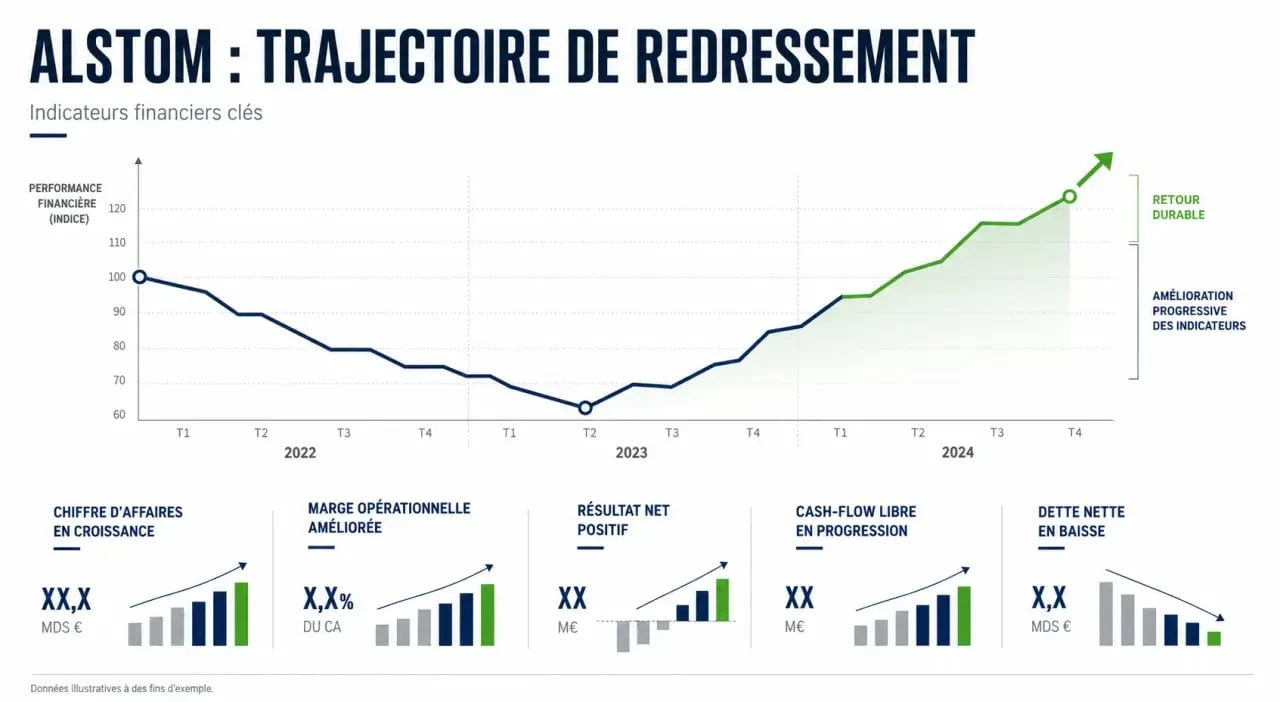
Profitability also follows a better path. LAEBIT spring EUR 1.18 billioneither one operating margin of 6,4 %. For an industry like Alstom, this level of margin is very important, as it shows the ability to turn orders into a result despite production costs, long contracts and possible differences in execution.
The net result goes back in the green
The return to a net result positive group share of the EUR 153 million send a useful signal, especially after a previous net result of EUR 307 million. This adjustment is not enough to make Alstom a risk-free value, but it changes the reading of the file. The issue is no longer just financial fragility, it is now to confirm this improvement in several publications.
On the Stock Exchange, such a value often reacts strongly to quarterly or annual announcements. An improvement in margins can support the price, while a liquidity warning or a delay in deleveraging can cause a rapid correction.
The financial figures to read before purchasing or retaining
To evaluate Alstom's action, turnover must not be stopped. In particular, investors must follow the marginnet debt, free cash flow and dividend policy. These indicators give a more concrete view of the strength of the group and its ability to sustain.
Alstom Investor Area: Financial reports and official documents · Access annual reports, universal registration documents and key financial information to track Alstom's performance.
| Indicator | Recent data | Reading for the investor |
|---|---|---|
| Turnover | EUR 18.5 billion, +4.9% | Growing activity by rolling stock and services |
| AEBIT | EUR 1.18 billion | Improving operational performance |
| Operational margin | 6,4 % | Key point for judging the quality of contract performance |
| Net income group share | EUR 153 million | Return to profitability after €307 million |
| Free cash flow | EUR 502 million | Capacity to finance activity and reduce debt |
| Net debt | EUR 434 million | Debt relief encouraging, to be confirmed |
Debt remains the true justice of the peace
Net debt of EUR 434 million and a financial leverage less than 3 go in the right direction. The debt-to-GDP ratio is also lower than that of the sector, while the ratio of financial autonomy exceeds the ratio of 50 %. These elements reinforce the credibility of the case, as they limit the risk of excessive financial pressure.
But the market is not just looking at the level of debt at a given moment. He wants to know if Alstom can maintain a free cash flow positive. The EUR 502 million Free cash flow is therefore a major indicator. If this flow remains strong, the company has more room for investment, debt relief and compensation to its shareholders.
Dividende: attractive, but to be interpreted with caution
The dividend return may seem interesting when it exceeds 3,5 %, and raised beyond 6 %. Alstom posts a regular dividend payment on 5 years, with a distribution rate greater than 50 %. For a return-oriented investor, it is an element to follow, but it must not forget the priority: the solidity of cash flow.
A high dividend is reassuring only if it is based on recurring profits and sufficient cash flow. Otherwise, it becomes a constraint. The analysis must therefore cross yield, distribution rates and capacity for debt relief.
Analyst consensus: how to interpret opinions on Alstom
Analyst opinions on Alstom are useful, but should not be read as an automatic purchase or sale order. Actors such as FactSet, Bernstein Research, CIC, Deutsche Bank Research, Jefferies, Oddo BHF, Redburn or Société Générale may publish estimates, course objectives or recommendations. These views change with results, margin prospects and perceived level of risk.
The most useful thing is to follow the direction of consensus. Are analysts becoming more confident about cash generation? Are they raising their margin forecasts? Do they lower their debt expectations? These movements often count more than the isolated recommendation of a single analysis office.
Buy, conserve or sell: three reasonable scenarios
Buy can defend itself for a long-term investor who accepts volatility and believes in a gradual improvement in profitability. The case becomes more credible if the operating margin remains upward and the free cash flow remains positive.
Keep seems consistent for an already exposed shareholder, especially if its cost price is reasonable. In this case, the challenge is to follow the next publications rather than react to each change in course.
Sell or Lighten may be considered if the security has rebounded sharply without further improvement of fundamentals, or if the investor does not wish to bear the risk of long industrial contracts, interest rates and public investment cycles.
A good method is to set its own thresholds in advance, such as an acceptable loss level, a valuation target, a maximum tolerated debt or a minimum expected margin. On a value such as Alstom, where movements can be large, this framework helps keep a clear discipline. It often protects better than an opinion read on a forum.
Risks and opportunities: what can move the course
Alstom's main attraction is its positioning on the railway, a sector supported by the need for mobility, decarbonisation and infrastructure renewal. Services +5,2 %, can also provide a more recurring share of activity than large rolling stock contracts.
Opportunities are therefore based on three levers: improved margins, continued debt relief and the ability to convert the order book into cash. If these three elements move forward together, the market can revalue the action.
Points of vigilance not to be underestimated
Alstom remains exposed to traditional industrial risks: inflation of costs, delays in delivery, pressure on margins, complex contracts and dependence on investment decisions by local or state authorities. Interest rate increases may also affect the valuation of companies in debt or capital intensive.
Volatility is therefore normal on this type of value. A beginner investor should avoid judging the action only on a stock exchange session or on a forum message. Opinions from other investors can enrich the thinking, but they often reflect very different horizons: short-term trading, return investment, speculative catching up or long-term conservation.
Our practical opinion on Alstom stock exchange
The most balanced opinion about Alstom on the Stock Exchange is nuanced: the file has improved, but it remains demanding. Recent figures show an increase in turnover, with a operating margin of 6,4 %, a return to positive net income, a free cash flow of EUR 502 million and net debt reduced to EUR 434 million. These elements call for a value to be closely monitored or even considered in the long term.
Alstom, however, is not a pure defensive action. It is more suitable for an investor able to follow financial publications, accept sometimes marked price variations and reason over several financial years. Before any decision is made, it is useful to compare the current course with the analysts' objectives, verify the latest consensus and reread the debt and cash flow indicators.
Careful profile: wait for a lasting confirmation of debt relief and margin.
Balanced Profile: keep or enter gradually, without committing all the capital at once.
Dynamic Profile: buy back if the fundamentals remain well oriented.
The best decision therefore depends less on a single opinion than on the coherence between the investment horizon, risk tolerance and Alstom's ability to confirm its financial recovery.