


Published by: Elise Caradec — Editor specializing in consulting
The Bouygues action regularly captures the interest of investors thanks to its diversified conglomerate model, operating between construction, telecoms and media. After a period of volatility, the title has a strong resilience. For the particular investor, the question of entry into position arises: does the current price already include future successes, or does there still exist a significant potential for progress?
Recent market performance and dynamics
Bouygues' stock market history over the past few months reveals a vigorous recovery. After touching a low point around 27 € At the end of the year, the share rose by 35% without a major break. This dynamic reflects a renewed market confidence, supported by strong operational results despite a complex sectoral environment.
Technical indicators need to be observed. With a course crossing the 33 €, the title reached an area of Overpurchase According to the RSI. While analysts often set a technical objective at 38 €This rapid increase requires caution. The investor must distinguish between the fundamentals' underlying trend and short-term speculative movements which can lead to technical corrections.
Financial pillars: strength and growth levers
Bouygues' strength is based on its diversification. Unlike a single-sector company, the group mutualizes risks. The turnover of 2024 reached EUR 56.8 billion, driven by sustained construction and successful integration of Equans. The current operating income was EUR 2,535 million, confirming the control of margins against inflationary pressure on the cost of materials.
The integration of Equals and the visibility of the order book
The acquisition of Equans marks a strategic turning point. With a backlog of 25.4 billion euros for this division alone, the group secures its long-term revenues. A key indicator for validating value creation is the ROCA d'Equans margin, expected to be 4% by 2024 with a target of 5% by 2027. This visibility reduces the uncertainty associated with short business cycles.
Debt management: a point of vigilance
With a net debt of €6.07 billion, a debt-to-equity ratio of 42%, Bouygues maintains a financial structure under control. However, in a context of high interest rates, the debt burden remains scrutinized by markets. A rigorous management of this leverage is essential to preserve the group's ability to pay out a Attractive dividend2 € per share for the current year.
Prospects and risks: beyond figures
The success of a long-term investment depends on the ability of the group to transform its assets. While construction remains the foundation, Bouygues Telecom's operational performance and the development of energy services offer the most dynamic growth levers. The resilience to Bouygues Immobilier's difficulties demonstrates the relevance of the conglomerate model. The main risk remains dependence on the European economic situation, particularly in the construction sector.
The functioning of the group resembles a structure where each entity — construction, energy, media — operates independently. The strength of the whole does not depend on the size of a single branch, but on their interconnection. If one division undergoes external pressure, the others absorb shocks, thus avoiding an overall collapse. This structure allows the distribution of financial constraints while maintaining a rapid expansion capacity when the market becomes more favourable.
Analyst consensus: what do experts say?
The opinions of financial analysts remain generally favourable, although balanced by the recent rise in the price. The consensus emphasizes asset quality and visibility on cash flows. Most of the recommendations lie between « purchase » and « strengthening », with course objectives incorporating a premium linked to group transformation. It is advisable to compare these objectives with its own investment strategy: are you looking for a return via the dividend or a surplus value on the valuation of the security?
Comparison: Bouygues against other investments
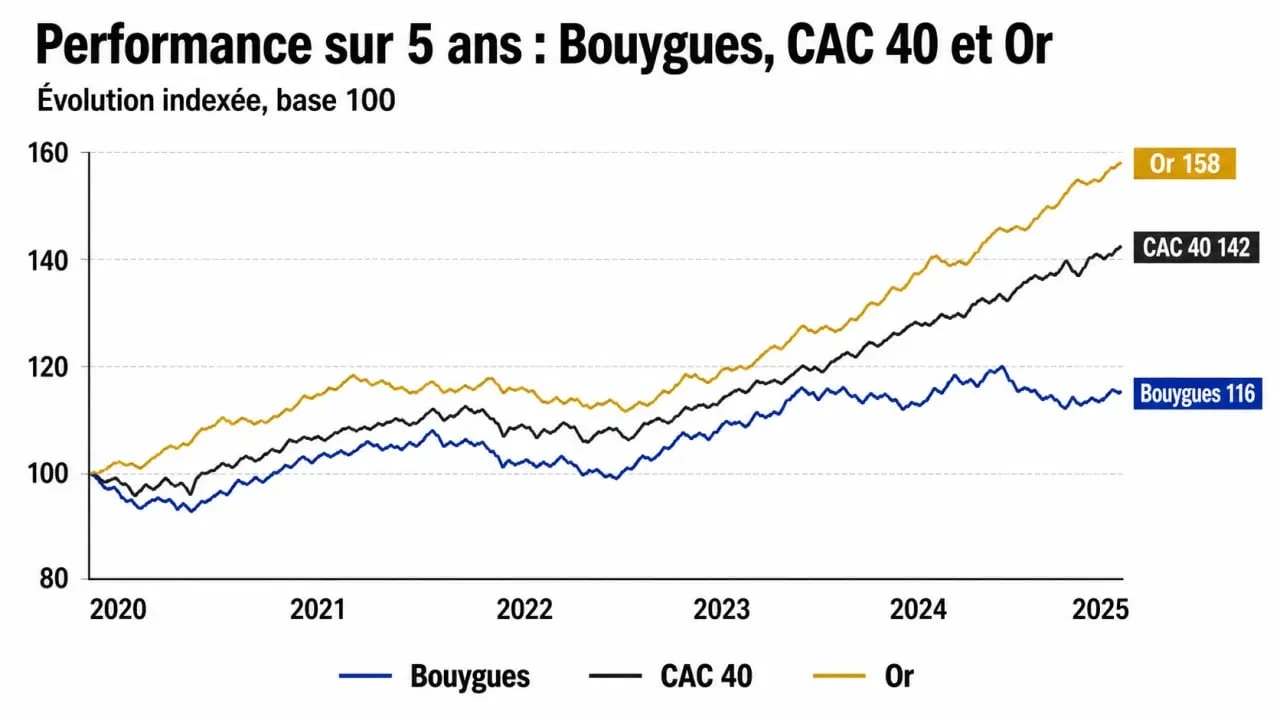
Comparing Bouygues to other assets helps to better situate risk. Over the last 5 years, the action has a performance of -8.80%, contrasting with gold (+64.93%). However, in 2023 Bouygues outperformed CAC 40 with an increase of 27.14% compared to 16.33% for the Parisian index. This observation illustrates that Bouygues is a cycle value It can go through periods of stagnation before catching up with economic recovery.
| Indicator | Performance (5 years) | Commentary |
|---|---|---|
| Bouygues Action | -8,80 % | Sensitivity to economic cycles |
| Or. | +64,93 % | Historical refuge value |
| ACC 40 | +16,33 % (2023) | Market reference |
Practical issues for the investor
The purchase of Bouygues shares can be made via an AEP (Plan d'Epargne en Actions), allowing for advantageous taxation after five years of holding, or via a CTO. For the posting of the dividend, the key date is generally set at May 5 of each year. It is advisable to monitor the timing of quarterly results publications, when volatility is highest and buying opportunities may arise.
In sum, the purchase of Bouygues shares is more justified for an investor seeking to diversify its exposure to the industrial sector and telecoms with a return component. While the title seems valued in the short term, the solidity of the fundamentals and the visibility on the order book provide a reassuring basis for medium- to long-term holding.