


Published by: Jean Bogle — Editor in Chief
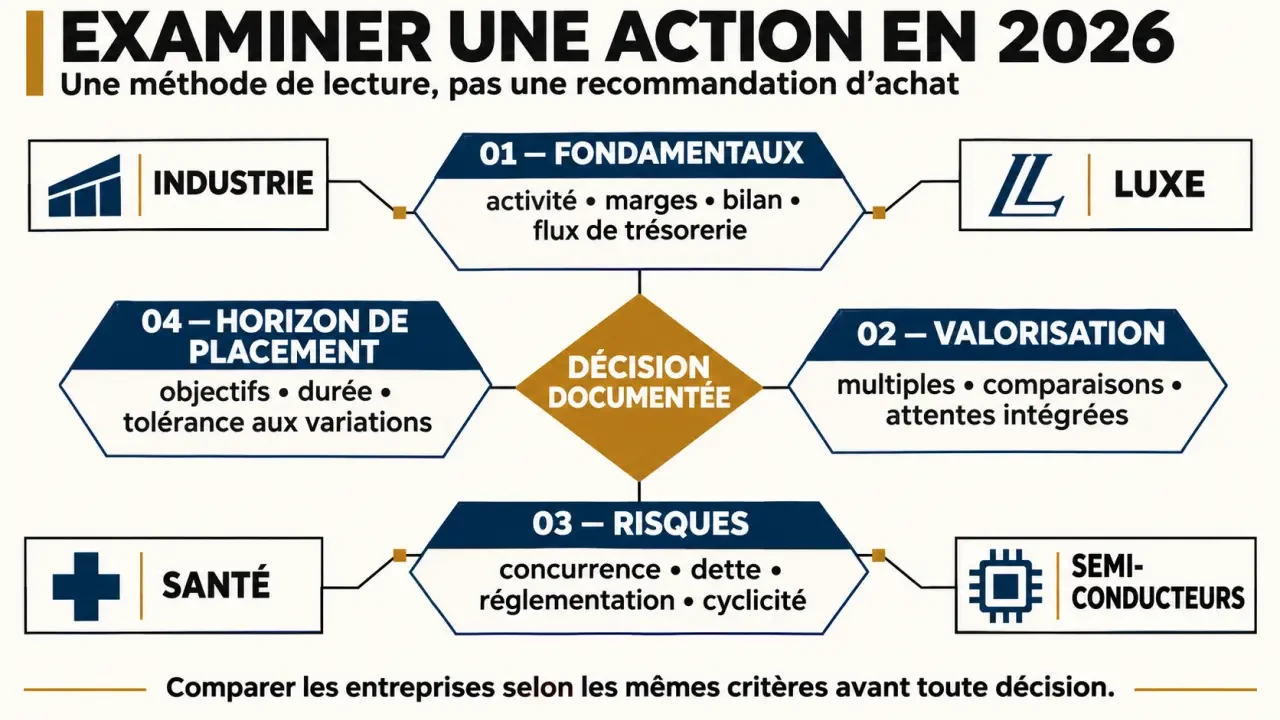
Air Liquide, Schneider Electric and LVMH are three French tracks to be examined for investment in 2026, with very different engines: industrial gases, electrification and luxury. Internationally, semiconductors and health are expanding opportunities. But a solid company is not necessarily an interesting action at the proposed price. Selection must cross results, valuation and risks, and then integrate into a portfolio tailored to your horizon.
Three French actions to study, for three different reasons
The following companies are examples of analysis, not personalized recommendations. The figures refer to the annual results 2025 presented by Mon Petit Placement. They provide a basis for comparison, to be completed with the latest publications and the course observed before any purchase.
Air Liquide: Examining regularity and margins
Air Liquide published a turnover of EUR 26.94 billion, with a comparable growth of 2%, and a net share of the group of EUR 3.52 billion, up 6.4%. Its operating margin exceeds 20 per cent. By 2026, the group aims to improve the margin by 100 basis points: this is a goal, not a result.
The trail deserves to be studied for its exposure to industrial gases and health. However, check the cost of investments, debt and the price paid for this visibility. The proposed dividend of €3.70 per share, up 12.1%, is not sufficient to determine the interest of the security.
Schneider Electric: electrification, with expectations to measure
Schneider Electric has a turnover of EUR 40.2 billion, an organic growth of 8.9% and a net result of €4.2 billion. The proposed dividend is €4.20 per share, up 8%. Its targets for 2026-2030 include annual organic turnover growth of 7-10 % and a cumulative improvement of 250 basis points in the adjusted EBITA margin.
Electrification, energy efficiency and data centres are drivers to follow. The main trap would be to pay today for a valuation that already presupposes their complete success. Examine the conversion of profits into cash and the sensitivity to client investments.
LVMH: Distinguish Slowdown and Sustainable Degradation
LVMH generated a turnover of EUR 80.8 billion, with a decrease in published sales by 5 % and an organic decrease by 1 %. Its operating margin is 22%, its operating income is EUR 17.8 billion and its net income is EUR 10.9 billion. Free cash flow increased by 8% to EUR 11.3 billion.
These results illustrate an activity under pressure but still generating cash. Organic growth of 1% in the second half of 2025 calls for demand monitoring, without automatically concluding a sustainable recovery. To invest, compare valuation with several consumption and margin scenarios.
Expand selection without only buying a trend
A selection limited to large French values leaves aside other activities and geographical areas. The following international examples are sectoral ones: their attractiveness in 2026 depends on their updated results and their value.
| Sector | Examples to be analysed | Engine to be examined | Principal risk |
|---|---|---|---|
| IA and semiconductors | Nvidia, ASML | Investments in computing capacity and chip production | High expectations, expenditure cycle and trade restrictions |
| Health | Sanofi, Johnson & Johnson | Salary portfolio and development of new products | Patents, Clinical Trials and Regulations |
| Energy | TotalEnergy | Production, investment and cash generation | Oil prices and geopolitical risks |
| Aviation industry | Airbus | Demand and delivery | Supply chain and industrial costs |
A leading trend can produce a bad investment if it is bought too expensive. For semiconductors, question the sustainability of customer spending. For health, look at addiction to a few medications. For energy and industry, test the resistance of the benefits to a cycle reversal. Foreign shares may also add foreign exchange risk.
Passing each company to the same financial examination
Start with annual reports and results reports. Compare data over five years, with consistent definitions and identical periods. An acquisition may inflate turnover without demonstrating an improvement in existing activity.
The recommendations of the AMF for reliable performance simulators · Discover the recommendations of the Autorité des marchés financiers on performance presentation, diversification and investment risks.
- Turnover and operating margin: Does the company sell more while maintaining its profitability?
- Benefit per share, or BPA: Is its progression steady or linked to an exceptional element?
- Debt and cash flow: Are the deadlines sustainable if activity slows down?
- Free cash flow: Is there any money left after the necessary investments?
- ROE: Is the return on equity supported by activity or amplified by debt?
Avoid sinking all companies into the same financial mold. An industrial enterprise must finance factories and equipment; other activity may require less immobilization. The same level of margin or debt does not therefore mean the same everywhere. Build your grid with common criteria, then compare businesses with their competitors: you will better distinguish a real advantage from a simple accounting feature.
The PER returns the price to earnings per share. Compare it to the sector and history, specifying whether you are using a published or forecast profit. A weak RIP can announce a discount, but also a future decline in profits: this is the trap of the value trap.
For teaching purposes only, a course of EUR 100 for a BPA of EUR 5 gives a RIP of 20. If the BPA falls to 4 euros, the same price represents a PIP of 25. The title is no longer as cheap as it seemed. Technical analysis can help prepare a point of entry, but it does not correct a fragile financial hypothesis.
Turn the tracks into a portfolio adapted to your situation
Before deciding which shares to buy in 2026, separate precautionary savings from invested capital. A common benchmark is to keep three to six months of accessible spending. The actions are suitable for a long horizon: eight years or more is a benchmark of preparation, never a guarantee against losses.
To begin or limit the analysis time, a Widely diversified ETF can serve as a base. It distributes exposure between several companies, without removing market risk. Check its composition: several ETFs can hold the same large companies and create an invisible concentration.
Individual actions require more follow-up. Set a maximum weight per business and sector before purchase and periodically review the distribution. Buying gradually reduces dependency on a single entry date, but does not guarantee any benefit or protection against a prolonged decline.
The envelope depends on the titles and your situation. The EAP welcomes eligible actions and funds; the title account offers a wider universe. Life insurance provides access to contract materials, including certain funds and ETFs. Compare the brokerage, management, foreign exchange and current tax conditions, without choosing only the tax advantage.
Finally, write for each purchase a short thesis: expected engine, acceptable valuation and event that would invalidate your reasoning. A drop in prices alone does not prove that you are wrong; sustainable degradation of profits may, however, require reassessment. The right goal is not to guess the winning action of the year, but to take an understood and bearable risk.