


Published by: Jean Bogle — Editor in Chief
For a natural resident tax person in France, ordinary dividends received in 2026 are, in principle, subject to the single flat-rate levy of 31,4 % - 12.8% of income tax and 18.6% of social contributions. However, the progressive scale may be more favourable. Before calculating the net amount, the corporation's tax system and the partner's social status must be verified: certain dividends are covered by social contributions.
Identify the right plan before calculating tax
A dividend is an amount distributed to partners or shareholders, usually from profits or distributable reserves. Its distribution presupposes a regular decision of the partners and the amounts actually available. The bank account balance is therefore not sufficient to determine what can be distributed.
Calculation of net dividends
Estimate the levies and the net amount retained according to the chosen plan.
Estimated results
Single lump sum levy
Progressive scale
—
Attention: Indicative calculation based on the assumptions of the article, excluding deductible CSG, haircut, contribution on high income, social contributions of self-employed workers, foreign income and possible prior taxation of the company to the IS.
Company with IS: two levels of taxation
In a company subject to corporate tax, the profit first bears the IS. The normal rate is 25 % ; a reduced rate of 15% up to 42,500 € profit applies to eligible undertakings. The sums then distributed are taxed by the partner. Dividends are not a charge deductible from the corporation's income.
The pre-IS profit must be distinguished from the gross dividend voted. Apply only the UFP to the initial profit underestimates the total tax: the calculation of the partner's net begins after the tax paid by the company.
Company at IR: profit is taxed on partner
In an income tax company, each partner is in principle taxed on its share of profit, even if it remains in the company. The category depends on the activity: BIC, BNC or property income, among others. The subsequent withdrawal of profits already taxed does not normally trigger new taxation as a dividend. A EURL or SNC at the IR is therefore not treated as a SAS at the IS.
PPU or scale: compare the base, not just the rate
The single flat-rate levy, or PFU, applies by default to the dividends concerned. With the rates of 2026, it represents 31.4% of the gross amount. No reduction of 40 % is then applicable.
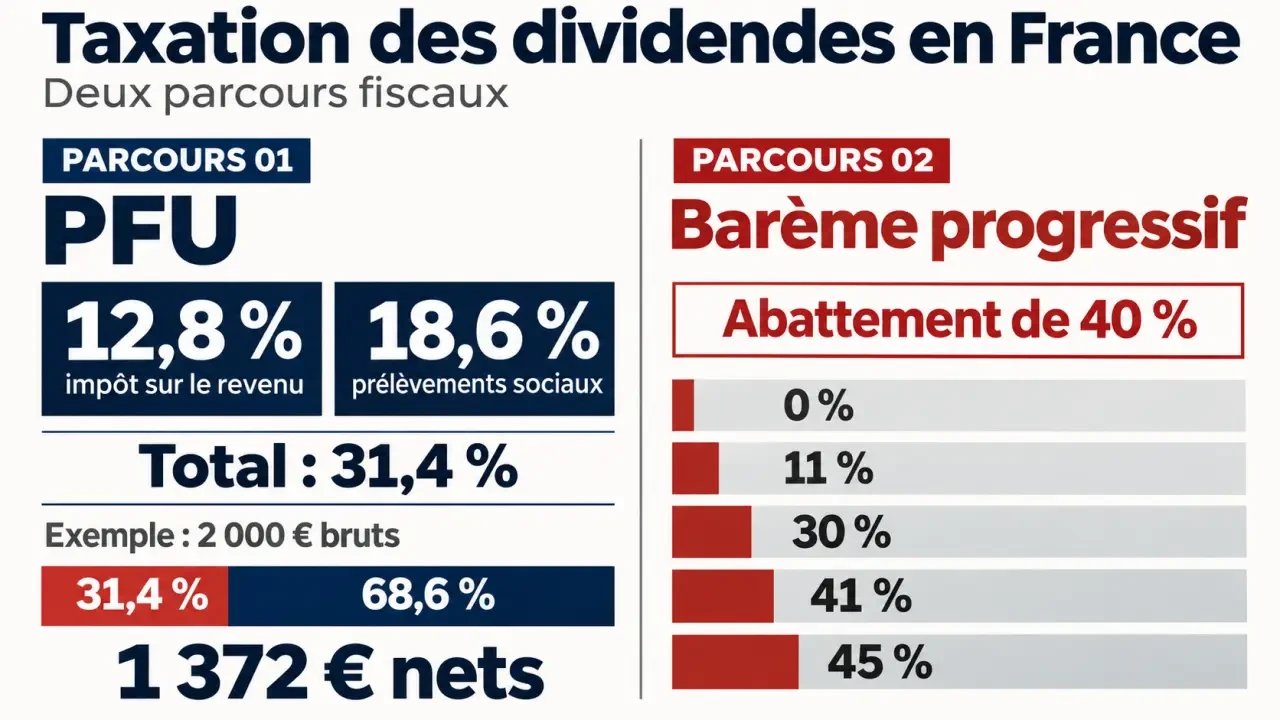
On an option basis, eligible dividends are subject to the progressive scale after a 40 per cent discount. Only 60% of the amount is therefore included in the income tax calculation. On the other hand, social levies are still calculated on the gross: the reduction does not reduce them.
The option is exercised by checking the Box 2OP the annual declaration. It is global for income and earnings that fall within its scope for the year: the dividend for which it is advantageous cannot be selected only.
- Non-taxable or 11% rent: the scale generally deserves simulation.
- 30 %, 41 % or 45 % range: The PFU is often more favourable, but all the income concerned must be examined.
- Income close to a band limit: a simple multiplication calculation can be misleading.
At the scale, a fraction of CSG of 6,8 % is deductible from total income under the conditions provided. This delayed effect can improve the result, but should not be confused with an immediate reduction in social levies. The 10% reduction for professional fees applicable to certain income does not apply to dividends.
Out of 2,000 € gross, calculate the net actually retained
For a partner covered by social contributions from wealth income, the calculation at the UFP is direct: 2 000 € - 256 € tax - 372 € social contributions = 1,372 € Net. Total taxation thus amounts to 628 €.
Official dividend simulator 2026 · Estimate the levies and contributions related to your dividends and distributions for 2026.
The following table compares this result to the scale, assuming that the € taxable after deduction remain entirely in the same instalment. It does not take into account the deductible CSG, the discount, or any contributions applicable to high incomes.
| Scheme or tranche | Income tax | Social levies | Net stored |
|---|---|---|---|
| PFU | 256 € | 372 € | 1 372 € |
| 0 % scale | 0 € | 372 € | 1 628 € |
| 11 % scale | 132 € | 372 € | 1 496 € |
| 30 % scale | 360 € | 372 € | 1 268 € |
| 41% scale | 492 € | 372 € | 1 136 € |
| 45 % scale | 540 € | 372 € | 1 088 € |
Reserves sometimes have the patina of old profits: their seniority can give the impression that they already have « finished paying tax ». However, if they come from a company with the IS, the previously paid SI does not replace personal taxation when they are distributed. To anticipate the net, look at the year of the payment and your current tax situation, not just the year the profit was realized.
Independent director or recipient company: decisive exceptions
The 10% threshold for self-employed
For some independent executives, including the majority manager of SARL and the sole partner manager of EURL at the IS, a fraction of the dividends fall into the social security contributions base. The threshold corresponds to 10% of share capital, issue premiums and associated current account amounts, according to the applicable calculation rules. The rights of Pacs' spouse or partner and minor children may also be affected.
The excess fraction is therefore not calculated simply with 18.6% of social contributions: it falls under the contributions of the self-employed, without automatically cumulating the two schemes on the same fraction. Conversely, dividends from a SAS or SASU president are not, in principle, subject to social security contributions solely because of his mandate. Nor do they create social rights as remuneration.
Where the partner is a legal person
A corporation that receives dividends does not apply the individual's UTP. The products fall under its own tax system. Subject to conditions, the mother-daughter scheme allows for an exemption with a 5 % share of costs and charges. In some tax integration configurations, this share is reduced to 1 %. These percentages are re-introduced into taxable income, not tax rates.
From payment to declaration: avoid double payment
On payment, the paying institution normally retains 12,8 % of flat-rate non-delivery levyIn addition to the applicable social levies. This 12.8 per cent is a down payment and is charged to the final tax calculated after the return. A surplus may be returned.
An exemption from this advance payment may be requested where the reference tax income of N-2 is less than 50,000 € for a single person or 75 000 € for a married or married couple imposed jointly. The request must normally reach the payer before 30 November of the year preceding the payment. It does not exempt from definitive tax or social levies.
- Check the gross amounts shown on the single tax printout and on return 2042, including box 2DC for eligible dividends.
- Check the already deducted deposit, usually carried over to box 2CK, as well as the social levies headings.
- Compare both regimes before checking 2OP when reporting to N+1.
- For an activity covered by the IR, use the appropriate professional headings: 2042-C-PRO and, for some real BICs, the 2031 declaration of results.
Before a major distribution, use the Urssaf dividend simulator by checking its vintage and perimeter. An accountant may supplement the calculation if social contributions, foreign income or several categories of investments occur.