


Published by: Elise Caradec — Editor specializing in stock exchange
An ETF eligible for the AEP may follow European actions, but also certain global or American indices. To choose it, three checks are essential: its official eligibility, the exposure actually obtained and the conditions of purchase at your broker. The name of the index alone does not make it possible to judge the costs, risks or quality of the follow-up.
EAP eligibility and stock market exposure: two different things
An ETF, also called Tracker, is a publicly traded fund that seeks to replicate the performance of an index. Buying a share thus makes it possible to get an exposure to a set of securities, without buying each share separately. The EAP, or share savings plan, is the envelope in which some of these funds may be held.
Not all ETFs are eligible for the AEP. For a fund, the rule is based in particular on an investment of at least 75 % of its assets in eligible securities the companies established in the European Union or in certain Member States of the European Economic Area. Domiciliation and the precise regulatory conditions also count: a quotation in Paris or the mention UCITS alone are not enough to establish eligibility.
Why a global ETF can enter this envelope
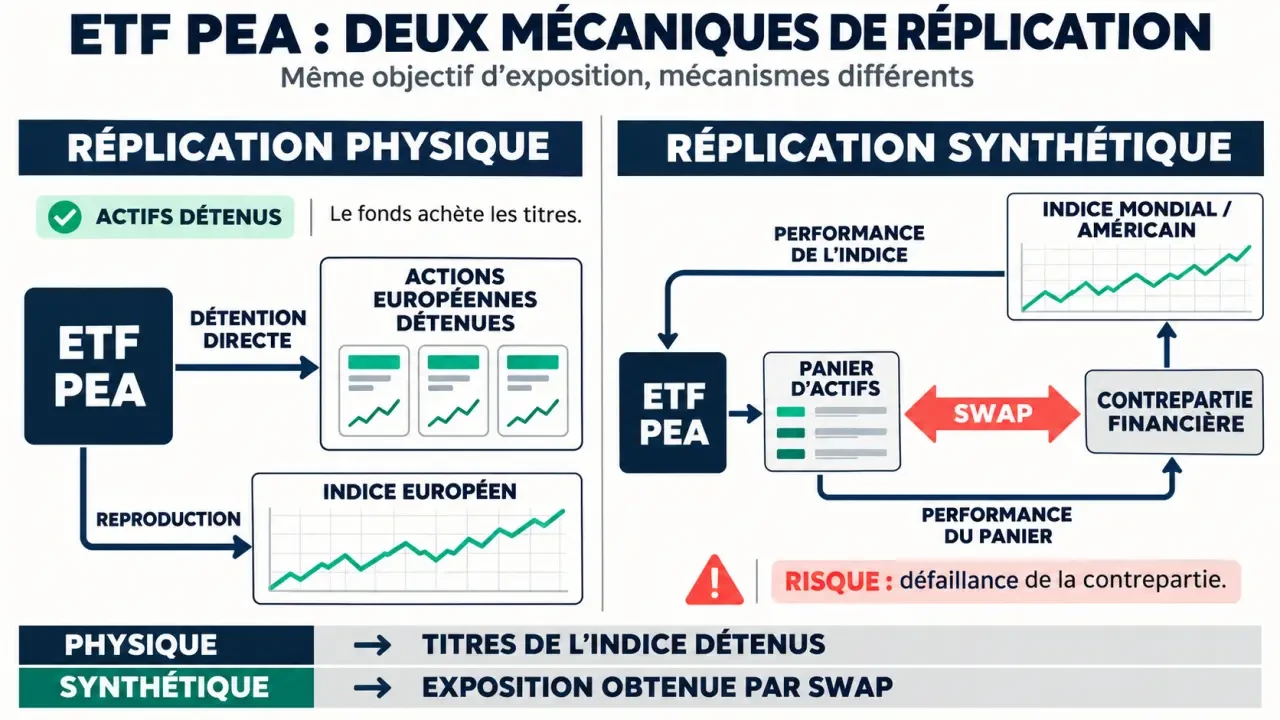
The assets held by the fund must be distinguished from the performance it seeks to deliver. An ETF can keep a basket of European securities compatible with the PEA, while achieving the performance of an international index through a financial contract. This explains the existence of some PEA ETFs following MSCI World, S&P 500 or Nasdaq 100.
These indices are not interchangeable. MSCI World covers 23 developed countries, while S&P 500 and Nasdaq 100 give different American exhibitions. An index « World » does not automatically include emerging markets and does not give the same weight to each country.
Physical or synthetic replication: understanding what the fund is doing
With the physical replication, the ETF purchases the securities constituting the index, or a representative sample. With the synthetic replicationhe holds a basket of assets and enters into an exchange contract, called swap, with a financial contribution. This contract allows him to exchange the performance of his basket against that of the index concerned, according to the arrangements provided for.
Understanding ETFs before investing · The AMF explains how ETFs function, how they replicate, their risks and the points to check before investing.
The basket does not necessarily describe your economic exposure. To find out which markets influence your investment, first look at the benchmark. To understand the structural risks, consider the replication, counterparties and collateral described in the prospectus.
The swap introduces a counterparty risk The contracting institution may not meet its commitments. Amundi mentions a regulatory limit of exposure to a counterparty of 10 % in the UCITS framework concerned. This limit does not mean that the maximum loss of the fund would be limited to 10 per cent or that the capital would be guaranteed.
Synthetic replication is therefore not a defect in itself, nor does physical replication eliminate all risks. The issue is to understand the mechanism used and the fund's ability to track its index, after fees.
Compare ETFs on something other than their displayed fees
First select the desired exposure, then compare the funds that follow the same index. To compete with a global ETF and a technological ETF only on their price is to compare two investments with different performance engines.
| Criteria | What needs to be considered | Practical utility |
|---|---|---|
| Index | Countries, sectors, weights and exclusions | Identifying real diversification |
| Annual or TER fees | Rate indicated in documentation | Compare recurring fund costs |
| Replication | Physical or synthetic | Understanding the structure and its risks |
| Dividends | Capitalisation or distribution | Adapting operation to requirements |
| Outstanding | Assets under management and changes | Appreciate the size of the fund |
| Liquidity | Purchase/sales spread and quotation conditions | Evaluate the cost of execution |
| Monitoring of the index | Tracking difference and tracking error | Observe replication fidelity |
Annual fees and net performance do not overlap
Ramify presents an indicative range of TER 0.05% to 0.60%. For example, the Amundi PEA World (MSCI World) UCITS ETF Acc's justETF card indicates 0.20 % per year and EUR 1 780 million (d) assets under management. These characteristics change: they must be checked before any purchase.
TER does not integrate all your costs. Add the brokerage fees, any custody fees and the spread, i.e. the difference between buying and selling prices. The tracking difference measures the performance gap between the fund and the index over a period; the Tracking error measures the variability of this deviation. Compare them over identical periods, with consistent treatment of dividends.
Think of following an index as a needle that must remain close to a trajectory: a low but constant shift does not have the same meaning as an irregular movement around the marker. This distinction helps to read the fact sheets: look for both how the fund differs from the index and how regular it is, rather than just a single cost figure.
Capitalization or distribution according to your use
A capitalizing ETF reinvests income into the fund. An ETF that distributes them into the AEP cash account. In the latter case, they do not automatically leave the envelope: reinvesting them implies a new transaction, possibly invoiced. Capitalization can simplify an accumulation strategy, without making the investment less risky.
From tracking to ordering: check the right part
Regulatory eligibility, broker SEO and effective possibility of purchase are three separate controls. An eligible fund may not be offered by your institution, or may be subject to negotiation restrictions.
- Find the ETF with the broker's PEA filter or a specialized engine like justETF.
- Raise its ISIN code to accurately identify the part, without relying solely on the business name.
- See the official sheet, the key information document and, if necessary, the prospectus.
- Check access from your PEA, the applicable fees and the place of listing. If in doubt, ask customer service.
- Check the order : quantity, price, amount and estimated costs before validation.
A limited price order allows you to set your maximum purchase price, but its execution is not guaranteed. Also observe the spread: a large stock or high trading volume does not guarantee good transaction conditions at every moment.
Risks and taxation: what the EAP does not change
An ETF shares may be subject to a partial or total loss of invested capital. Diversification reduces dependence on a single enterprise, not the risk of a general decline. Several ETFs can also hold the same large companies: multiplying lines does not necessarily diversify the portfolio.
Examine market, concentration, replication, counterparty and liquidity risks. The foreign exchange risk deserves special attention: a euro quotation does not neutralise exposure to foreign currencies. Only explicit coverage can reduce it, depending on its modalities and costs.
The key information document includes a risk indicator on a scale of 1-7. It completes the analysis without replacing the review of your horizon, your precautionary savings and your ability to withstand a drop.
Finally, taxation depends on the PEA envelope, not just the fund. A sale within the plan is not a withdrawal; The tax consequences depend in particular on the length of the plan and the exit conditions. Check the applicable rules before a withdrawal, without transposing the rules of a security account. Past performance does not prejudge future performance.