


Published by: Elise Caradec — Editor specializing in stock exchange
An index fund seeks to replicate the performance of an index, up and down. It allows to invest in a set of securities without selecting them individually, with generally contained fees. But its simplicity of access does not guarantee capital or sufficient diversification: the index chosen, the costs and the holding envelope remain decisive.
Index Fund, ETF and Tracker: distinguishing the strategy from the format
The index management follows the rules of an index rather than selecting securities to try to beat the market. The AIFM shall adjust the portfolio when the composition or weight of this index changes. This management, generally passive, requires fewer discretionary decisions than active management.
Measure the effect of fees on an index investment
Compare two annual fee assumptions from the same investment parameters.
Estimated results
| Indicator | Scenario A | Scenario B |
|---|---|---|
| Estimated final capital | ||
| Total paid | ||
| Estimated gains |
Comparison of final capital
Mathematical simulation only. Gross yield is a hypothesis, not a forecast. The calculation does not take into account taxation, brokerage, spread, inflation or real changes in performance. Payments are made at the end of the period.
An ETF, for Exchange Traded Fundis a publicly traded fund. The term « Tracker » commonly means an index ETF. However, not all index funds are ETFs, and not all ETFs are index funds Some index funds are not listed and some ETFs are actively managed.
| Type of funds | Management objective | Purchase and sale |
|---|---|---|
| Unrated index funds | Follow an index | Subscription or redemption at a liquidative value calculated periodically |
| Index ETF or tracker | Follow an index | Exchange trading during market hours |
| Traditional active fund | Select investments according to an own strategy | Generally at a periodic liquidative value |
Two methods to reproduce the index
Physical replication is based on the purchase of all or part of the index securities. Synthetic replication uses a financial contract, usually an exchange of performance with a counterparty. This second method introduces in particular a counterparty risk, framed but not non-existent. The key information document and the prospectus identify the mechanism chosen.
Diversification depends on what the index actually contains
Index funds may follow actions, obligations, a geographical area, a sector or a theme. According to the example of Crédit Agricole, an ETF CAC 40 gives an exposure to 40 enterprises. This avoids buying each share separately, without constituting a global portfolio.
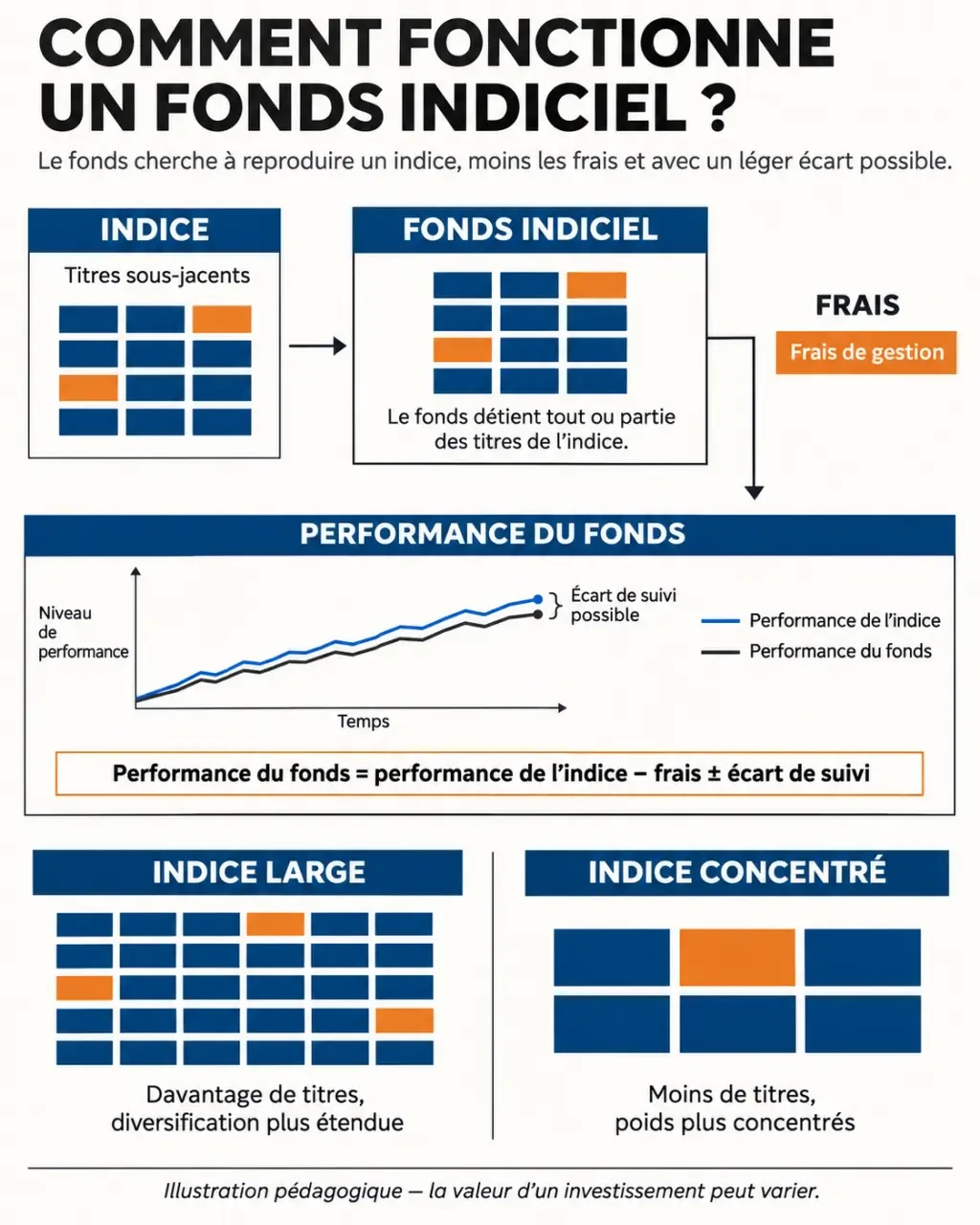
A broad index divides the risk between several issuers, but its larger positions may weigh heavily. A thematic fund can concentrate savings on a few activities sensitive to the same events. The number of lines is therefore not enough: consider weights, countries and sectors.
Think of your portfolio as a succession of exposure strata. Two funds with different names can be based on the same large companies: adding a technological ETF to a global index can strengthen an already dominant layer rather than diversify the whole. Comparing the main positions and their weight reveals these covers, often invisible in the commercial titles.
Income distributed or reinvested
A distributive share pays the income according to the terms of the fund. A capitalizing share reinvests them in the portfolio. The first may be appropriate for a need for income; the second avoids manual reinvestment. However, their taxation depends on the envelope and the situation of the holder: capitalizing does not mean being automatically exempt.
Before you choose, set your horizon and the drop you could bear without having to sell. A necessary saving soon should not depend on a volatile market. A bond fund also presents risks, including interest rates and credit.
Fee, index and risk follow-up: compare beyond the displayed price
Management fees are generally lower than many active funds. Wikipedia says they are usually less than 1 % for index funds, but this benchmark does not replace reading the specific product fee. Low annual fees reduce the remaining investment in a sustainable manner.
In addition to the current costs, brokerage, custody and envelope fees may be added. For an ETF, also monitor the spread, the difference between buyer and seller price. A small order can become expensive if the minimum commission of brokerage represents a large part of the amount invested.
The fund follows the index, without replicating it perfectly
The tracking difference measure the performance gap between funds and index over a period. The Tracking error measures the variability of this deviation. Compare identical periods in the same currency and with the same dividend treatment: otherwise, the comparison can be misleading.
- Market risk: a decline in the index leads to a decrease in the investment; all or part of the capital can be lost.
- Foreign exchange risk: a quotation in euro shall not remove the exposure to the currencies of the underlying assets.
- Liquidity risk: in times of tension, selling can become more difficult or more expensive.
- Leverage effect: it amplifies the variations and can produce, over several sessions, a result different from the expected multiple.
The Chione risk scale ranges from 1-7. It is a benchmark, not a guarantee. Performance scenarios are also not forecasts.
Choose the envelope before comparing intermediaries
The same fund is not accessible everywhere. The EAP eligibility and the presence in a life insurance contract or RIP must be verified for the exact amount envisaged. So compare the product and its detention frame together.
Understanding ETFs before investing · The official reference of the AMF to discover the functioning, benefits and risks of ETFs and trackers.
| Envelope | Access to funds | Tax principle and constraint |
|---|---|---|
| Securities account | Generally wide choice | Income and capital gains taxed according to applicable rules |
| PEA | Funds specifically eligible | After five years, earnings exempt from income tax, but social contributions due |
| Life insurance | Units of account proposed for the contract | Taxation of the share of gains included in a redemption ; variable scheme according to contract and payments |
| PER | Supports proposed by the plan | Savings normally intended for retirement; taxation related to payments and exit arrangements |
For the securities account, Economy.gouv.fr mentions a single flat-rate levy of 31.4% since 1 January 2026, consisting of 12.8% of income tax and 18.6% of social contributions. An option for the progressive scale may be possible. Check the rules applicable to your situation and the date of the transaction, without automatically transposing this rate to the other envelopes.
Make a first order with a verifiable method
An individual usually buys his ETFs on the secondary market, via a bank or broker. The primary market, where shares are created or purchased, mainly concerns specialized players. In life insurance, the transaction takes the form of a payment or a trade-off between carriers.
- Check the intermediary: check his authorization in official records and beware of identity fraud.
- Identify the right part: Use its ISIN code, then check the index, currency, replication and distribution policy.
- Read the Chione: examine risks, recommended duration, fees and scenarios; consult the prospectus if necessary.
- Control the regulatory status: In particular, use the AMF's OPC Geco database when the fund is included. A foreign fund may come under another competent authority.
- Prepare order: check quantity, price, spread and fee before validation.
A limited price order allows a maximum purchase price or minimum sale price to be set, without guaranteeing execution. After the transaction, keep the notice and periodically check whether the placement is appropriate for your purpose. Licensing and regulatory oversight are never a guarantee of return or capital.