


Published by: Elise Caradec — Editor specializing in stock exchange
The stock purchase order, more commonly referred to as the BSA, is a preferred financial instrument by companies to strengthen their own funds or to retain strategic partners. Contrary to popular ideas, this tool is not limited to large groups on the side; It is widely used by SMEs and startups to structure their capital while maintaining high operational flexibility.
Understanding the mechanism of the stock purchase order
The BSA is a financial security which confers on its holder the right, but not the obligation, to purchase one or more shares of the issuing company at a price fixed in advance, called year pricefor a specified period. This instrument makes it possible to anticipate a future capital increase without causing immediate dilution for current shareholders.
Test your knowledge of BSA
The issue of BSA is to be voted at an Extraordinary General Assembly (AGE). The terms, including the exercise price, the number of underlying shares and the expiry date, are then legally agreed. Unlike a traditional share, the BSA does not confer voting rights or dividend rights until it is converted into shares.
Why use BSAs: benefits and leverage
The main attraction of BSAs lies in their flexibility. For the company, they allow to raise funds deferred, while aligning the interests of the beneficiaries with the long-term success of the company. For the investor or partner, the BSA acts as a financial leverage : if the company's valuation increases significantly beyond the fixed year price, the potential gain becomes very attractive.
A strategic loyalty tool
BSAs are not restricted to capital investors. They are often used to attract or retain key profiles, such as external consultants, board members or business partners. By creating this capital link, the company ensures a lasting commitment from its stakeholders. It is common to issue BSAs with an exercise price slightly offset by the real value of the shares at the time of issue to enhance the attractiveness of the offer.
The BSA acts as a bridge between the immediate liquidity needs of a growing company and the long-term aspirations of its employees or partners. By structuring the relationship, the company integrates the provider into the entrepreneurial adventure, transforming a simple service into an active participation in value creation.
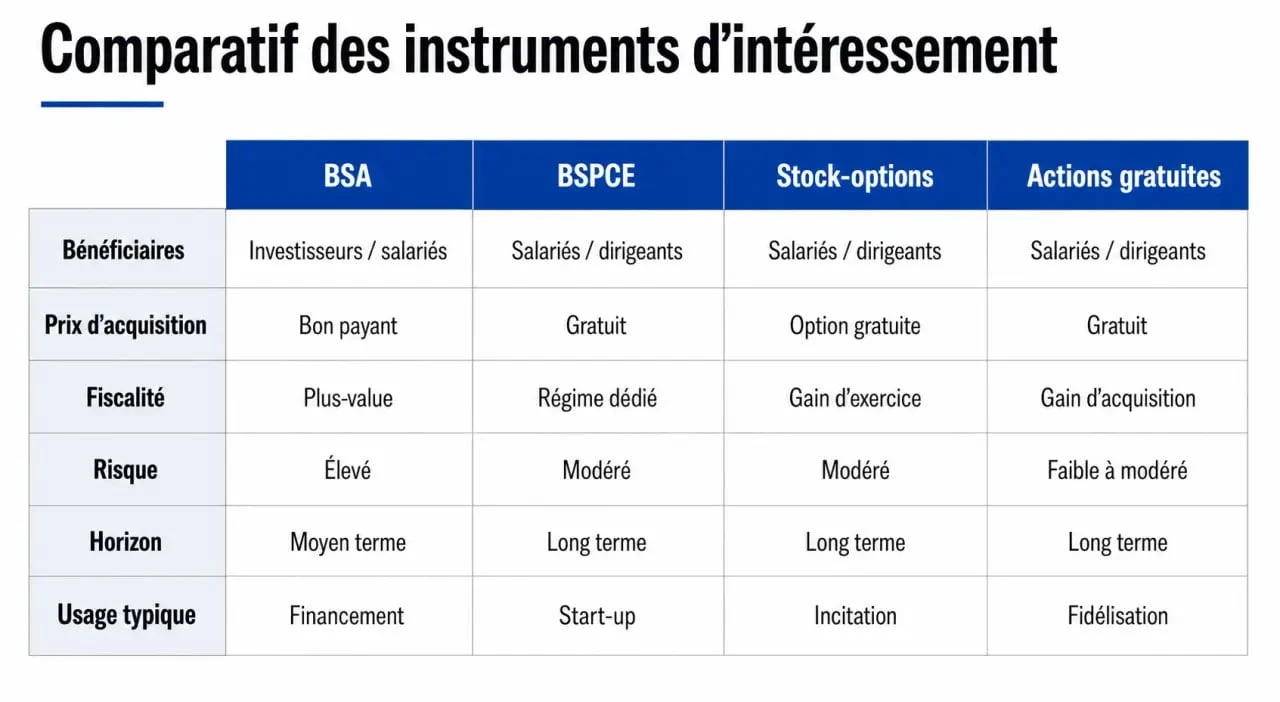
Comparison : BSA, BSPCE, stock options and free actions
The landscape of financial tools may seem complex. Here is a summary table to differentiate the most common devices in France:
| Instrument | Primary target audience | Major advantage |
|---|---|---|
| BSA | Investors, partners, third parties | High flexibility, no wage link required |
| BSPC | Employees and startup managers | Very advantageous taxation |
| Stock options | Employees and social agents | Traditional legal framework |
| Free actions | Employees and leaders | Direct transmission without exercise price |
The choice between these tools depends on the profile of the beneficiary and the objective sought. While the BSPC is often preferred for employees because of its tax efficiency, the BSA sets itself the benchmark for a business provider or an external investor because of its neutrality vis-à-vis the social status of the beneficiary.
Terms of issue and legal framework
The issuance of BSA is a formal legal act that requires several steps to be followed. A precise assessment of the company's value is essential to establish a coherent exercise price and avoid any risk of tax requalification. This valuation is validated at the extraordinary general meeting by the shareholders.
Once the issue is voted, a contract of issue details the conditions of exercise. It is crucial to include clauses of bad leaver or good leaver if the BSAs are intended for partners or collaborators, in order to predict the fate of the vouchers in the event of a breach of the commercial relationship or employment contract. This legal provision protects the structure of the company's capital against inappropriate outflows.
Taxation and points of vigilance
BSA taxation is less advantageous than BSPC taxation, but remains predictable. In exercising the vouchers, the beneficiary does not realize an immediate gain. It is when the subscribed shares are resold that the surplus value is recognized and subject to income tax and social contributions. It is advisable to consult a specialist lawyer or an accountant to secure the assembly, especially on the issue of initial valuation, a point of major attention for the tax administration.
Keep in mind that the issuance of BSA, although less intrusive than a conventional fund raising, results in a future dilution of capital. A rigorous management of the number of vouchers issued is therefore necessary to maintain a healthy balance between the attractiveness of beneficiaries and the maintenance of control for the founders.