


Published by: Elise Caradec — Editor specializing in stock exchange
Allowing large amounts of cash to sleep in an unpaid current account or a limited yield futures account is a loss of profits for a company. The company securities account, or Common Securities Account (CTO) for a corporation, offers a flexible solution to boost cash surpluses. Unlike regulated savings products, it allows direct access to global financial markets without any limit of payment.
Why open a securities account for his company?
The objective of a securities account for a legal person is to seek performance in the medium or long term. Whether you are running a SAS, a SARL, a corporate tax (IS) SCI or a holding company, this tool turns a dormant cash flow into a lever of wealth growth.
Growth Simulator
Project your cash growth with compound interest.
Unequivalent diversification of assets
The title account is a versatile envelope. It enables investment in a wide range of financial instruments:
The actions to become a shareholder of listed companies for dividends and capital gains. The obligations are used to lend capital to states or companies in exchange for interest. The ETF (Exchange Traded Funds) replicate the performance of stock indices such as CAC 40 or S&P 500 at lower cost. The UCITS, such as SICAV and FCP, are managed by professionals. Finally, the structured products offer return strategies with full or partial protection of capital.
Total availability of funds
One of the major assets of the CTO is the liquidity. Unlike some capitalization contracts or real estate investments, securities housed in a securities account can be resold quickly. The funds are available within a few days, after the settlement deadline, to finance an operational investment, acquisition or unforeseen need.
Operation and taxation of CTO legal person
The operation of a professional securities account is similar to that of an individual, unlike accounting and tax treatment. For a company subject to the SI, capital gains and income are included in the taxable income for the year.
The corporate tax system
Gains on a corporate securities account do not qualify for the flat tax of 30%. They are taxed at the normal IS rate, i.e. 25 % or 15 % for the fraction of the profit less than 42 500 € under conditions. Capital gains are deductible from taxable income, which provides a lever for tax optimization in difficult market exercises.
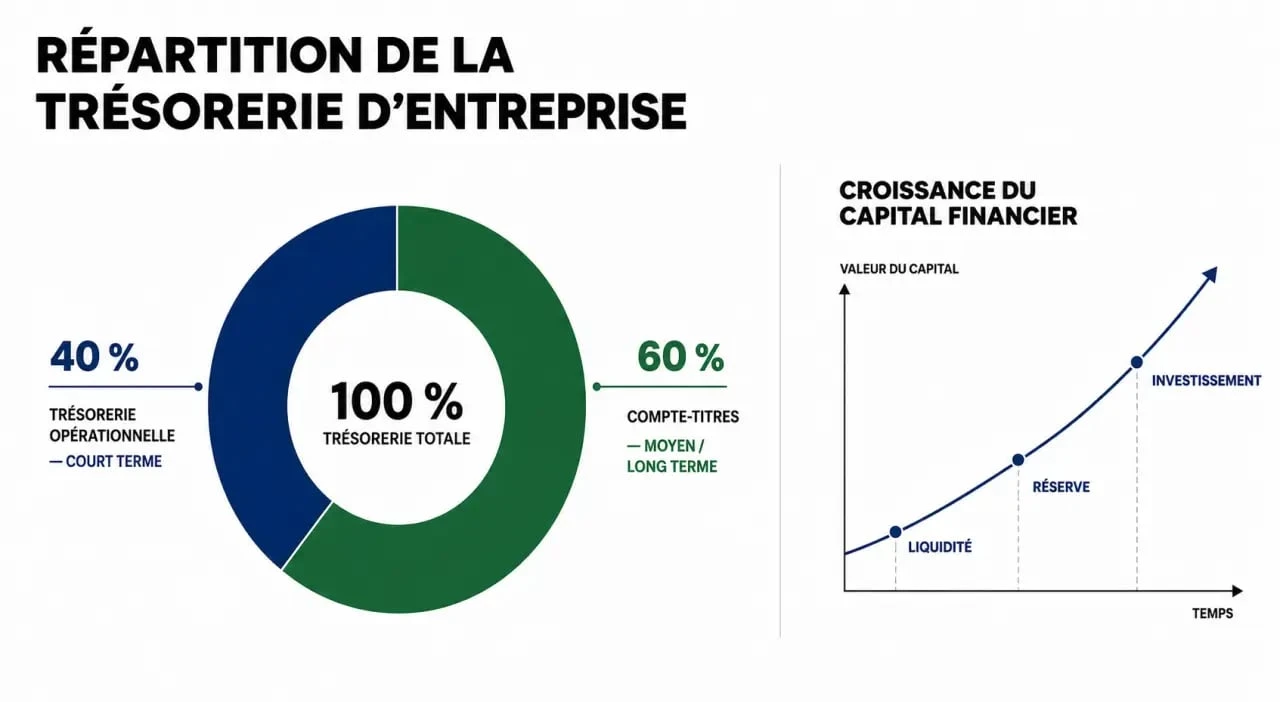
In a heritage approach, the securities account acts as a value reserve isolated from the operating cycle. By housing part of his cash in this structure, the manager creates an asset that is not related to business activity. This strategy enables the operational risk of financial risk to be deconceived, thus reinforcing the balance sheet resilience in the long term.
Accounting valuation of securities
At year-end, the company must assess its portfolio. For investment securities, the rule is that of historical cost: latent capital gains are not recorded, but latent capital losses must be provided if the market value is below the purchase price. This monitoring requires close collaboration with the accountant.
How to choose the right financial intermediary?
The choice of broker or bank impacts net performance, as brokerage fees and custody fees can have a significant impact on returns. Enterprises have access to three main types of actors.
Obtain or renew your official LEI code · The official portal to request, renew or consult your Legal Entity ID (LEI) from INSEE.
| Type of actor | Benefits | Disadvantages |
|---|---|---|
| Traditional banks | Physical interlocutor, global services (credit, factoring). | High guard fees, high brokerage fees. |
| Online Brokers | Competitive fees, access to global markets, analytical tools. | Self-management, sometimes dematerialised customer service. |
| Robot-advisors | Delegated management to experts, reduced fees, adapted risk profile. | Less control over individual securities. |
Essential selection criteria
Before opening an account, check the following: brokerage fees the existence of custody rights, the extent of access to international markets and the quality of the interface for extracting accounting reports.
Steps to open a company securities account
The opening of a securities account for a legal person is more regulated than for an individual because of regulatory obligations to combat money laundering.
Documents required
The financial institution will systematically request a Kbis extract of less than three months, the current statutes, the legal representative's identification document, the list of beneficial owners and the LEI code (Legal Entity Identifier). The latter is compulsory for any legal person wishing to place orders on the financial markets and obtains from INSEE.
Defining its investment strategy
Once the account is opened, the company must define its risk profile. If cash is to be mobilized in the short term, a prudent strategy on money funds or bonds is preferable. If the horizon exceeds 5 years, a higher exposure to equities via ETFs can counter inflation.
Risks and limitations of professional securities account
Investment in a securities account presents a risk of capital loss. The value of investment fluctuates according to financial markets. Moreover, volatility can impact the balance sheet: a fall in pre-closure markets may force the company to see a provision for depreciation, artificially reducing accounting profit.
The securities account must therefore be reserved for the Structural cash flow, which the company does not need immediately, rather than operating cash for current needs. In summary, the company's securities account is a powerful tool offering complete freedom on selected media and permanent liquidity. For optimized management, the support of a financial investment advisor (FIC) or the use of managed management platforms allows the delegation of asset selection while maintaining control over the overall strategy.