


Published by: Elise Caradec — Editor specializing in stock exchange
The BNP Paribas dividends It is of interest both to shareholders already invested and to investors who compare large European bank values. The topic is summarized as three simple benchmarks: the amount per share, the return on the purchase price, and the group's ability to maintain its distribution over time.
Amount of the BNP Paribas dividend and forecasts to be used
For the 2025 financial year, the dividend forecast per share is based on the EUR 5.16with a deposit of 2,59 EUR and one balance of EUR 2.57. This two-stage presentation gives more visibility to shareholders, as part of the remuneration is paid before the final payment. For an investor, this reading counts as much as the gross amount, especially when comparing the return and valuation of the security.
Performance calculator
Estimate the annual return on your investment.
| Year | Dividend per share | Estimated yield | Estimated BPA | Estimated PER |
|---|---|---|---|---|
| 2025 | EUR 5.16 | 4,60% | EUR 10,29 | 10,89 |
| 2026 | EUR 5.99 | 5,34% | EUR 11,51 | 9,74 |
| 2027 | EUR 6.54 | 5,83% | EUR 13,11 | 8,55 |
These figures remain estimates. The dividend depends on the results, the capital available, the decisions of the Board of Directors and the voting of shareholders. The yield also varies with the course of action. The same dividend seems more generous if the title declines, and more moderate if the price rises. The BPA and the RIP give another reading angle, useful to situate the dividend in the whole valuation.
History of BNP Paribas dividends: a progression, with some breaks
History since 1998 shows a long-term upward trend, but also interruptions due to financial cycles and regulatory constraints. The dividend is therefore not automatic. It monitors the bank's profitability, its level of solvency and the economic context in which it operates.
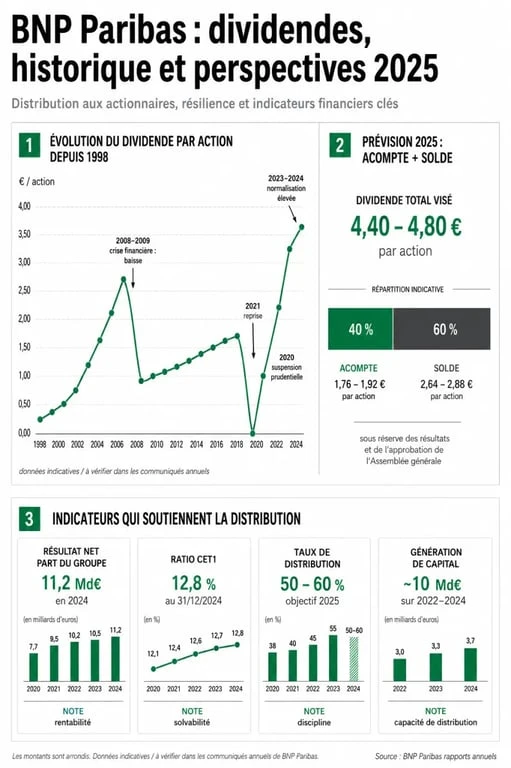
| Year | Gross dividend per share | Quick reading |
|---|---|---|
| 2025 | EUR 2,59 deposit + EUR 2,57 balance | Payment in two steps |
| 2024 | EUR 4.79 | High confirmed |
| 2023 | EUR 4.60 | Progress |
| 2022 | EUR 3.90 | Significant increase |
| 2021 | EUR 3.67 | Resumed after the period of constraint |
| 2020 | EUR 2.66 | Boxed distribution |
| 2019 | EUR 0.00 | Distribution suspended in Covid context |
| 2018 | EUR 3,02 | Stability |
| 2017 | EUR 3,02 | Stability |
| 2016 | EUR 2.70 | Progress |
| 2015 | EUR 2,31 | Gradual resumption |
| 2014 to 2012 | EUR 1.50 | Distribution tray |
| 2011 | EUR 1.20 | Relative low point |
| 2010 | EUR 2.10 | Rebond |
| 2009 | EUR 1.50 | After financial crisis |
| 2008 | EUR 0.97 | High drop |
| 2007 | EUR 3.26 | High pre-crisis level |
| 2006 | EUR 3,01 | Progress |
| 2005 | EUR 2.53 | Progress |
| 2004 | EUR 1.93 | Progress |
| 2003 | EUR 1,40 | After historical adjustments |
| 2002 | EUR 1.16 | Year marked by division of nominal |
| 2001 | EUR 1.16 | Stability |
| 2000 | EUR 1,09 | After merger BNP and Paribas |
| 1999 | EUR 0.85 | Progress |
| 1998 | EUR 0.72 | Historical base |
Two points deserve attention. First, the year 2019 to EUR 0.00 does not reflect a lasting loss of beneficiary capacity. It corresponds to an exceptional period of suspension or neutralisation of bank distributions. Second, the old amounts should be read with caution, in particular because of the adjustment related to the division of the nominal in 2002. This precaution avoids comparing amounts that are not based on exactly the same basis.
Payment schedule: down payment, balance and secondment
What the shareholder really needs to monitor
To receive a dividend, it is not enough to buy the share in the year. The title must be held before the date of secondment. The secondment marks the moment when the right to the dividend separates from the share. Payment is then made, usually a few days later, on the shareholder's securities account or PEA.
History of BNP dividends and splits · See the history of dividends and BNP share divisions, with inflation-adjusted data.
The introduction of a semi-annual deposit changes the usual reading of the payment. Instead of waiting for a single payment at the end of the year, the shareholder collects a first part and then the balance after validation. This organization gives distribution a more legible pace and may be of interest to investors who track their cash flows closely.
Why a deposit can be made
A dividend deposit may be decided when the results and financial position permit. In particular, BNP Paribas paid dividend deposit of EUR 3.23 per share in a context of favourable results and exceptional added value. This point shows that a dividend does not depend solely on recurring profits, but can also be influenced by specific transactions.
For the investor, the issue is to distinguish between what falls within the normal functioning of the group and what comes from a one-time event. A high dividend inspires more confidence when it is based on a sustained increase in net earnings per share. If it depends above all on an exceptional gain, reading must remain more cautious.
Financial results: what supports distribution
The BNP Paribas dividend must be analysed with the group's results. In a recent quarterly publication, net profit was EUR 4.35 billion, up by 33%, while net banking income was EUR 14.09 billion, up by 12%. The CET1 ratio, which is the central indicator of bank solvency, is shown in 13% and improved 20 basis points.
These figures count because a bank does not only distribute according to its published profit. It must also retain sufficient capital to finance its business, absorb credit risks, meet supervisor requirements and continue to invest. BNP Paribas also aims to increase the net income of more than 10% per year and a ROTE of more than 13%. These benchmarks help determine whether the group's trajectory can support the announced distribution.
The logic remains simple: when profitability increases, the bank has more margin to pay a dividend. When the net result declines, the cost of risk increases or the CET1 ratio increases, the distribution can be adjusted. Conversely, a solid GNP, a net profit per progressive share and a stable solvency make the dividend more credible. This reading avoids focusing on performance alone, without looking at the financial basis that supports it.
Consensus, return and investment decision
What analysts say
FactSet consensus mentions 22 analysts1 median score of 1.771 median price target of 105,06 EUR and one potential of 11.32%. These data do not predict the future, but they give an idea of how the professional market values the title at a given moment.
For a dividend-oriented investor, this consensus must be met with BPA, PER and yield forecasts. An action can show an attractive return while already integrating a lot of optimism into its price. It can also offer high returns because the market anticipates more caution. The comparison between expected dividend, net earnings per share and valuation therefore remains essential.
PEA, SRD, nominative: practical aspects
The BNP Paribas action is listed on Euronext Paris and is usually followed by French investors for its eligibility for the PEA and SRD. Shareholders may hold their shares in the bearer, in the administered name or in the pure name. The choice depends mainly on the desired level of relationship with society, the simplicity of management and the fees charged by the financial intermediary.
On the tax side, a dividend housed in an ordinary securities account is not treated as a dividend placed in a PEA. Before purchasing only to receive a payment, it is therefore necessary to integrate taxation, brokerage fees and the possible adjustment of the course after secondment. To consult the official information, BNP Paribas' investor page remains the preferred reference, especially for payment dates, history and shareholder documents.