


View the evolution of yoursavingin just a few clicks actually simplifies your financial choices – by changing the amount, duration or rate expected, theonline savings simulatorgives you a legible projection of your future capital, without registration or jargon. Thus, your goals come to life in the form of figures, which makes it possible to optimize each euro reserved.
Simulate your savings in 1 minute: calculate your future capital online
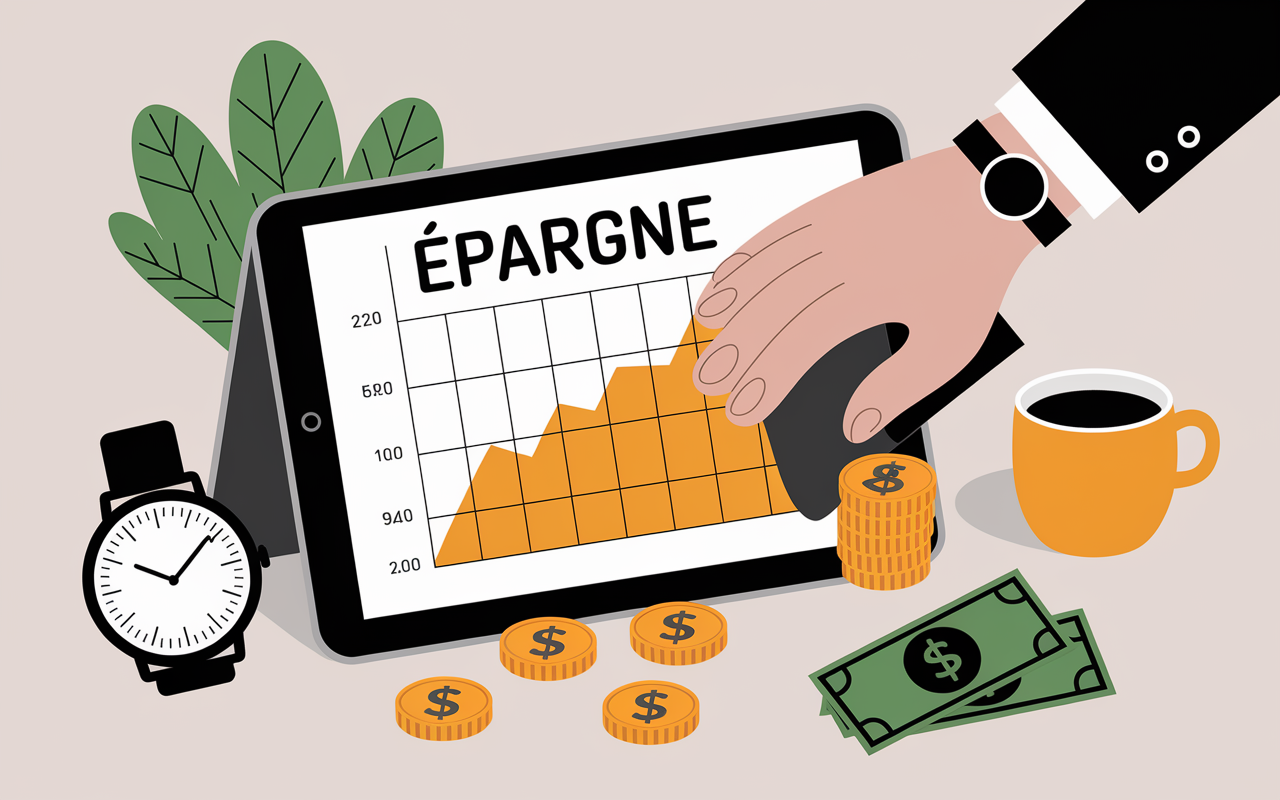
Calculate in an instant the amount you could reach through regular savings, even with a modest amount at the start. The online savings simulator offers the possibility in a few clicks to visualize the evolution of your capital according to your payments and the selected duration, without registration or commitment.
No jargon, no trap: you choose your goal (real estate, retirement, personal project), specify the initial amount, periodic payment (e.g. 100 €/month), the duration (5, 10, 20 years) and the rate envisaged (relatively often between2 and 3 per centfor conventional investments). Within seconds, a graphic estimate shows your projected capital and total interest earned on compound interest. In other words, you immediately get an idea of the accessible capital, and find out what savings effort would be needed to realize your project.
Concrete example: saving300 €/monthduring20 yearsto3 %The market's simulations show that it is possible to reach close to99 868 €(excluding taxation and inflation). Some users sometimes test when buying a home or preparing for retirement. Want to check? Launch the interactive simulation below:
Why use a savings simulation?
Take the lead, compare, go to action – the simulation transforms your blurred questions ("How much do we put aside? Can I finance my purchase? » etc.), in regularly motivating numerical markers. It is an initial step to see more clearly, to understand whether the effort is sufficient... or, on the contrary, if an adjustment proves useful.
Projecting your savings over several years may surprise you: did you know that when you started10 years earlier, for a100 000 €to3 %the monthly payment goes from717 €(over 10 years)306 €20 years? This is the importance of time and consistency, illustrated by the SERP simulators in mind.
- ✅ You define more precisely the financial effort necessary for each project (real estate, retirement, studies...)
- ✅ Nothing prevents you from comparing several variants to adapt the plan to your actual ability
- ✅ The impact of rate and duration on your target appears in seconds, clearly
Finally, the simulation brings concrete benchmarks and motivates action, while revealing the determining weight of compound interests over the long term. A trainer regularly shared the case of students who realized, thanks to this tool, that regularity eventually prevailed over the initial amount.
Good to know
I recommend you always test several scenarios with the simulator to adjust your savings according to your actual capacity and specific objectives.
How does a savings simulator work?

Some information is enough to get a reliable projection: there is no need to fill dozens of fields. With each change, the result adjusts automatically: ideal to test different scenarios before making a decision. Is this really enough to get involved? It is usually advisable to return several times.
The essential parameters to simulate your savings
Most of the recognized tools in the market (HSBC, Finance for All, etc.) allow to act on several main parameters:
- ✅ Initial amount– it is the amount initially paid (sometimes zero, or a first contribution around500to1000 €)
- ✅ Periodic payment: according to your abilities, pay each month, quarter or year
- ✅ Duration: of1 to 30 years, according to your personal goals
- ✅ Interest rates: in general2 and 3 per centfor secure options, but you can adjust according to your risk tolerance
Do you doubt the rate or the product? Simulators accessible to the general public often have a "classical" rate (HSBC, for example,2,5 %default) and invite you to compare different situations. Another point, some advisors recommend to be careful about the rate used, to avoid disappointments...
The secret of compound interests
What really changes the situation over a long period is the share of compound interest: at each maturity you receive interest on the capital, but also on the previously accumulated interest. The snowball effect, in a way (a bank agent recently reported that some customers underestimated this aspect at the beginning of the investment).
An example?1 000 €placed with50 €/monthduring10 yearsto2 %, as "The Keys of the Bank" suggests, leads to a final capital of8 339 €– including more than800 €interest generated year after year only. It is noted that the effect is limited at the beginning; then the deviation becomes consequent after15 or 20 years, often beyond the forecasts of novice savers.
Concrete examples for your projects: retirement, real estate, precautionary savings
Building on lived situations is more meaningful; Test several hypotheses to find those that most naturally coincide with your reality.
Simulating retirement savings
"Would I be retired enough?" This question comes up regularly during the interviews. Simulators usually offer a "retirement target" module to visualize the expected effort or amount to be secured. According to CCF, the equivalent of2 000 €/monthon20 yearsin retirement requires close to480 000 €at the time of departure (excluding taxes that remain to be anticipated).
By starting a simulation with200 €/monthpaid out of30 yearsto3 %, we manage to116 058 €capital. In order to focus on the above, it is sometimes recommended that either the monthly amount or the duration be increased or that investments with higher potential be considered. Some professionals suggest mixing several products.
Saving for real estate
For a purchase project5 to 10 years, simulation proves valuable to mark the course. Common example:30 000 €in10 years. From zero, we should place about240 €/monthat a rate of2 %(indicative simulation, excluding notary fees and taxation).
It is better to extend the simulation over several periods, as the monthly effort decreases significantly in the long term. A couple regularly decides to make a modest initial contribution (1 000 €) and then adjust monthly payments according to changes in income or exceptional premiums. Have you ever done the test? Some real estate agents note that this approach better anticipates unforeseen events.
Anticipating precautionary savings
The majority of experts stress the need to set aside the equivalent of3 to 6 months' salaryon a readily accessible booklet. For example, starting from income from2,500 €/month, a mattress7,500 to 15,000 €achieved more or less quickly according to the saving rate chosen (200 to 400 €/monthmost often).
A simulation, even a brief one, makes it possible to measure the effort realistically: there is no good or bad universal response, everything depends on the situation (an advisor recently explained that some clients choose to split their goal according to personal unforeseen circumstances). Several tools also offer a dynamic follow-up, month by month, so as not to lose the thread and feel accompanied.
Precautions, limits and advice for use
A simulator always offers an indicative estimate, excluding taxation or inflation – it is systematically recalled on the sites analysed. Before any important decision, it is best to check the assumptions used one last time. It is also convenient to download or save your scenarios to adjust them with family or with an advisor. Some users testify that this step avoids forgetfulness.
Quick story: a user found himself surprised after "gaining"10 000 €interest, then discovering social levies. It is regularly observed that it is better to inform about the limits of each tool, and not to consider the results as a definitive promise.
- ✅ All recognized simulators show an indication « indicative simulation – excluding tax, excluding inflation » at the beginning or end of the calculation
- ✅ The proposed rate has no contractual value: it corresponds to a reasonable assumption by the banks
- ✅ Before opening a savings product, it is best to read the official documentation carefully or interview an advisor
Finally, there is nothing to exclude that these tools are there to help you clarify your options, but never to decide in your place without outside advice, especially in case of doubt.
Frequently Asked Questions – Simulation of Savings
Since many users often ask the same questions when starting a simulation, here are some quick answers:
How do I calculate my compound interest with a simulator?
You simply provide the initial amount, monthly payment, duration and rate – the simulator automatically calculates all interest earned year after year and adds the accumulated interest ("annual capitalization"). An expert pointed out that this mechanics sometimes remains confused for beginners.
How much to save per month to reach 100,000 € In 10 years at 2%?
Plan717 €/monthif you start from zero (excluding taxes and fees). With savings spread over20 years, effort falls to306 €/monthfor the same purpose, always to2 %. This calculation is relatively frequently cited in financial education workshops.
Does online simulation take into account costs and tax on investments?
Most tools ignore management fees and taxation in automatic calculation. A box regularly recalls this limit, but it is often advisable to apply a lower "net" rate to obtain a more conservative estimate.
Can I compare Booklet A, life insurance or PEA with these simulators?
Yes, by indicating the interest rate of each product (Book A around3 %, life insurance between2and3 %, PEA sometimes more, but with a share of risk). Test a handful of variants to choose according to your goals and profile. Some professionals believe that it is best to refine each simulation according to the product conditions.
And if I start saving late, is it too late?
No, it's never pointless to start. The sooner you start early, the less effort required is important, but even late, it is better to start small than to push back indefinitely. The simulators clearly illustrate the difference:306 €/monthon20 yearsto achieve100 000 €... against717 €/monthon only10 years. In practice, some users discover that the important thing is consistency, not timing perfection.
Ready to test your script?
Launching an immediate simulation usually takes only a minute, and you leave with a solid plan to move forward. Need an accompaniment to decrypt the results or choose the best formula? Contact an advisor, download a guide, or schedule an appointment to refine your project.
Simulating is already acting, (and sometimes it's not always obvious to take this step!). Your turn.