


Published by: Elise Caradec — Editor specializing in consulting
The activity of a merchant of goods attracts many investors thanks to its potential for rapid profitability. However, behind the purchase and sale of real estate is a complex regulatory framework where the boundary between private wealth management and commercial activity is sometimes thin. Mastering the taxation of the merchant of goods is essential to protect your margins and avoid sanctions from the tax administration, which closely monitors speculative intent and repeat operations.
Qualification criteria: when do we become a merchant of goods?
Contrary to the ideas received, it is not the choice of a legal status that defines the activity of a merchant of goods, but the nature of the transactions carried out. The tax administration relies on Article 35 of the General Tax Code (GIC) to requalify individuals as professionals as soon as two cumulative criteria are met.
The habit of buying and selling
The usual concept is the first pillar. It does not depend on a specific number of transactions per year, but on the repetition of purchase actions followed by resale. The case law has already validated the designation of a merchant of goods for only two short-term transactions. The higher the frequency, the greater the real risk of requalification. The administration examines the length of detention: a systematic resale a few months after the acquisition reports a professional activity.
Speculative intent at the time of purchase
The second criterion is the intention to realize a profit upon acquisition. If you buy a building with the displayed objective to divide it to sell it to cutting, speculative intent is characterized. Conversely, the resale of a principal residence or rental property held for ten years following a life accident (divorce, transfer) does not fall into this category. What begins as a heritage investment can, through its success and repetition, transform the investor into a market operator, requiring a suitable legal structure to absorb the tax burden.
Taxation of profits: IR or IS?
The merchant of goods is not taxed on the property surplus value of individuals, but on his commercial profit. This result falls into the category of Industrial and Commercial Benefits (BIC). The choice of legal structure dictates the method of taxation.
Income Tax (PI)
If the business is carried out in its own name or through a transparent company (EURL, family SARL), the profits are included in the operator's progressive income tax schedule.
The main advantage is the possibility of charging deficits on overall income. On the other hand, high profitability can quickly propel the taxpayer into marginal tax brackets (41% or 45%), plus social contributions.
Company Tax (IS)
This is the current speed for SAS or SARL structures. Profit is taxed at 15% up to 42,500 € of profit, then 25% beyond.
The advantage lies in steering remuneration and dividends to optimize the income of the manager. The disadvantage is double taxation in the event of dividend withdrawal, combining corporate tax and Flat Tax.
The specific mechanism of real estate VAT
VAT management is the most technical aspect of the taxation of the goods merchant. Unlike a sale between individuals, business transactions follow strict rules that impact the final selling price.
Marginal VAT: the concession scheme
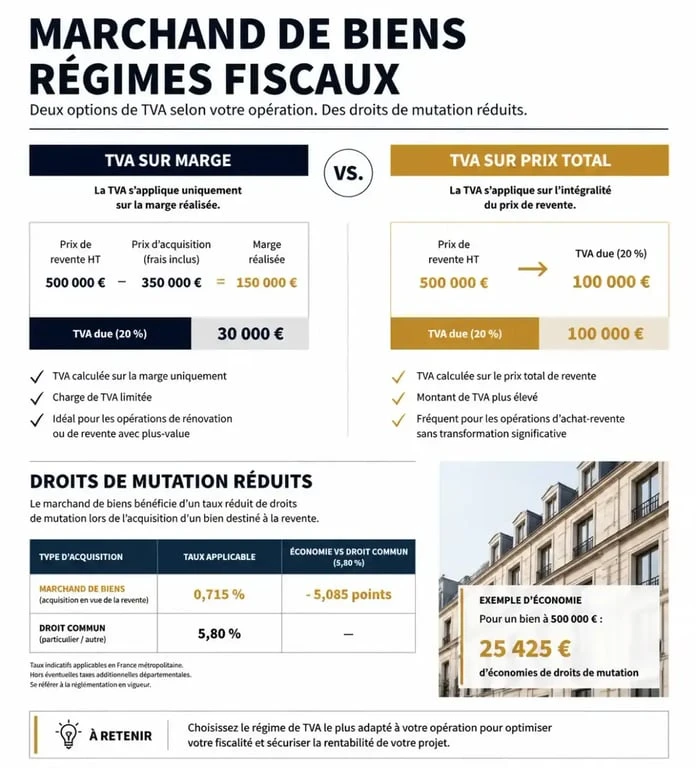
In most cases, the merchant of goods benefits from the VAT on margin. It applies where the property was acquired from a non-taxable person (an individual) and the merchant cannot deduct VAT on the purchase price. The tax is calculated only on the difference between the sale price and the purchase price, including acquisition costs. This mechanism avoids prohibitive taxation on the total value of the property.
VAT on the total price
This scheme is mandatory when the property is considered to be « nine » (completed for less than 5 years) or when major works are considered reconstruction. The 20% VAT then applies to the entire selling price. In return, the merchant may recover the VAT paid on his works invoices and associated costs.
| Type of operation | VAT base | Transfer rights |
|---|---|---|
| Old purchase / Resale in condition | VAT on margin (20%) | Reduced (approx. 2-3%) |
| Heavy renovation (new assimilation) | VAT on total price (20%) | Reduced (approx. 2-3%) |
| Building land | VAT on margin or total price | Variables by purchaser |
Additional benefits and points of vigilance
The status of goods dealer offers substantial savings to acquisition, provided that strict commitments to the State are respected.
Transfer duties at reduced rates
This is a major advantage of status. While an individual pays about 7 to 8% of notary fees, the property dealer benefits from a reduced rate of around 2 to 3%. To enjoy it, he must take a undertaking to resell property within 5 years. If this period is not met, the merchant must repay the realized savings of duties, with interest on delay and sometimes a penalty of 10%.
Deductibility of actual expenses and costs
In contrast to the individual scheme, the property dealer deducts from his taxable income all the expenses incurred for the operation: notary fees, agency fees, borrowing interest, renovation costs, management fees, insurance, property taxes and prospecting expenses.
The risk of requalification: how to protect oneself?
The danger for an investor carrying out several transactions is that the market regime of goods will apply retroactively. The administration can claim uncollected VAT on past sales, reclassify capital gains into BIC and require payment of social contributions. To protect oneself, clearly separate private assets from professional assets, document each investment intention and, from the second close-up operation, consult an accountant to validate the creation of a dedicated structure.