


Published by: Elise Caradec — Editor specializing in stock exchange
The closure of an accounting year requires strict compliance with the principle of separation of financial periods. Among the inventory operations, the calculation of Accrued unmatured interest (NCCI) provides a precise link to the previous year for borrowing expenses or investment income that have not yet been paid. This practice is necessary to present a true picture of your company's wealth and profitability.
What is an unmatured accrued interest?
Accrued unmatured interest is the portion of the interest on a debt or debt generated between the date of the last payment due and the closing date of your accounting year. Although such interest is not yet due or payable under the banking contract, it constitutes an expense or product that is economically linked to the year ending.
CNE calculator
Their accounting meets a requirement of transparency. Without this integration, your accounting result is artificially reduced for expenses or increased for products, which distorts the reading of your annual performance. This regularization mechanism ensures that each financial year bears only its own costs and benefits.
In which cases do the NECIs be calculated?
The NECI calculation relates to interest-bearing financial instruments. Frequent situations include:
Bank borrowing: You calculate the amount of interest accrued on the remaining capital owing from the last levy until 31 December.
Current partner accounts: If the agreement provides for paid interest, the interest shall be pro rata temporis.
Financial investments: These are revenues receivable and therefore accrued interest to the company.
Participatory bonds or loans: These instruments require special attention according to the periodicity of coupons.
The distinction with interest paid in advance
NICs are often confused with prepaid interest. NECIs relate to a period that has passed but not been invoiced, while interest paid in advance corresponds to amounts already paid to the bank for a future period. The latter are subject to regularisation in Deferred charges (account 486) to exclude them from the current year's income.
How to calculate unmatured accrued interest?
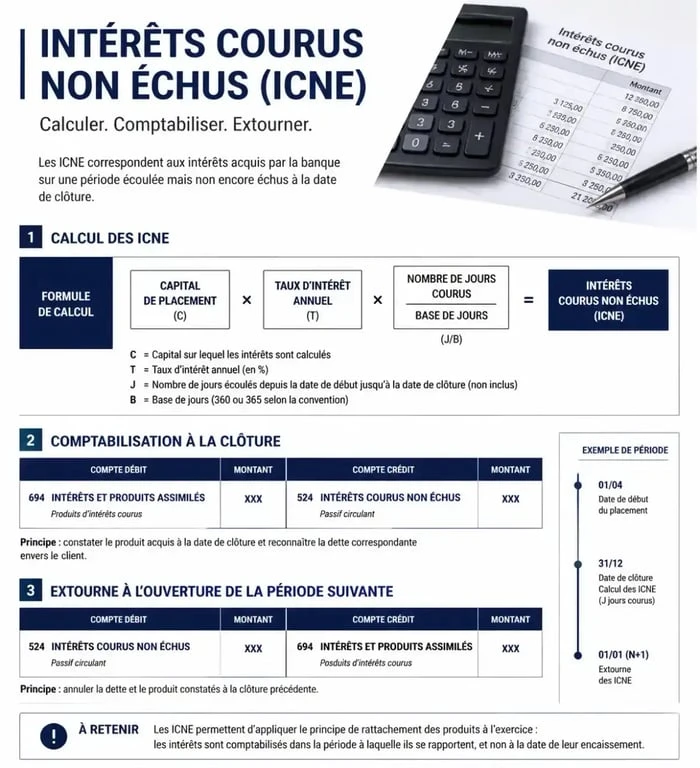
The calculation method is based on a formula proportional to the time elapsed. To obtain a reliable amount, you must have the remaining capital owing, the annual interest rate, and the exact number of days between the last maturity and closing.
Understanding account 1688: Accrued interest and similar liabilities · Discover the accounting operation of account 1688 to accurately record your accrued and unmatured interest on loans.
The standard formula is:
NCI amount = Capital remaining due × Annual interest rate × (Number of days accrued / Number of days in the year)
Practical example of calculation
Let's take a company with a loan of 500,000 € at an annual rate of 4.26%. The last deadline was taken on 30 November. On December 31, you calculate interest for December, 31 days.
Based on 365 days, the calculation is as follows:
500 000 € × 4,26 % × (31 / 365) = 1 809,32 €.
This amount of 1,809.32 € is the interest charge to be attached to the financial year ended.
To consider this exercise as a financial steering tool allows to go beyond the simple legal constraint. By automating this data extraction from the middle of the year via a dashboard, you turn a year-end obligation into a cash forecasting lever. This anticipation provides a clear vision of your future flows, avoiding surprises during peaks in financial disbursements and strengthening the reliability of your budget forecasts.
NECI accounting: standard entries
At the time of the inventory, the accounting record must be accurate to allow an automatic exit on the first day of the following financial year.
Registration at closure (31/12)
For a loan, the debiting of the expense account and the crediting of the debt account are:
| Account | Wording | Flow | Credit |
|---|---|---|---|
| 6611 | Interest on borrowing and debt | 1 809,32 | |
| 1688 | Accrued interest not due | 1 809,32 |
End of year (01/01)
From the beginning of the new financial year, it is imperative to cancel this entry in order to avoid double registration when the bank actually pays the due date. The reverse write: account 1688 is debited and account 6611 is credited.
Tax impacts and mistakes to be avoided
The omission of accrued unmatured interest results in an undervaluation of your expenses, and therefore an overvaluation of your taxable profit. Although the tax administration sometimes tolerates deviations that are considered insignificant, the accounting rule remains strict. A recurring error consists of forgetting the extirpation, which leads to double counting the same interest charge: a first time in the inventory, a second time in the actual payment.
To secure your writings, check the following:
The basis of calculation: Use the same number of days (360 or 365) as specified in your loan contract.
The reference date: Be vigilant about the actual date of the last deadline, especially if it falls on a holiday or a weekend.
Significantness: If the amount is derisory, the principle of prudence sometimes allows us to abstain, but a consistent policy is preferable to avoid any discussion during a check.
By structuring your financial records with tracking tables dedicated to each loan, you facilitate the work of your accountant and ensure full compliance with the standards of the General Accountant Plan.
The rigorous treatment of NECIs reflects controlled financial management. By systematically integrating these adjustments, you guarantee the reliability of your financial statements and optimize the preparation of your annual closure. This approach, although technical, secures your tax situation and enhances the transparency of your accounting vis-à-vis your banking partners and investors. Remember that every accounting detail contributes to the strength of your balance sheet.