


Published by: Elise Caradec — Editor specializing in consulting
Set the Corporate positioning radically transforms the way an activity can impose itself on a saturated market: choosing the right place, clarifying its difference and formulating a credible promise represent major levers to attract its ideal customers and secure its growth against competition.
Business positioning: the key to emerging – definition, method and concrete examples
Are you wondering how best to get out of the lot in a bottled environment? Positioning is the strategic compass that determines where your business settles in the minds of your customers – and why they may prefer you to your direct competitors. In 2024, neglecting this step amounts to running the risk of remaining invisible, even with a substantial marketing budget.
Positioning your business is not just a catch. It is a fundamental orientation that weighs on your range, your messages, your rates and even the posture of your sales team. To build true differentiation, this article offers a simple overview: definition, steps, tools, recurring traps, diagnostic checklist and examples in different sectors. Here's what we can remember about positioning power to give meaning and traction to an SME, a consulting firm or a bold start-up.
Summary of key points
- ✅ Positioning is the strategic compass to differentiate in a saturated market.
- ✅ It influences the company's range, messages, rates and business position.
- ✅ A clear and credible promise attracts ideal customers and secures growth.
Definition and key principles of good positioning
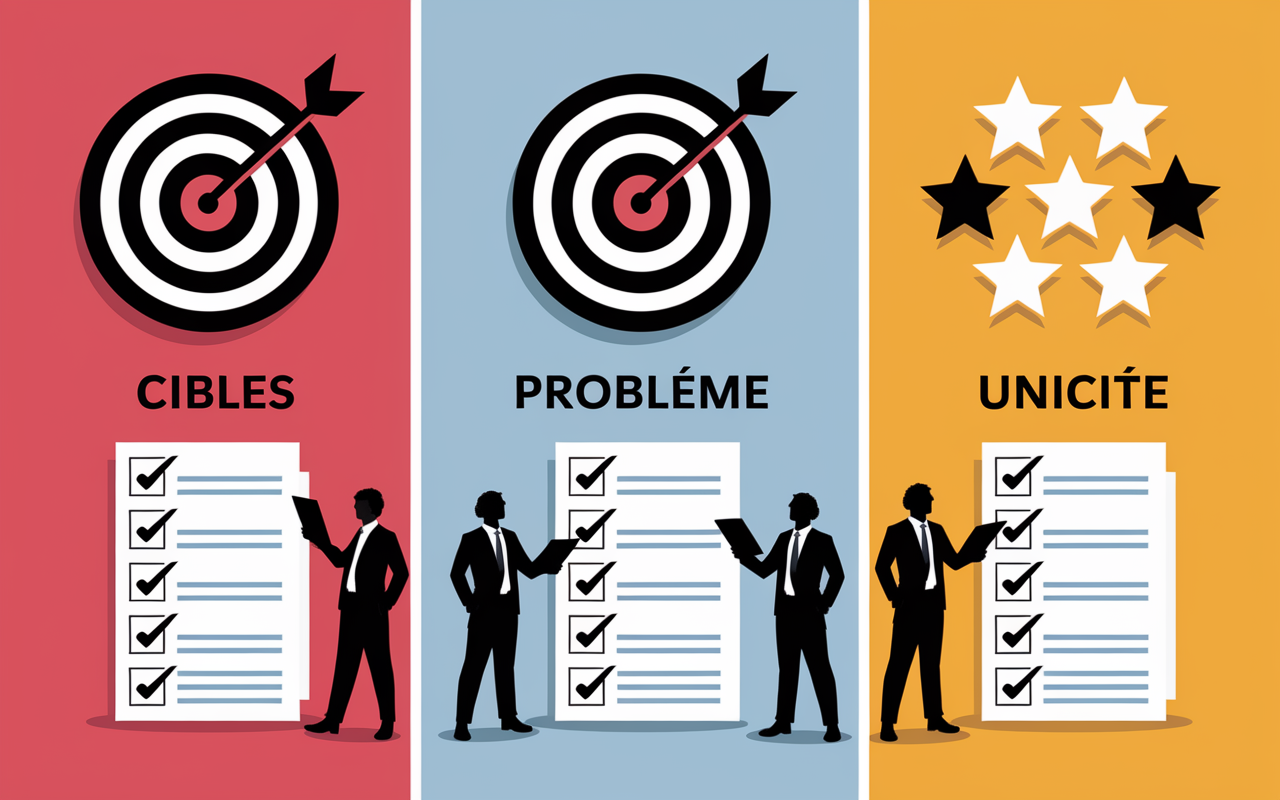
Seizing the notion of positioning is a decisive step forward on the clarity of its entrepreneurial project. Yet this concept is sometimes vague... Its impact is often underestimated.
What is the positioning of a company?
Positioning sets the strategic perception that one wants to set in the spirit of its target market, facing competition. In other words, there is a clear answer to three questions: who is the target? What's the problem? What makes us unique – or preferable? As an example, Nespresso does not just sell coffee: the brand promises "the exceptional coffee to taste at home, in complete simplicity", embodying the idea of an accessible luxury. A solid positioning acts as a magnet, naturally attracting its target (it happens that a leader suddenly discovers customers totally unexpected just by a precise promise).
A trainer recently mentioned the need for a simple and specific formulation: complexity leads to difficult adherence or confusion. It's not always obvious, but subtlety pays.
Difference between positioning, branding and value proposition
These three notions are still frequently confused! Last point to note: Positioning means the desired position in the customer's head; on branding transcribes this intention via tone, imagination, graphic codes, brand universe; Finally, the Value proposal brings together the key promise and the famous unique benefit for the customer. It is recommended not to mix: branding is a matter of appearance and storytelling, while positioning remains the strategic compass.
Some professionals also believe that this clarification avoids structural errors, even among the most experienced marketing managers.
The essential criteria for effective positioning
To be effective, positioning must meet several criteria – it must be understood within seconds, offer a clear difference, solve a real concern of the target, be credible (evidence to support), and remain aligned with its corporate DNA. A "catch-all" message often ends up not convincing anyone!
Here are some practical benchmarks for solid positioning:
- Clarity instant: the customer understands precisely the offer unambiguously
- Differentiation that comes to mind: a singularity that marks (not "like everyone")
- Real relevance: the proposal responds exactly to the target segment problem
- Verifiable credibility: social evidenceStudies, key figures
Some find that simply asking a customer "What do I do differently?" in five minutes gives a revealing feedback... If the answer delays, it is better to revisit its positioning.
The strategic stakes of positioning: why is it decisive in a saturated market
Barely between 15% and 20% of companies manage to differentiate in a sustainable way in their market, according to analyses reported by M&BD Consulting. Building on a good position means significantly increasing your chances of being chosen, even in front of major players.
Where does positioning make all the difference?
Positioning has nothing to do with a simple cosmetic effect in a commercial pitch. It works concretely: it simplifies customer choice, directs your marketing campaigns, secures prices and generates a marked preference. Let's think of Nespresso: over 400 shops, and with a turnover of the EUR 6.5 billion In 2022, the premium choice pushed back the price war while retaining customers beyond the mere coffee market.
Some industry experts see a strong positioning as an antidote to the trivialisation of a supply, especially in saturated markets. Without differentiation, there is a high risk of dilution (and many independents do not always understand why).
Test the credibility and relevance of its positioning
A promise "too beautiful" or disconnected from your real abilities will eventually turn against you: it is the boomerang effect typical of the unfulfilled promise. In practice, a clear and ambitious promise must be supported by tangible elements: customer testimony, Official figuresconcrete examples of success. It is common for even small SMEs to creditize their positioning through opinions, references (e.g.: 42 training videos on Pass Créa allow Bpifrance Création to demonstrate its expertise), or by sector labels.
It is often recommended that you put your positioning phrase to three customers: "Does that make sense to you? Do you find this credible?" This seems unstoppable, and returns are sometimes destabilizing... But precious.
Good to know
I recommend that you test your positioning phrase with three clients to verify its relevance and credibility, as feedback from the field is often valuable.
Step by step methodology to define the position of your company

Differentiating is hardly improvising: the construction of the positioning takes several structured phases. The recognized guides, including those of WeShareBonds or M&BD Consulting, recall the interest of taking the time for real brainstorming – not just a rushed sprint.
Step 1: Analyze the market and identify your direct competitors
It is better to start with a realistic mapping of the context. List your competitors (direct, indirect, sometimes unexpected), record their messages, identify their strengths/weaknesses. The tool of the moment: the perceptual card or the competitive mapping. A simple table on two axes: "price" and "value added", enough to spot where you are too close, aligned, or really different.
A consultant recently reported that using a visual mapping team facilitates the transition from "feeling" to accurate data via surveys, interviews or analysis of competing online sites.
Step 2: Identify your target persona and key expectations
A solid positioning always starts on the basis of the real customer – not on the dream persona. Who are they? What major needs? What frustrations or "irritants"? Sector successes usually start with an ultra-targeted response to an open vacuum or wait. It is often recommended to create a persona card, or an empathy card, to formalize expectations, obstacles and channels of influence.
Sometimes a leader is inspired by Bpifrance's 42 tutos to quickly map his targets: this is also why the "pedago-productive" approach is gaining popularity.
Step 3: Define your central promise and evidence
At this point, formulate in a sentence what you are trying to bring or transform for your client-target, bearing in mind that any promise requires proof: customer results, case studies, certifications, testimonials (social proof is often decisive).
In contrast, a company that claims to be "best everywhere" ends up not convincing anywhere... "We support SMEs in their development" or "We help managers double their turnover" the second, being more precise and factual, inspires more confidence.
- Concise message and specific: the promise must keep in a short sentence
- Support a score, study or study documented performance
Another point: prioritise evidence before eloquence. Some professionals make it a basic rule!
Step 4: Formalize (and test) your positioning phrase
Consolidate your ideas, then test the formulation with your "phare" employees or clients. Be open to feedback, even if it turns out to be nuanced: the terrain is an implacable filter. Several positioning simulators or interactive FAQs exist to refine your message. The final version usually requires 2 to 3 iterations, and no one finds the perfect formulation at first stroke (which is rather reassuring!).
Practical cases, examples of positioning and inspiring storytelling
Sometimes a concrete course is worth more than a series of tips. Some actors have been pushing their market message through sharp positioning – and the results are talking...
Example 1: Nespresso, the ultimate premium difference
By positioning itself as the accessible luxury of home coffee, Nespresso has invested a niche, avoiding price wars to generate a turnover of the EUR 6.5 billion in 2022 and open more 400 shops in the world. The message is clear: capsule rhymes with taste, simplicity... and singularity.
An expert packaging said that everything, from the box to the boutique atmosphere, reinforces the same promise. She could not be confused with a simple coffee actor.
Example 2: SME consulting firm – the choice of specialization
"We help Western industrial SMEs digitize their shopping chain to win between 28 and 32% time This position allowed a regional firm to triple its visibility in less than two years, while excluding local generalist competition (data from M&BD Consulting sector benchmarks).
Some professionals believe that to assert its playground reinforces the anti-competition effect and clarifies the message.
Before/After: When the formulation changes everything
Take the example of a professional coach: before, "I offer tailor-made accompaniment to any person", after repositioning, "I help managers aged 35-50 to succeed in taking up their position in 100 days". The impact is immediate and the conversion rate rises, which many independents report according to their returns.
Some consultants note that this effect "express declaration" becomes a powerful accelerator to target and reassure... (Is it really so complex? After all, it's a matter of practice!)
Frequent errors and alert points to secure your positioning
Many companies fall into traditional traps – and lose the efficiency of their positioning. Let's see how to avoid sometimes costly false steps (visibility, customers, growth may suffer...)
1. The trap of generic message or offer "for all"
To seduce everyone is often to convince... No one. In 7 out of 10 cases, the "generalist" positions ("for all sectors", "global solutions") trigger the most indifference or misunderstood customer (source: analysis Bpifrance, M&BD Consulting).
Another point: precisely target your audience to gain legitimacy and impact. Some experts teach it as a founding principle for leaders in repositioning.
2. The gap between speech and reality
An ambitious positioning only works if it is based on concrete evidence: numbers, field results, verifiable sharing. A "promising gap" can be expensive in reputation. It is often recommended to align the discourse with the real forces of his company and to adjust regularly to keep pace with market developments.
Common example: promise a delivery within 24 hours and then notice a week of delay – an error avoidable by a regular check of the consistency between promise and operational.
3. No field test or customer feedback
It is better never to finalize a positioning without testing its understanding on several external clients or partners. It is the best safety net, well before major internal debates. Let's not forget that the market, not the company, determines the relevance.
Some guides offer quick diagnostic checklists to get structured feedback in just a few minutes. Sometimes a leader discovers a decisive return thanks to this type of tool.
Tools, practical resources and FAQs to muscle your thinking
To advance its positioning becomes more accessible thanks to concrete advice: guides, matrices to download, diagnostic simulators, customer returns and tutorial videos are highly appreciated in the best specialized content. Let's add that on Pass Créa, there already exists 42 videos tutos to accompany creators and leaders towards action (and anticipate the risk of strategic breakdown!).
FAQ – short answers to key questions
What is the positioning of a company?
This is the distinct place that one chooses to occupy in the minds of customers, compared to its direct competitors.
How to define the positioning of its brand?
Analyze the target, map the competition, isolate your strengths, formulate your specific promise, and test it in your market.
Difference positioning/branding?
Positioning is a strategic intention; brand image is what the public perceives (it often depends on consistency... or not!).
How do I know my positioning is good?
Test the understanding and preference generated: three prospects must reasonably perceive what distinguishes you in less than twenty seconds.
How to differentiate in strong competition?
Look for the "unsatisfied niche": forgotten target, unprecedented angle, measurable profit, strong commitment or sector expertise (some consultants say that simply deosing an unexpected angle radically transforms visibility).
Can we reposition a company?
Yes, it is best to do so in a strategic shift, growth crisis or target change, following the methodology outlined above.
Where can we find concrete examples?
Resource centres of reference organizations: Bpifrance, specialized guides, Pass Créa videos, downloadable matrices.
Want to act? Get an express diagnostic tool or tailor-made accompaniment
Need a new look? Download a positioning matrix, view a tutorial video or make an express diagnosis on the recommended platforms (Pass Créa, M&BD Consulting, MerciApp guides). It is regularly useful to ask for an exchange of advice or to test an interactive simulator to challenge your message... In 2023, more than one out of every three SMEs who reworked their positions found an immediate gain in the conversion rate or number of qualified appointments according to sector studies. What if it was your turn soon?