


Published by: Elise Caradec — Editor specializing in consulting
New subscriptions to SCPI Pinel are no longer possible since 1 January 2025. On the other hand, investors who already held shares before that date may continue to benefit from their tax advantage, subject to compliance with their commitments. The operation of the product, its conditions and its prospects of exit therefore remain useful to understand.
What is a Pinel SCPI?
A Pinel SCPI is a SCPI tax, i.e. a civil real estate investment company that collects the savings of many investors to buy a new or renovated housing estate eligible for the Pinel scheme. Instead of buying a specific apartment, the investor acquires shares of the company. It becomes associated with the number of shares held.
Historical calculator Pinel SCPI
Important note: A limit of 5,500 €/m2 applies to the cost price of the property (not calculated here due to lack of surface information).
Warning: Indicative historical simulation, valid for the mentioned rules, not taking into account the overall cap on tax niches, the personal tax situation, fees, any recoveries or the performance or liquidation value. New subscriptions are no longer possible since 1 January 2025.
The management company, approved by the Autorité des marchés financiers, selects real estate programmes, often in VEFA, i.e. for sale in the future state of completion. It is then responsible for leasing, rent collection and day-to-day administration. The investor thus delegates rental management, without having to choose property or directly manage a tenant.
The principle remains that of the Pinel law. Housing must respect rent ceilings and tenant resources, be located in tense areas, including areas A, A bis or B1, and meet certain energy performance standards such as the RT 2012 or BBC label. In return, the SCPI gives the partners a share of the tax reduction obtained at the company level, proportional to the number of shares held.
The difference with direct detention
Investing in Pinel Direct consists of buying specific accommodation, choosing its location and managing its rental. The investor then assumes the risk of a vacancy or of being paid on the property alone. A Pinel SCPI spreads this risk across several housing units, often located in different cities. If an apartment remains vacant for a few months, its impact is distributed among the different assets in the portfolio.
This mutualization does not remove the real estate risk. It distributes it between several properties and several tenants. However, the investor has neither the exact location of the housing nor the decisions taken by the management company.
Can we still subscribe a Pinel SCPI in 2026?
No, new subscriptions are closed. The Pinel scheme ended on 31 December 2024. Since 1 January 2025, no new Pinel investment, either directly or through an SCPI, can qualify for this tax benefit. There is therefore no more SCPI Pinel open to subscription in the strict sense.
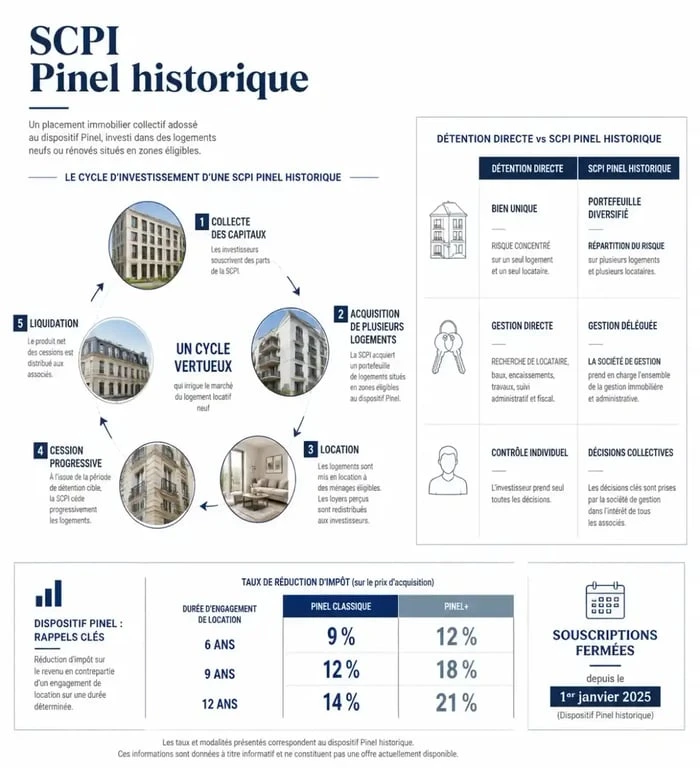
This closure concerns new investments. It shall not automatically call into question the shares subscribed before that date. If you invested in a Pinel SCPI before January 1, 2025, your tax reduction continues to apply according to the rules in force at the time of subscription, provided you meet your lease and retention commitments.
Two situations must therefore be distinguished. The new investor can no longer access the Pinel device. The existing holder of shares continues the timetable provided for by his investment. The management company continues to manage housing until assets are disposed of and the SCPI is wound up.
How did a Pinel SCPI work?
The complete cycle of a Pinel SCPI could last 15-17 years, well beyond the only period eligible for tax reduction. It included the collection of capital, the acquisition of housing, its leasing, and the gradual resale of wealth.
Collection, acquisition and leasing
The management company first marketed the shares during a collection period. It then had a period of up to 18 months to fully invest the funds paid for the acquisition of housing. The marketing and acquisition phase generally lasted 30 to 36 months.
Once the housing was acquired and leased, the rents were redistributed to the partners in the form of periodic dividends, after deducting management costs. The rents, however, remained regulated by the Pinel rules. The current efficiency could therefore be limited compared to that of a yield SCPI.
Disposal of assets and liquidation
At the end of the rental commitment period of 6, 9 or 12 years, depending on the initial choice, the management company began the gradual resale of the housing. The disposal and liquidation phase usually lasted 2 to 3 years.
The proceeds were then returned to the unitholders. The capital recovered depended on the state of the real estate market at the time of resale. So he wasn't Never guaranteed and could be less than the amount invested.
What tax reduction and under what conditions?
The tax reduction depended on the commitment period and the regime applicable at the time of subscription. In 2024, the classic Pinel had rates of 9%, 12% or 14% for commitments of 6, 9 or 12 years. Pinel+, which required enhanced energy quality and performance criteria, kept rates of 12%, 18% or 21% for these same periods.
The calculation base was capped at EUR 300 000 per year per fiscal home, with a limit of 5,500 euros per square metre. Investment was also limited to two dwellings per year. For example, per 100 000 euros invested over 9 years at an 18% rate, the total reduction was 18 000 euros, or around 2000 euros per year during the period concerned.
This reduction was part of the overall cap on tax niches, set at EUR 10 000 per year. A taxpayer who already enjoyed other tax benefits could therefore not fully benefit from the theoretical reduction. The amount actually obtained depended on its tax situation and other arrangements used.
Conditions to be met to the end
The benefit of the reduction was that the dwellings would remain rented as principal residences, subject to the rent and resource ceilings set by the area. The shares were also to be retained for the entire commitment period chosen.
Early resale could lead to the challenge of the tax advantage already obtained and its resumption by the tax administration. However, certain special situations, such as disability, death or dismissal, could be recognized by the administration. The exact conditions depended on the record and the applicable regulations.
Benefits, limitations and comparison with Pinel live
A Pinel SCPI first met a tax objective, not a high-yield search. Its current yield was generally between 1.5% and 2%, while the SCPIs had an average distribution rate of 4.72% in 2024. This difference was explained in particular by the capped rents and the tax nature of the investment.
As a result, the tax reduction could partially offset the low level of distributed revenues, but it did not transform SCPI Pinel into a return investment. We had to distinguish The tax advantage, the rents received and the final value of the shares. These three elements could evolve differently.
Subscription fees, generally between 10% and 12% of the amount invested, also weighed on overall performance. They were to be amortized over a long period of detention. Liquidity was also very limited. The secondary market for SCPI Pinel's shares was rarely active, which made it difficult to resell before the expected term.
Finally, the investment involved a risk of capital loss. The value recovered at liquidation depended on the sale price of the housing, the state of the real estate market and the costs associated with disposal operations.
SCPI Pinel vs Pinel live
The SCPI offered a more accessible entrance ticket, starting at EUR 5,000, against the full price of a house purchased live. It also made it possible to delegate property search, rental management and administration. Diversification among several housing units reduced exposure to one asset.
In return, the investor lost control over the choice of the property, its precise location and the timing of resale. These decisions were the responsibility of the management company or the collective liquidation process. The Pinel live was theoretically able to select a site with a better value potential, but it concentrated the risk on a single dwelling and left more responsibility to the owner.
You already own shares: what to watch
If you have subscribed shares of SCPI Pinel before 2025, start by checking the terms of your commitment. The management company must continue to respect the lease term, rent limits and tenant rules. For your part, you must keep your shares until the specified term, unless there is a special situation recognized by the tax administration.
An advance sale, even partial, may expose to the recovery of the tax advantage already received. It is therefore preferable to check the tax consequences before applying for withdrawal or sale. Since liquidity is low, a quick exit can also be carried out under unfavourable conditions.
As the term approaches, the management company organizes the gradual disposal of housing and the liquidation of the SCPI. The capital actually recovered may differ from the amount initially invested according to the development of the real estate market in the areas concerned. Distributed revenue and tax reduction do not guarantee the final amount of resale.
After the expiry of your Pinel SCPI, other solutions of real estate defiscalisation can be explored, such as the land deficit or Malraux SCPI. These schemes have different mechanisms and eligibility conditions. The choice depends in particular on your tax situation, your investment horizon and your need for liquidity.