


Published by: Elise Caradec — Editor specializing in stock exchange
In the financial management of a company, the distinction between different types of securities goes beyond mere accounting semantics. It directly determines the tax burden on capital gains on an assignment. The participation securities are not mere financial investments, but tools of influence or control. Mastering their definition, both in accounting and fiscal terms, helps avoid a recovery and optimize the profitability of your long-term investments.
What is a participation title? Definition and criteria
A holding interest is defined by the intention of the undertaking upon its acquisition. In contrast to investment securities, whose objective is immediate profitability or cash management, equity interests reflect a desire for a lasting anchor in another company.
Accounting definition: utility beyond performance
According to the General Accountant Plan (GCP), equity securities are securities whose long-term ownership is useful for the business, in particular because it allows for influence or control over the issuing company. This utility can be operational, such as a commercial partnership or security of supply, or purely strategic.
There is an accounting presumption: securities representing at least one shareholding are presumed to be securities 10% of capital a company. However, this limit is not absolute. A company can hold 8% of the capital and justify a significant influence, just as it could hold 12% without a real will to influence, although the latter is more difficult to defend before the tax administration.
Tax definition: a stricter approach
At the tax level, the definition is more framed to avoid abuses related to the preferential regime. The following are considered to be equity securities:
Securities which have the character of holding securities in the accounting sense, securities acquired under a Public Purchase Offer (OPA) or a Public Exchange Offer (OPE) by the initiating undertaking, as well as securities which qualify for the parent company scheme, often linked to the threshold of 5 % of capital.
The crucial distinction with investment securities
It is common to confuse equity securities (account 261) with equity securities (VMP – Investment Securities, account 50). However, the issue is major: the treatment of capital gains and losses differs radically.
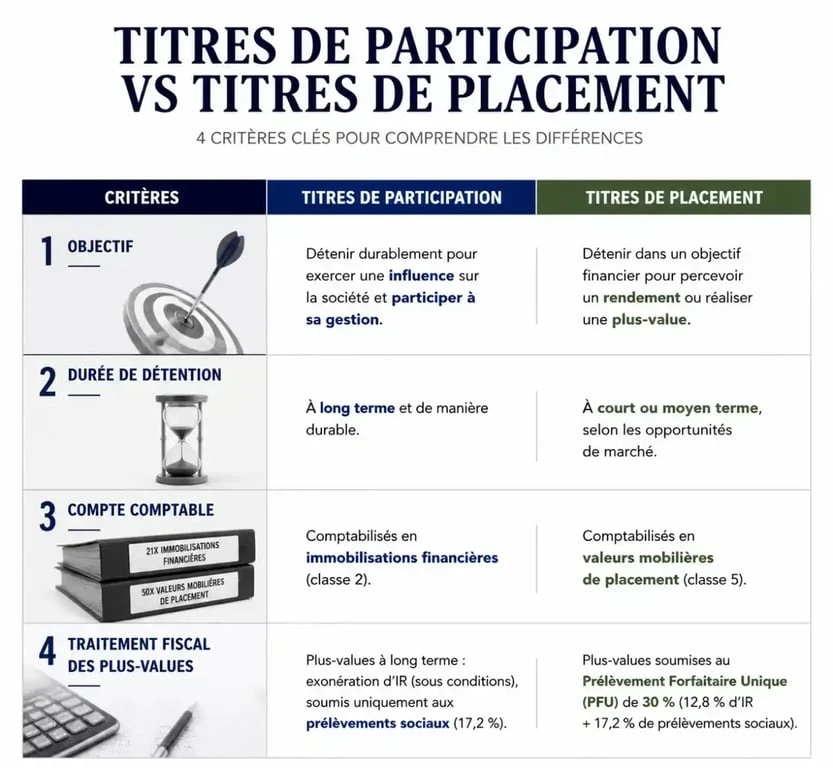
| Characteristics | Participation | Investment Titles (VMP) |
|---|---|---|
| Objective | Influence, control, strategy | Cash, quick gain |
| Duration of detention | Durable (usually > 2 years) | Short or medium duration |
| Accounting account | Class 2 (Immobilization) | Class 5 (Treasurery) |
| Taxation of capital gains | Exemption (under assessment) | Taxation at normal IS rate |
The choice of category must be made at the time of entry on the balance sheet. A subsequent requalification is complex and often scrutinized by the tax authorities. If you purchase shares without intent to influence the subsidiary's decisions, they will remain investment securities even after three years of holding.
The preferential tax system: exemption from capital gains
This is the major argument in favour of equity. When a company subject to corporate tax (IS) sells these securities, the realized surplus value can be virtually exempt from tax.
Conditions for eligibility at zero rate
To qualify for this scheme, two cumulative conditions must be met:
The securities must have been kept for at least two years and meet the tax definition of equity, including the 5% capital threshold for the mother-daughter scheme.
The cost-sharing mechanism (12%)
The exemption is not total. The Act provides for the reinstatement of a 12% share of costs and expenses the gross amount of the capital gain in the taxable profit. If you realize a capital gain of 100,000 €88 000 € are exempt and 12,000 € are taxed at the normal SI rate (25%). This amounts to an effective tax rate of about 3% on total capital gain.
This mechanism works as a financial lever: once the qualification of participation is validated, it triggers the application of the long-term regime. If the administration considers that the intention of influence was not demonstrated, it is the entire tax optimisation building that collapses, exposing the company to taxation at a full rate of 25% on the entire gain.
How to register equity in accounting?
The administrative aspect is evidence of the company's intention.
Acquisition of securities
At the time of purchase, securities are recorded at their acquisition cost, excluding costs, except for the option of incorporating costs. The account used is the 261 « Participation securities ». Writing consists of debiting account 261 for the purchase value and crediting account 404 (Providers of capital assets) or 512 (Bank).
Inventory and depreciation
At each year end, the company must estimate the inventory value of the securities. If the present value is less than the input value, a depreciation must be recorded in Account 296. Unlike investment securities, the latent loss on equity is not always tax deductible, especially if it concerns securities covered by the long-term regime.
Points of vigilance and notable exclusions
All that looks like participation is not necessarily one in the eyes of the tax authorities. Several situations exclude your titles from the preferential regime.
Preponderant real estate companies (SPI)
This is the most common exclusion. If the assets of the company with which you hold the securities consist primarily of real property not allocated to its own professional operation, the securities are considered as SPI securities. The system of long-term capital gains favour does not apply, and taxation is carried out at the rate of common law, even after two years of detention.
Evidence of influence: moving jurisprudence
The Council of State regularly states that the mere holding of a percentage of capital is not always sufficient. The company must prove that it has the means to exert influence. This may include the presence of joint leaders, the existence of meaningful trade agreements or active participation in general meetings.
Conversely, a purely passive holding, even greater than 10%, may be challenged by the administration if it considers that the purchase was solely intended to benefit from the tax exemption.
Risk of corporate securities established in tax havens
Securities of companies located in a non-cooperative state or territory (ETNC) are generally excluded from the preferential regime. The capital gains on the disposal of these securities are heavily taxed, with no possibility of benefiting from the 12% quota.