


Published by: Jean Bogle — Editor in Chief
The dividend calculation distinguishes between three amounts: what the corporation can distribute, the gross dividend allocated to each partner, and the net dividend received after deduction. For an investment in shares, you must also calculate the income per security and its return. These transactions answer different questions: an accounting profit is not an available dividend, and a posted return is not a guaranteed net income.
Determine what the company can actually distribute
A dividend is a distribution decided for the benefit of the partners or shareholders. In a company subject to corporate tax, the starting point is after-tax income, not turnover or bank balance.
Gross, net and return dividend calculator
Two routes to estimate a distribution or analyse the return of a portfolio. The amounts are calculated from the data you enter.
Distribution by a company
Inform the calculation elements and one or more sampling assumptions, separated by commas. The rates entered are used for simulation purposes only.
Portfolio return
Enter company and portfolio data. Gross return is calculated on the dividend per share deducted from the total distributed.
Distributable profit = profit for the year - previous losses - minimum reserves + carry-forward. Available reserves may also be distributed by an appropriate decision. They should not be confused with legal or statutory reservations not available.
Make the legal reservation without exceeding the necessary complement
For the companies concerned, the minimum allocation is 5 % of profit for the year minus previous lossesuntil the legal reserve reaches 10% of social capital. If it is already close to this threshold, only the necessary supplement is mandatory, subject to the applicable statutory provisions.
Let's take a company with a capital of 20,000 €with a legal reserve of 1,500 €. Its profit after tax amounts to 30 000 €, without previous losses, with a carry-over of 4,000 €. The legal threshold is 2,000 € : the necessary allocation is therefore 500 €, not 1,500 €. The distributable profit reaches 33 500 €.
Control of equity and cash flow
Distribution should not reduce equity capital under increased social capital from reserves prohibited by law or statutes. The distributable amount is therefore a ceiling to be verified, not an amount to be paid automatically. The decision usually takes place when the accounts are approved and the result is allocated.
Apply also a liquidity filter: mentally remove the tax and social debts to be settled, the debt maturities and the need to finance the next business cycle. A company can display a distributable profit while waiting for the settlement of its customers. This second control prevents a legally possible distribution from weakening current payments.
Switch from gross dividend to net amount
The amount voted shall be allocated according to the rights attached to the securities and the statutory rules. In our example, if the partners decide to distribute 20,000 € and that a partner holds 50% of the dividend rights, its gross dividend is 10,000 €.
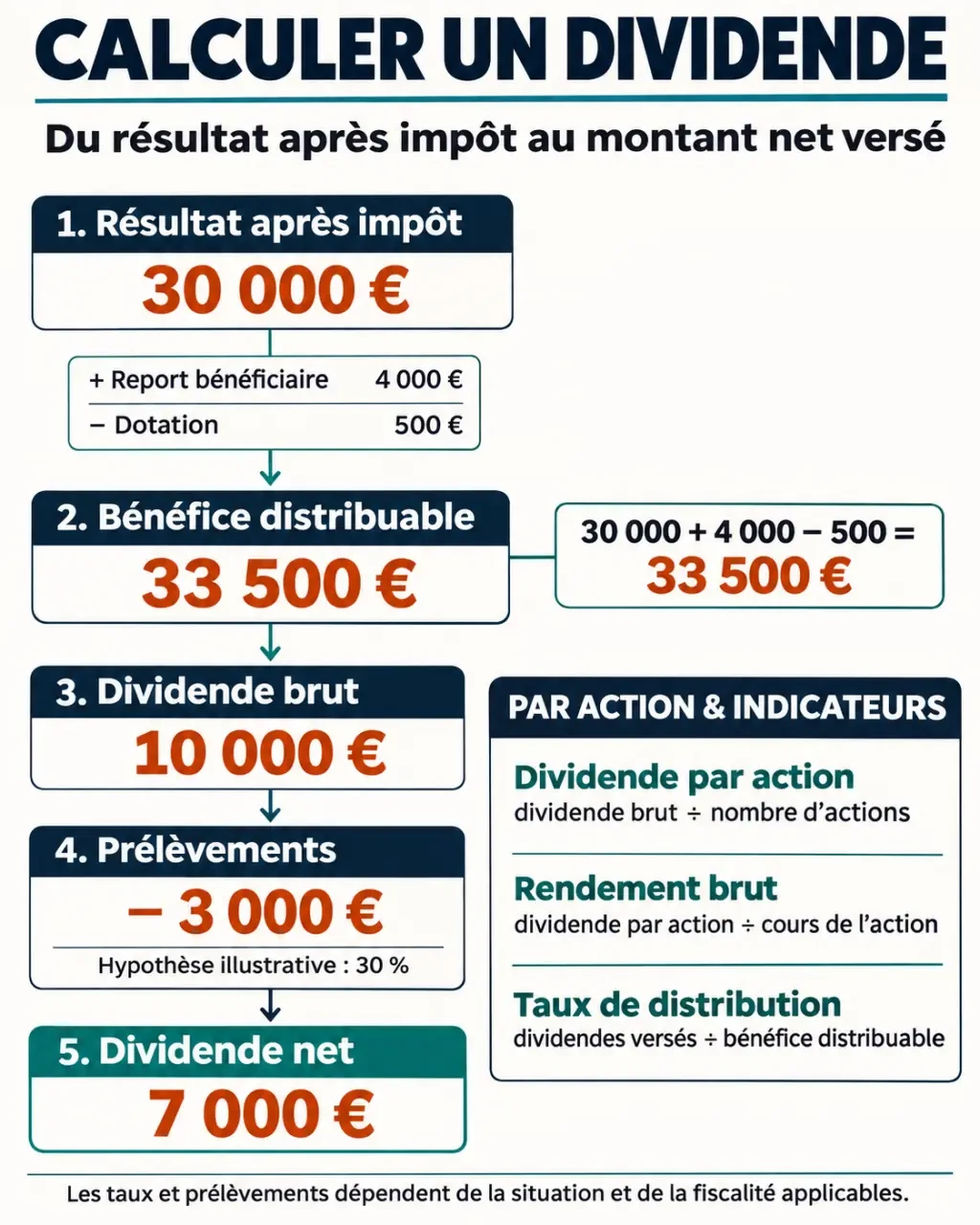
Net paid = gross dividend - levies made on payment. This immediate net may differ from the final net on return of income, in particular in case of option for the scale or dispensation of payment.
Do not choose a rate without checking its application date
A UPF of 30 %, including an income tax advance of 12,8 %. The Entrepreneurs' Corner, in its article indicated as updated on April 5, 2026, mentions a discount of 31,4 %, consisting of 12,8 % of deposit and 18.6% of social contributions. These diverging indications require verification of the rate applicable on the date of payment to the tax administration.
To understand the impact of this audit, here are two calculations on the same gross amount. These are computational assumptions, not two freely selectable rates.
| Crude dividend | Sampling hypothesis | Sampling | Net obtained |
|---|---|---|---|
| 10 000 € | 30 % | 3 000 € | 7 000 € |
| 10 000 € | 31,4 % | 3 140 € | 6 860 € |
Compare PFU and scale according to beneficiary
For a French resident tax individual, the PFU and the option for the progressive scale follow different logics. The comparison should relate to the final tax of the household, and not only to the deduction visible to the payment.
Simulate the levies on your dividends · Estimate the amount of the levies applicable to your dividends and consult the official information of the Urssaf.
| Point to compare | PFU | Progressive scale |
|---|---|---|
| Income tax | Flat rate | Calculation by household income |
| Dividend allowance | No reduction of 40 % | 40 % reduction for eligible distributions |
| Social levies | To be included in the calculation | The tax reduction of 40% to their base has yet to be incorporated. |
| Scope of choice | Standard scheme applicable by default | Overall option for the income and earnings concerned |
The scale may be interesting for some low-taxed households, but the option also affects other relevant financial income. A limited comparison with dividends alone can therefore lead to a bad decision.
Discount exemption and special situations
The exemption concerns the advance payment of 12,8 %, not definitive tax or social contributions. The reference tax income thresholds for the penultimate year are: 50,000 € for a single person and 75 000 € for a couple imposed jointly. The application must in principle reach the paying institution before the 30 November of the year preceding payment. Check these conditions for the year concerned.
For certain self-employed managers, in particular the majority managers of SARL, a fraction of the dividends exceeding a threshold of 10 % social security contributions. The reference base may include, in addition to capital, the issuing premiums and current accounts concerned: simply applying the taxation of a SAS shareholder would be misleading.
Finally, a recipient corporation does not calculate its net as an individual. Subject to conditions, the mother-daughter scheme allows for an exemption of 95 % dividends, with a share remaining taxable. This regime requires a separate analysis.
Calculate the income of a portfolio without confusing the indicators
For one investor, three formulas separate the amount received, the return on the security and the distribution effort of the company.
- Dividend per share = total distributed ÷ number of shares eligible for dividend.
- Gross yield = annual dividend per share ÷ share price × 100.
- Distribution rate = dividends distributed ÷ net profit × 100.
Saxo illustrates these calculations with USD 5 million distributed for 1 million shares, i.e. USD 5 per share. Another example: an annual dividend of USD 3 for a price of USD 60 represents 5 %, i.e. 5 USD annually per 100 USD invested, before taxation. Finally, USD 3 million distributed out of USD 10 million in profit give a distribution rate of 30 % The company retains 70% of its profits.
High yields can also come from falling prices. It does not guarantee the firm's strength or the maintenance of the dividend. See also the dates of secondment, registration and payment: from the secondment, the action buys without entitlement to the next payment.
Prepare a workable simulation before payment
The Urssaf dividend simulator allows you to estimate the levies and compare PPU and scale. Prepare the assigned crude, your status, your tax residence and the information requested about your home. Check its scope: A simulation for a natural person receiving dividends from a company at the IS is not automatically suitable for a beneficiary company or a self-employed manager.
Keep assumptions and date of calculation. Before payment, confirm the distributable amount, the rights of each partner, the applicable rates and the reporting and remittance formalities. The simulator estimates the consequences of a distribution; it does not validate its legality or the final accounts.