


Published by: Elise Caradec — Editor specializing in consulting
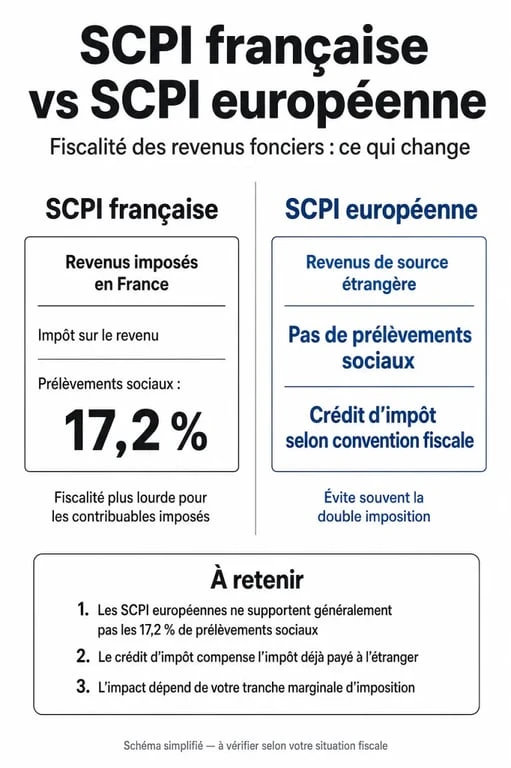
Investing in European real estate via Civil Property Investment Companies (SCPI) is an effective strategy to diversify a heritage. Beyond the pooling of geographical risks, the main attraction lies in a tax framework that is often more favourable than that of property income received in France. The complexity of international conventions and declarative specificities may, however, intimidate. Understanding the mechanisms that govern the taxation of foreign IPCCs allows us to transform a performance opportunity into real heritage optimization.
The fundamentals of international SCPI taxation
When an SCPI holds buildings in Germany, Spain or Ireland, rents are taxed in the country where the property is situated. This is the principle of territoriality. For the French saver, the management company pays local tax on its behalf before paying a net dividend of foreign levies.
Test your knowledge of taxation of foreign SCPIs
Exemption from social levies
It's a major advantage. Unlike French-source property income, which is subject to social levies of 17.2%, foreign-source income is exempt. This rule applies because these revenues do not form part of the CSG and CRDS base in accordance with international tax treaties. For an investor in a high marginal tax bracket (MIB), this lack of social security contributions increases mechanically in the net performance placement.
The principle of non-double taxation
To prevent a French resident from being taxed twice on the same income, France has signed tax treaties with most European countries. These laws provide for two methods of neutralizing double taxation: the tax credit and the effective rate. The aim is to ensure that tax already paid abroad is taken into account when tax is paid in France.
Both methods of eliminating double taxation
The French tax system applies one of the two conventional methods depending on the country of investment. It is necessary to distinguish them to anticipate their impact on your overall taxation.
The tax credit method (Germany, Spain, Italy)
In this scenario, your foreign SCPI revenues are included in your taxable income in France and taxed according to your TMI. However, the French State grants tax credit. This credit is generally equal to the amount of French tax corresponding to these foreign revenues. In practice, this cancels the French tax on these amounts, while using them to determine your overall tax bracket.
The effective rate method (Belgium, Ireland, Portugal)
Here, foreign income is exempt from income tax in France. They are not added to your taxable income. However, they are used to calculate the actual which will be applied to your other income from French sources (wages, pensions, rents). This method preserves tax escalation: your foreign income may change your band, but they are not taxed a second time.
The foreign SCPI stabilizes the tax burden from day one. In contrast to direct real estate investment in France, where the tax burden increases over time, notably by the disappearance of the deductibility of borrowing interest, the international structure preserves the value of each euro distributed. By delegating management to professionals who optimize source levies, you secure sustainable tax efficiency.
How to report your foreign SCPI income
Collectives facilitate the process by providing a Single Tax Printer (IFU) or a reporting guide. Here are the steps and forms to use.
Report your income received abroad (Form 2047) · Access the official form to report your income collected outside France, including the specific annex for Swiss wages.
Form 2047: the basis of the return
Form 2047 is dedicated to income received outside France. You must disaggregate your income according to their geographical origin and the applicable tax method. The amounts on this form are then reported on your main return (2042).
Deferrals on Declaration 2042 and 2042-C
Once Form 2047 is completed, carry forward the amounts in the specific boxes of your tax return:
The Box 8TK in respect of income eligible for a tax credit equal to French tax. The Box 8TI is reserved for exempt income but taken into account in calculating the effective rate. Finally, the Box 4BA receives net property income if you have opted for the actual plan.
If your global property income is less than 15,000 €, you can claim the micro-bottom diet. However, the application of the micro-subsidy to foreign income is complex and often less advantageous than the actual scheme, as it may limit the effectiveness of the conventional tax credit.
Comparative table of fiscal impact
The following table illustrates the difference in tax treatment between a 100% French SCPI and a 100% European SCPI for an investor in a 30% marginal tax bracket.
| Indicator | SCPI France | SCPI Europe (ex: Germany) |
|---|---|---|
| Dividende Brut | 1 000 € | 1 000 € |
| Foreign tax (source) | 0 € | ~ 150 € |
| Social levies (17.2%) | 172 € | 0 € |
| Income tax (TMI 30%) | 300 € | 0 € (after tax credit) |
| Total Taxes | 472 € | 150 € |
| Net Dividend | 528 € | 850 € |
This comparison shows that, for the same gross return, the foreign SCPI offers a higher net return due to the absence of social levies and to local taxation often softer than the French progressive scale.
Points of vigilance and optimization
Attractive taxation of foreign SCPIs requires special attention to secure your investment in the long term.
Impact on Taxation on the Fortune Immobilier (IFI)
The shares of SCPI are included in the IFI base for French tax residents, even if the buildings are located abroad. The value to be reported is the withdrawal value of the shares on January 1, in proportion to the real estate assets held by the SCPI. The French tax administration maintains their inclusion in the base, except in very specific cases provided for by certain conventions.
Management of disposal gains
If your shares are sold, the realized surplus value follows a particular regime. It is generally taxable in the country of situation of buildings. In France, the tax credit mechanism applies to avoid double taxation. It is advisable to retain its shares over a long period of time in order to benefit from the detention allowance, although the latter vary according to local legislation.
The importance of IFU
The quality of the management company is measured by its ability to accompany you during the tax period. A clear and detailed IFU is a valuable tool. Some companies offer simulators or webinars to help partners complete their forms. Do not ignore this aspect when choosing your SCPI, as an error in reporting can cancel the benefits of tax optimization.