


Published by: Elise Caradec — Real Estate Editor
Updated on 2 November 2026
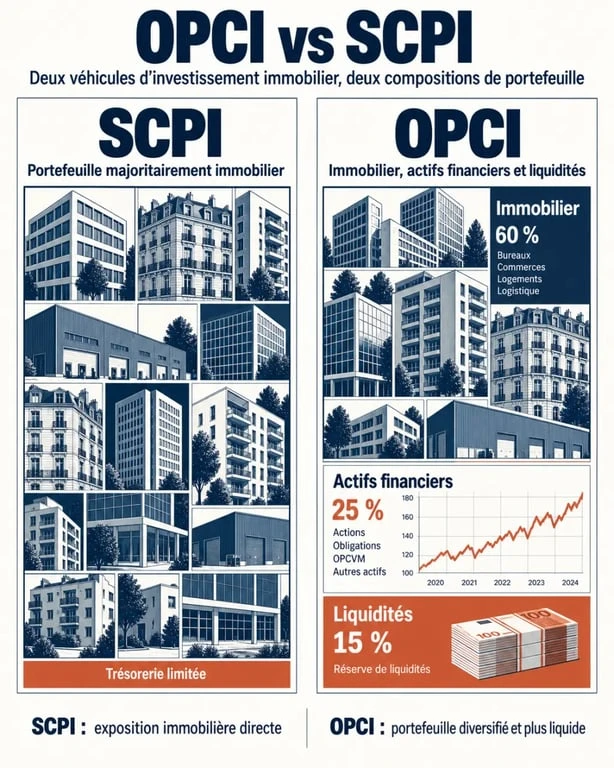
The acronym OPCI means a Collective Real Estate Investment Organization. SCPI means Corporation Civil de Placement Immobilier. These two paper-stone vehicles allow for indirect investment in buildings without buying or managing on-line property. Their main difference is the composition of their portfolio: the SCPI favours real estate, while the OPCI combines real estate, financial assets and liquidity.
Two acronyms, the same principle: investing in multiple property
In both cases, savers subscribe shares of a collective vehicle. The funds raised are used to acquire and exploit real estate assets, often professional: offices, shops, warehouses, hotels or health facilities. Rentals received, after deduction of expenses and expenses, may be distributed to the partners or contribute to the valuation of the shares.
Tax simulator: SCPI, SPPICAV and OPCI
| Support | Tax | Net perceived |
|---|
Details:
• SCPI: TMI + 17.2% PS.
• SPPICAV: PPU 30% (12.8% IR + 17.2% PS).
• OPCI (Life insurance > 8 years): 7.5% after annual allowance.
The SCPI, a company focused on buildings
A SCPI is a civil society that holds real estate assets directly or indirectly. The investor receives shares, usually listed in his name, and delegates the selection of buildings, the search for tenants, the works and the collection of rents to a management company. This company must be approved by the Autorité des marchés financiers, the AMF.
The SCPI often attracts people seeking Potential rent income, with a long placement horizon. It does not guarantee the capital invested or the level of distributions. A rental vacancy, a decline in the value of buildings, unpaid payments or resale difficulties may affect the investment.
A more hybrid real estate portfolio
The OPCI retains a dominant property but is not limited to buildings. Its regulatory composition provides at least for 60% of professional real estate, up to 35 % of financial assets and at least 5 % liquidity. The financial pocket may include shares, bonds or shares of other funds. It provides more flexibility, but also exposes the value of investment to financial market movements.
The term "OPCI" includes, in particular, the SPPICAV, or Investment Company at Preponderance Immobilier à Capital Variable, and the FPI, or Real Estate Investment Fund. SPPICAV is the most common form. The investor generally follows a liquidative value, i.e. the value of the share calculated from the assets held.
OPCI or SCPI: the deviations to look at before subscribing
| Criteria | SCPI | OPCI |
|---|---|---|
| Nature of portfolio | Mostly real estate | Real estate, financial assets and liquidity |
| Common objective | More regular potential income | Diversification and increased flexibility |
| Change in value | Related mainly to the real estate market | Real estate and financial markets |
| Liquidity | Depends on the existence of purchasers or the conditions for withdrawal | Eased by financial pocket and liquidity, without being guaranteed |
| Current mode of detention | Shares held live, often by name | Title account or life insurance contract according to offer |
| Indicative Horizon | Long term, often 8 to 10 years | Also long term, often 8 to 10 years |
Liquidity does not mean immediate availability
The OPCI is often presented as more liquid, as it retains a pocket of liquidity and financial assets more easily transferable than buildings. This does not mean that a redemption will always be instantaneous or that it will intervene at a stable price. When markets are tense, exit requests can be framed and the liquidative value may decline.
A clock makes it possible to understand this difference: real estate evolves over a long time, rhythmic by leases, works, negotiations and sometimes slow divestitures. Financial assets react daily. In an OPCI, these two rhythms coexist. The financial pocket can help finance buybacks, but it also transmits to the investment market accelerations and declines. The liquidity is a management mechanism, not a capital promise available without variation.
Potential yield or apparent stability: avoid the wrong shortcut
There is no universal answer to the question of placement « most profitable ». A SCPI can distribute income from rents, while an OPCI combines real estate income, financial performance and changes in the value of its assets. Past performance does not prejudge future performance. Therefore, a posted return is not sufficient to measure the real risk.
Comparing two products requires an examination of the assets held, debt, subscription and management fees, exit conditions, distribution policy and geographical and sectoral exposure. For OPCI, the distribution rule provides at least 85% of redistributed income, but the share of financial market performance can remain fluctuating.
Taxation: Holding medium counts as much as the acronym
Taxation does not depend solely on the choice between OPCI and SCPI. It varies according to the shape of the vehicle, the nature of the income and especially the envelope retained. This point deserves to be examined before subscription, as it can change the net income actually received.
SCPI held on-line: land and social income
Revenues distributed by a SCPI held on-line are normally property income. They are added to other taxable household income according to the progressive income tax schedule, from 0% to 45% depending on the marginal tax bracket, plus 17.2% of social contributions. The shares also form part of the property tax base where the assets concerned exceed the applicable thresholds.
An SCPI invested abroad may be treated differently according to tax treaties. It is then necessary to check, country by country, the taxation of income and mechanisms to avoid double taxation.
OPCI: distinguishing SPPICAV, FPI and life insurance
A SPPICAV usually generates income from movable capital, which may be subject to the single flat-rate levy on 30 %. This rate includes 12.8% of income tax and 17.2% of social contributions. A more rare IPF is closer to the land income system. Therefore, the OPCI does not have a single tax.
When an OPCI is housed in life insurance, the taxation of this envelope applies to withdrawals. The taxable share is taxed at 12.8% before 8 years and 7.5% after 8 years, under the terms of the contract, with an annual reduction of 4 600 € for a single person and 9 200 € for a couple. However, the real estate portion of an OPCI remains covered by the IFI.
Which choice according to your need for savings?
The SCPI may be suitable for a saver who primarily searches for real estate exposure and potential distributions, without itself providing rental management. It requires accepting an exit that can take time. In direct detention, its taxation may also be heavy for households already heavily taxed.
The OPCI is more suitable for a person who accepts a more sensitive value in financial markets in return for wider diversification and potentially improved liquidity. It can also be studied in the context of life insurance, when this support is available and consistent with the heritage strategy.
- You focus on potential revenues: Review the SCPI, the quality of its buildings and its distribution policy.
- You are looking for an allocation combining real estate and financial markets: look at the actual composition of the OPCI and its volatility.
- You may need your money soon: none of these investments replaces a precautionary savings available.
- You hesitate between the two: Combining them can diversify performance engines, provided you do not multiply the costs or exceed your acceptable level of risk.
Before you subscribe, read the key information document, fees, purchase terms and the vehicle's annual report. An investment in OPCI or SCPI is being prepared over a period of 8 to 10 years. It must become part of your overall assets, after the establishment of a liquidity reserve and the assessment of your tax situation.