


Published by: Elise Caradec — Editor specializing in consulting
One SCPI tax allows for collective investment in new or old housing, while seeking a tax advantage related to rental or work. It is mainly intended for savers who wish to delegate property management and who pay a sufficiently high and regular tax. In return, this investment involves a long horizon, costs and sometimes slow resale.
A tax SCPI is not a return SCPI with a simple tax bonus
A civil real estate investment company, or SCPI, collects capital from several partners to purchase and operate a real estate stock. In a SCPI tax, the wealth is mostly residential and selected to open up access to a challenge mechanism, in the form of a tax reduction or a deduction from taxable income.
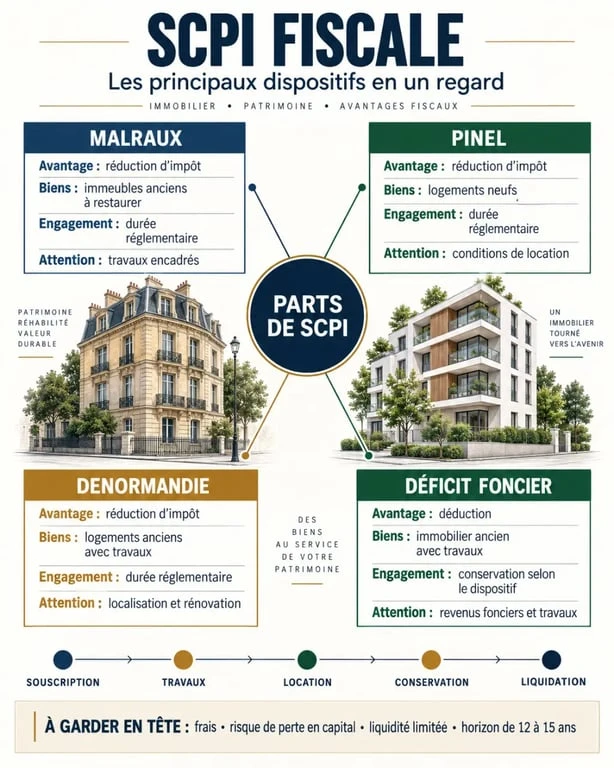
The management company supports the entire real estate cycle: acquisition of buildings, monitoring of works, leasing, relationship with tenants, accounting and, eventually, sale of assets. The partner holds shares, not a specified apartment. It collects its possible share of revenue and benefits from the tax treatment associated with the operations carried out by the SCPI.
Tax advantage goes before immediate income
A performance SCPI seeks first to distribute regular rents from offices, shops, warehouses or housing. A tax SCPI favours compliance with the conditions of a scheme: duration of rental, nature and amount of work, location, applicable ceilings or retention of shares. As a result, distributed revenues may be more modest, especially when buildings are under renovation or are subject to supervised rents.
A distinction must be made between tax reduction a tax deduction. The reduction directly reduces the tax calculated. The property deficit reduces taxable income and, according to applicable rules, property income. Its interest therefore depends more on the marginal tranche of investor taxation.
Pinel, Malraux, Denormandie or land deficit: choose according to tax situation
The right device is not chosen from a displayed rate. It depends on the nature of the tax to be reduced, the personal calendar and the ability to immobilize its savings. The following table compares the main logics.
| Device | Tax logic | Real estate | Duration and focus |
|---|---|---|---|
| Pinel | Tax reduction | New or similar housing | Former scheme: new subscriptions are no longer open since 1 January 2025. Existing SCPIs may, however, remain in management. |
| Malraux | Tax reduction of up to 30% | Old buildings in protected and restored areas | Minimum rental of 9 years; work and location are decisive. |
| Standard | Tax reduction | Old to renovate in eligible cities | 6, 9 or 12 year commitment; the work must represent at least 25% of the total cost. The scheme is indicated as extended until 31 December 2027. |
| Land deficit | Deduction of costs and work | Old buildings to renovate | Particularly relevant in the presence of land income; 1− charge against total income is limited to 10,700 € per year. |
Tax cap may reduce the interest of the transaction
Tax cuts for certain schemes fall within the general tax niche cap set at 10 000 €. Before joining, add together the benefits already used, such as home employment, previous investments or other reductions. A theoretical economy that you cannot use does not improve the return on investment.
The land deficit often responds to another situation, that of a taxpayer who already receives heavily taxed land income. It should not be confused with a tax reduction. The analysis should cover the actual share of work, deductible expenses and timing of imputation.
Duration, costs and liquidity: constraints to encrypt before subscribing
The defiscalisation does not remove real estate risks. Capital is not guaranteed, nor rents, and the value of shares may decline. A tax SCPI is an unlisted real estate investment, designed for the long term.
Why an early exit can be expensive
The conservation of shares frequently extends over a total period of 12-15 years. This period may include collection, work, lease imposed by the scheme and the gradual liquidation of the assets. Selling before the term can compromise the tax advantage and involves finding a buyer in the secondary market. The price obtained may be lower than the subscription price, especially when demand is low or the charges remain heavy to absorb.
A tax SCPI immobilizes saving during a succession of difficult steps to shorten: acquisition, authorizations, construction site, delivery, rental, duration of commitment, then disposal. A tax reduction over a year is therefore not sufficient to assess the transaction. The exit scenario must also be considered 15 years later. The savings invested must remain separate from that which finances family projects, unforeseen events or a possible decline in income.
Net performance is not limited to dividend
Subscription documents detail the Subscription fees, management and, as appropriate, disposal costs. Their impact is particularly marked when investment is quickly resold. Also consider the period of use, often between 3 and 6 months, during which the newly subscribed shares usually do not generate income.
To assess the result, add the actual usable tax savings, the actual net revenues collected and the resaleable value. Then transfer fees, income taxes and the potential cost of the credit. Land income is in principle taxed on the progressive scale and supports 17.2 per cent of social contributions. For a heavily taxed household, this tax can significantly reduce net flow.
Which investor does a tax SCPI fit?
This investment is intended primarily for a tax-taxed taxpayer who identifies a specific tax need, accepts long-term detention and does not wish to seek property, follow work or manage tenants. It may also be of interest to a holder of high land income when the land deficit corresponds to its level of taxation.
It is less appropriate if the priority objective is to quickly collect income supplement, if savings may be needed in the short term or if income tax is low. Investing only because a reduction is available amounts to letting taxation guide the entire wealth. The tax advantage must complement a coherent strategy, not replace it.
A concrete method for selecting and subscribing
Subscriptions can be made in cash or on credit. Bank financing may have a heritage interest, but it increases the debt risk and does not automatically make the transaction relevant. Life insurance and dismemberment may be considered for some SCPIs, but their compatibility with the tax advantage sought must be verified on a case-by-case basis. The advantage holder and the investor must comply with the rules of the scheme.
Documents and criteria for consideration
- The information note, the articles and the subscription bulletin, to understand the risks, costs and conditions of disposal.
- The annual report, the quality of the heritage, the level of work, the rate of financial occupation and the value of reconstruction when available.
- The transaction schedule: subscription date, tenure period, start of lease, commitment period and liquidation strategy.
- The division between acquisition, work and costs, as it conditions the tax advantage and the economy actually achieved.
- The management company, its experience in renovated residential real estate and the consistency of its exit policy.
Before subscribing, simulate at least three scenarios: retention to the end, decline in distributed revenues and discount resale. A wealth management advisor or tax professional can check the adequacy of the scheme, capping tax niches, other household income and your liquidity targets. The tax SCPI then becomes a heritage tool evaluated over its entire duration, not a mere expense incurred before the end of the year.