


Published by: Elise Caradec — Editor specializing in stock exchange
If you hesitate between a PEA and a title account, here is the short answer: PEA is generally the best choice for long-term investment in European equities, thanks to a reduced taxation after 5 years. The ordinary securities account (CTO) takes over as soon as you want to invest outside Europe, exceed 150 000 € or transmit a wallet. Both do not exclude: many savers end up cumulating them.
What really distinguishes the two envelopes
The EAP (Plan d'Epargne en Actions), created in 1992, is a tax framework designed to direct savings towards European businesses. CTO, on the other hand, has no particular purpose: it is the basic account for buying and selling securities, without restriction. The EAP can thus be seen as a more framed tax envelope, where the CTO offers total freedom but without tax advantage.
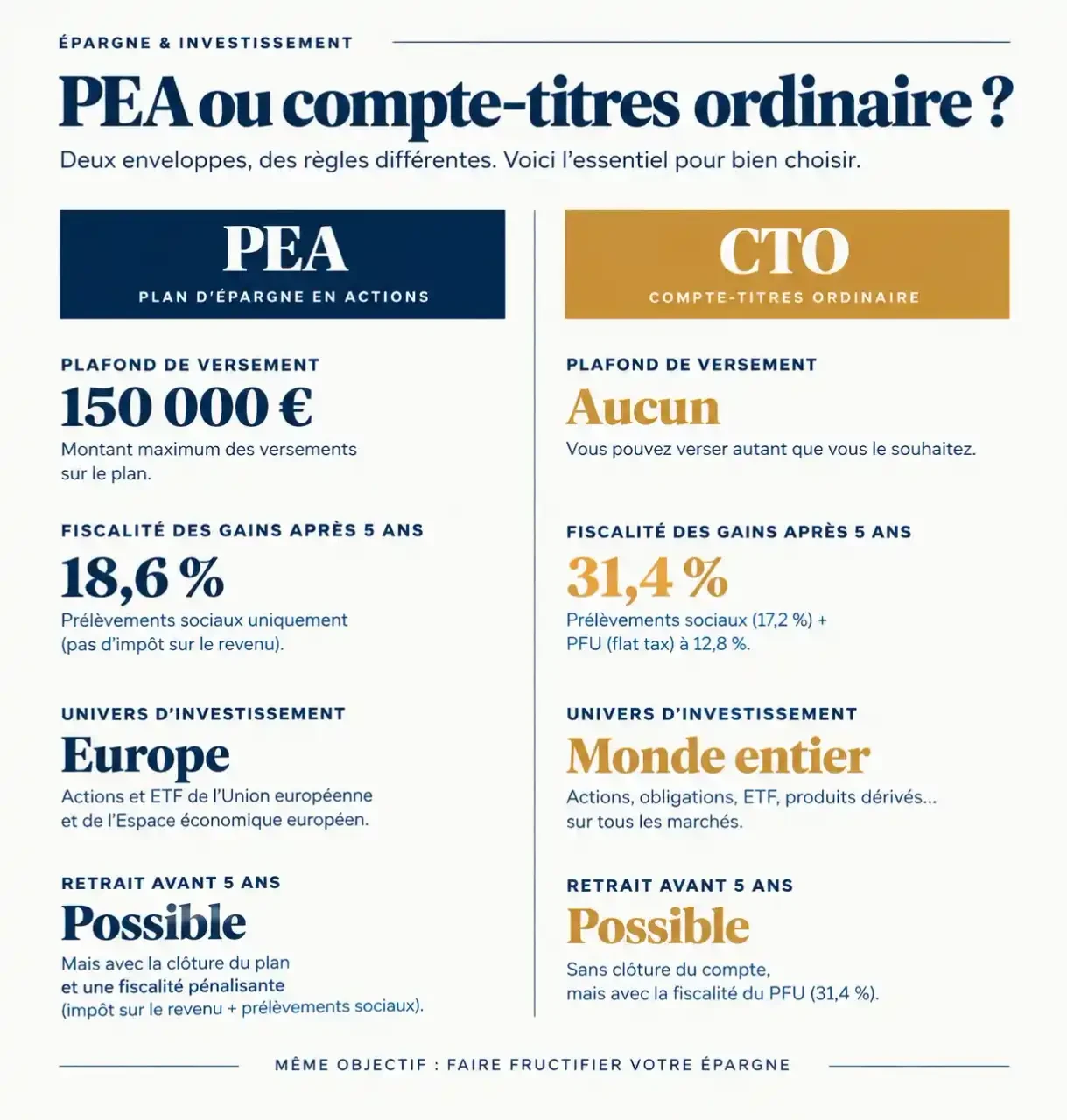
| Criteria | PEA | CTO |
|---|---|---|
| Payment ceiling | 150,000 € (PEA-SME: 225 000) € additional) | None |
| Taxation of earnings | After 5 years: income tax exemption, 18.6% of social contributions | PFU from 30 to 31.4% (12.8% DIR + 18.6% Social contributions), or progressive optional scale |
| Investment universe | EU/EEA actions and eligible ETFs | All titles, all world places |
| Withdrawal before 5 years | Closing of the plan in principle, with legal exceptions | Free, at any time |
| Number of accounts | 1 classical PEA per person | Unlimited |
| Minimum payment | About 80 € | None |
| Brokerage fees | 0.5 % caps in online order (CAPTE law) | Free, according to broker |
Taxation: the gap widens over time
PEA rewards patience
After 5 years of detention, EAP earnings are exempt from income tax. Only 18.6 per cent of social contributions remain due. Since 1 January 2018, the rate applied is that in effect at the time of withdrawal, and no longer that of the year in which the gain was realized: « historical rate » disappeared.
The counterpart is clear. A withdrawal before 5 years normally results in the termination of the plan, unless provided for by law such as dismissal, invalidity, early retirement or the resumption of business. The EAP therefore assumes that it does not need this money in the short term.
The CTO charges each assignment, without conditions of duration
On a CTO, each capital gain realized and each dividend is subject to the UFP of 30 to 31.4%. The option for the progressive scale remains possible: it can become interesting if your marginal tax bracket is low, and it is a point to simulate each year before reporting. In return, no time constraint: you withdraw when you want, without closing anything.
Another point not to be overlooked: the tax envelope is a bit like a reservoir. In the PEA, all that remains, dividends and reinvested capital gains, accumulates without being imposed on each arbitration; tax only comes out. On a CTO, each sale triggers taxation, even if you buy something else immediately. For an investor who often re-arbitrates his portfolio, this difference in mechanics sometimes weighs more than the spread of interest rates.
Investment universe: Europe or the whole world
The PEA shall give access to the shares of companies headquartered in the European Union or the EEA, as well as to eligible ETFs and UCITS. This includes some ETFs replying to MSCI World or MSCI ACWI, despite a strong exposure in the United States: eligibility depends on the structure of the fund, not the countries in which it invests. Always check the mention « Eligible PEA » before buying.
The CTO does not impose any geographical limits. It is the only way to buy directly American or Asian shares, but also more risky products such as warrants, turbos or CFDs. On this last point, caution is required: some brokers show that 72% or 76% of individuals lose money with CFDs.
Which choice according to your profile?
Beginner or young active: start with PEA
For a first long-term investment, such as a diversified ETF that feeds every month, the PEA is difficult to beat. Even if you're not ready to invest much, open it early with the minimum: it's the opening that triggers the 5-year meter. This « date taken » avoid starting from scratch later. 18-25 year olds attached to the tax home can also look at the Youth EAP, capped at 20,000 €.
Trader active or international investor: CTO imposes
If you target U.S. values, derivatives or frequent movements, the PEA becomes too restrictive. The CTO also allows the plan to be withdrawn freely, without fear of closure. Compare the brokerage fees, which are not capped as on the PEA.
Wealth transfer: the advantage of CTO
In the event of a donation or succession, the latent surplus value of a CTO is purged. Let's take 20,000. € investment worth 80,000 € : a sale before transmission generates 60,000 € capital gain of 18,840 € 31.4% taxes. Directly transmitted, this portfolio is not taxed on this surplus value. To be seriously considered for an important heritage and a transmission horizon.
Cumulate PEA and title account: the most common strategy
Nothing prevents both from being held. A simple breakdown consists of housing in the EAP the long-term base (ETF European actions or eligible world), as long as the ceiling of 150 000 € is not achieved, then use the CTO for what the PEA does not allow: values outside Europe, investments beyond the ceiling, positions more speculative or intended to be transmitted. A couple can hold up to four plans (two AEPs and two AEP-SME/ETI), which expands the margin.
To decide, ask yourself three questions: do I need this money before 5 years, do I want to invest outside Europe, and does my assets exceed the EAP ceiling? Three « No » designate the EAP alone. One « yes » In the second or third case, add a CTO. Once the choice is made, keep in mind the MIF questionnaire at the opening: it evaluates your experience and risk tolerance, and it is mandatory regardless of the broker.