


Published by: Elise Caradec — Real Estate Editor
Updated on 2 November 2026
Investment in shares of SCPI, often referred to as Paper stone, imposes itself as a robust alternative to classic rental real estate. At a time when savers are seeking to reconcile performance and delegated management, this investment provides access to a diversified housing stock — offices, shops, logistics, health — without the constraints of rental management. However, performance and risk remain vigilance points for investors wishing to invest their capital in a changing economic environment.
What is a SCPI? Essential in 30 seconds
A Société Civile de Placement Immobilier (SCPI) is an investment vehicle that collects funds from savers to build and manage a professional real estate asset. In exchange for your contribution, you receive social shares that entitle you to a share of the rents received, less management fees.
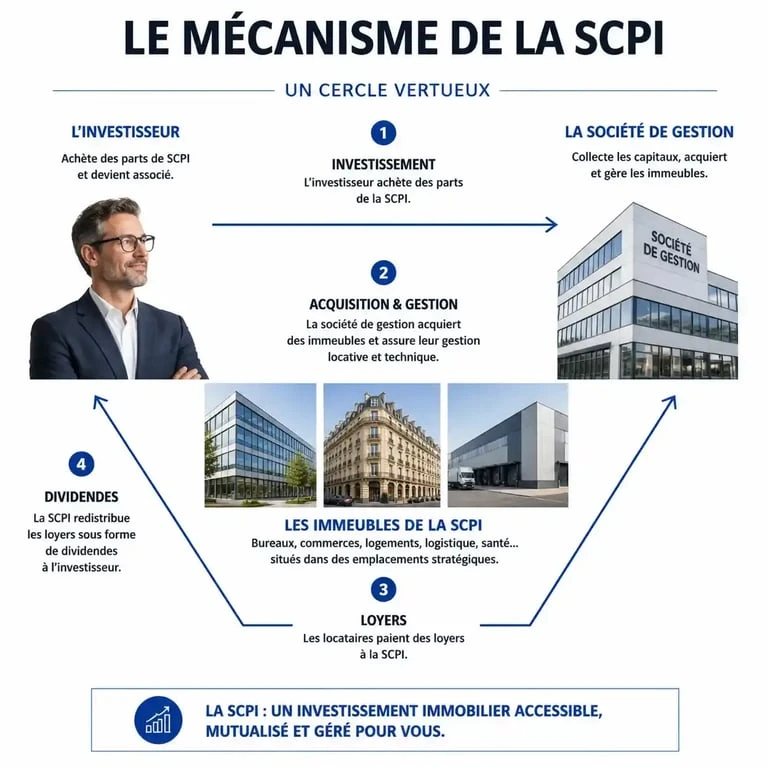
The operation is simple: a management company approved by the Autorité des Marchés Financiers (AMF) manages all operations. It manages the acquisition of buildings, selection of tenants, renovation and maintenance. Your role is passive: you perceive dividends, usually paid quarterly, without having to intervene on the day-to-day management of assets.
The benefits of IPSCs: Why savers join them
The popularity of SCPI is based on several pillars that meet the traditional barriers of traditional real estate:
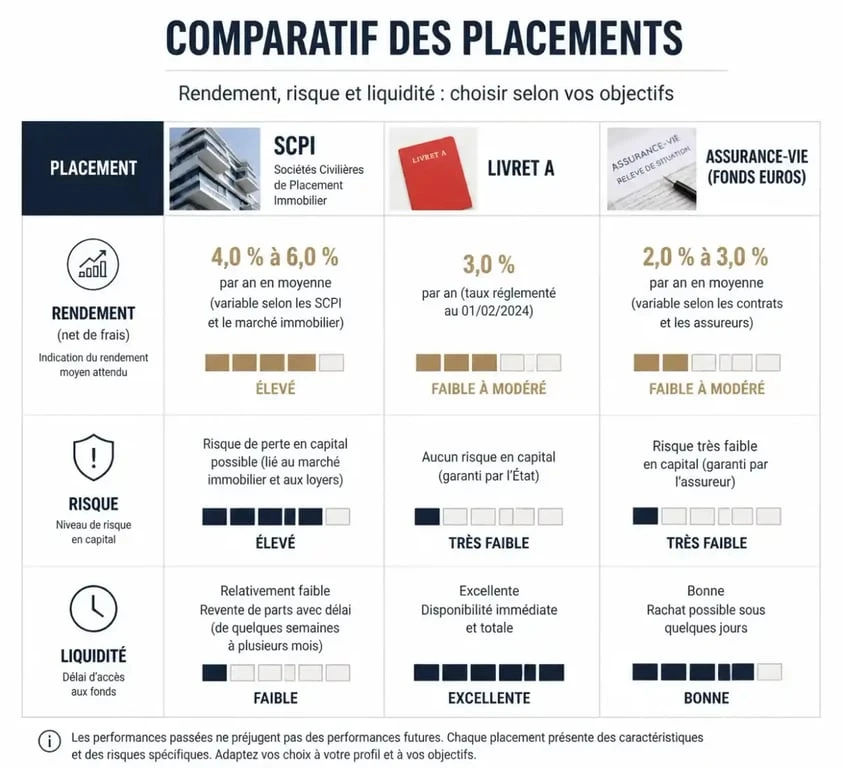
LFinancial accessibility is a major asset. Unlike a live real estate purchase that requires significant input, the SCPI entry ticket is very accessible, often between 100 € and 200 € by part. The delegated management free the investor from any concerns of rental vacancy, management of unpaid payments or follow-up of works, since the management company takes care of everything.
The immediate diversification is also a strong point. By investing in a single SCPI, you become a co-owner of a park composed of tens or even hundreds of buildings, geographically and sectorally distributed. Finally, the risk pooling, thanks to the multiplication of tenants and sectors of activity (health, logistics, offices), allows to smooth rental risks and secure income over the long term.
This investment is a lever to structure its assets. By optimizing each euro invested, it is possible to transform a dormant savings into a regular revenue engine, while adjusting the strategy according to its time horizon.
Constraints and risks before investing
Any financial investment carries risks. Past performance does not prejudge future performance.
Capital loss and lack of collateral
Capital invested in a SCPI is not guaranteed. The value of the shares may vary both upwards and downwards, depending on the valuation of the property held by the company. A decline in the professional real estate market directly impacts the value of your investment.
Limited liquidity
SCPI is not a liquid product like a publicly traded share. In the case of variable capital SCPIs, resale depends on the ability of the management company to find new buyers. In fixed capital SCPIs, the market is more limited, with sometimes long resale times.
Subscription and management fees
The investment in SCPI bears subscription fees (usually between 8% and 12%) and annual management fees (approximately 10% of the rents received). These costs must be included in your cost-effectiveness calculation, which requires a long holding horizon, ideally over 8 or 10 years, to amortize these costs.
What return will be expected in 2026?
The SCPI market has shown significant resilience in recent years. According to ASPIM data, the average distribution rate was 4.52% in 2023, before increasing to 4.72% in 2024. For 2025 and 2026, projections remain encouraging with an estimated average of 4.91%.
Key figures and official statistics of the SCPI market · See the ASPIM Reference Report for an analysis of the capitalization, number of companies and overall evolution of the SCPI market.
It is necessary to distinguish between two key indicators: distribution rate, which represents the relationship between the gross dividend paid and the price of the share on 1 January, and TRI (Internal Performance Rate), which measures annualized performance over a given period by including capital gains.
While some thematic SCPIs perform more than 7%, these levels of performance are accompanied by greater risk-taking on the nature of the assets or geographic area concerned.
Taxation of SCPIs: what changes your final opinion
Income from IBCCs is considered land income. They are subject to income tax according to your marginal tax bracket (MI), plus social contributions of 17.2%.
To optimize this tax, several strategies are commonly used. Llife insurance allows you to house your shares of SCPI in a contract benefiting from advantageous taxation while benefiting from better liquidity. The subdivision of property, by buying bare ownership of shares, offers an immediate discount on the purchase price, often around 65% of the total value over 10 years, without collecting rents during the period of dismemberment. Finally,investment on credit uses leverage to build a real estate estate with a reduced saving effort, while deducting interest on borrowing from your property income.
Our final opinion: Is SCPI a good investment for you?
The SCPI is a relevant investment for savers seeking to diversify their heritage with a medium to long term horizon. It is adapted to profiles wishing to collect additional income without the burden of rental management.
However, it must not constitute all of your investments. Due to entry costs and the volatility inherent in the real estate market, it must be integrated into a diversified overall allocation, including monetary products, shares or life insurance in euro funds. Before subscribing, always check the strategy of the management company, the history of its distribution rates and the composition of its housing stock.