


Published by: Elise Caradec — Insurance Editor
Accident insurance may seem unnecessary when social security, mutual insurance and home insurance already appear sufficient. However, these protections do not answer the same question: who takes care of the lasting consequences of an accident to which you are a victim, when no one can be identified? The Life Accident Guarantee (LAG) is optional. Its interest depends on your family situation, income, savings and contracts you already hold.
Why VAG is neither indispensable nor superfluous in principle
Life insurance is a personal insurance designed to protect the insured person's privacy. Depending on the contract, it may occur after a fall at home, burn, DIY or gardening accident, sports injury, school accident, assault, natural disaster or medical accident. Occupational accidents and traffic accidents are generally covered by separate schemes or guarantees. Their treatment must therefore be verified under contractual conditions.
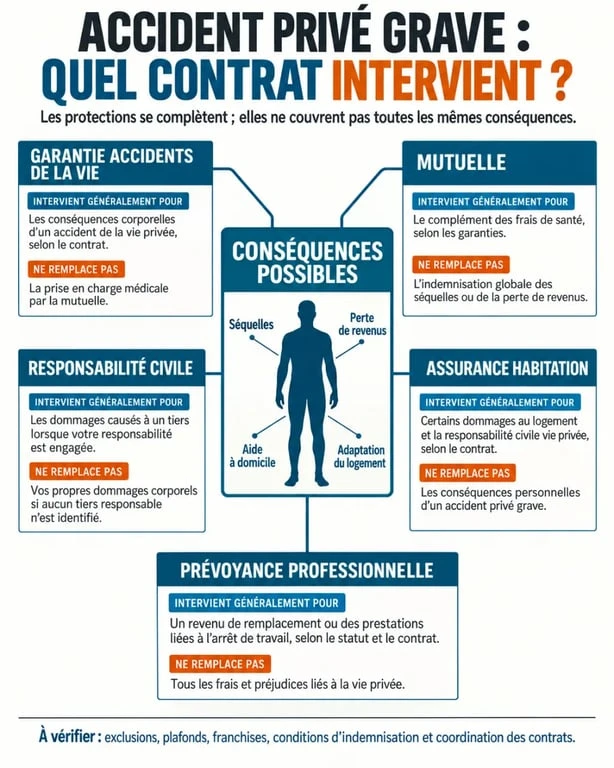
Its usefulness is not measured by the number of small incidents in everyday life, but by the ability of the household to absorb a serious accident. Prolonged hospitalization, sequelae, reduced income or temporary inability to care for children can disrupt a budget, even when care is properly reimbursed. The GAV targets the consequences that exceed the medical bill.
The real risk: being victimized without being able to turn against someone
If a third party hurts you and his or her liability is established, his or her liability insurance can compensate your damages. On the other hand, after a fall in your stairs, a break in a move or a bicycle injury without any other person involved, no person responsible can be involved. Civil liability included in home insurance mainly protects against damage caused by you talk to others, not against those you suffer. This difference explains in which cases life accident insurance can be useful.
A protection against your self-insurance capacity
To give up a VAG is to keep the financial risk yourself. This decision can be consistent for a person with a solid saving, stable income in the event of a break and an already extended foresight. Conversely, a two-earner household, an independent or a single parent can hardly absorb a long period of disruption. The question, therefore, is not just whether you often have accidents, but how to measure the consequences of an accident that would permanently reduce your autonomy or income.
What other contracts actually cover
Confusion between insurance is common, as several contracts may occur after the same event. However, they do not finance the same posts or damages. Comparing guarantees avoids duplicates, but also detects missing protection.
Understanding compensation for life accidents · Discover the accidents covered by the life insurance, the conditions of compensation and possible remedies.
| Protection | Main role | What it often leaves to your burden |
|---|---|---|
| Sickness and mutual insurance | Reimbursement of care, within limits | Loss of income, moral damage, home adjustment and daily help |
| Civil liability privacy | Compensation for damage to a third party | Your own injuries when no responsible third party exists |
| Home insurance | Housing, property and civil liability according to guarantees | The body sequelae of the occupant after a domestic accident |
| Professional provision | Maintenance of income or payment of capital according to status and contract | Certain personal injuries and family assistance |
| School insurance | School-related accidents and guaranteed activities | Comprehensive protection of privacy, especially for adults |
| GAV | Damage suffered by the insured victim, according to the terms of the contract | Excluded events, claims below threshold and exceeded ceilings |
Thus, mutual assistance is not necessarily sufficient in the event of a serious accident. She mainly takes care of the rest to pay for the care. The VAG may supplement this protection by compensation for the physical, economic and moral consequences. It may also provide for Home assistance, carrying meals, caring for children or animals, psychological support and school support.
Compensation: the threshold, expertise and harm to be examined
The promise of compensation must always be reconciled with the terms of the contract. Some schemes provide for lump sum capital in the event of death or permanent injury to physical and mental integrity. Others apply an indemnity logic, which evaluates the harm actually suffered. This second approach can take into account the impact on working and personal life, within the limits of the guarantee ceiling.
AIPP, IPP and consolidation: key concepts
After treatment, health generally needs to be stabilized. This step is called consolidation. Medical expertise can then assess the permanent impairment of physical and psychological integrity (AIPP), or partial permanent disability (IPP). The rate is set on a scale of 0 to 100%. Many contracts, however, trigger compensation only beyond a disability threshold provided for in the general conditions. A daily injury can therefore not be compensated if this threshold is not met.
Before signing, check the services provided after the accident. The contract may include back-to-home assistance, ergonomie evaluation of housing, travel care, a relay for family tasks or assistance in re-entry into employment. These benefits meet specific needs when the person cannot immediately resume his or her usual organization.
Posts that can count after an accident
According to the formula, compensation can cover physical, aesthetic, moral or pleasure damage, i.e. the lasting deprivation of a valued activity. It may also include loss of income, accommodation or vehicle, search and rescue costs, funeral expenses and a death capital paid to eligible beneficiaries. Daily financial assistance in case of hospitalization may also be provided. Some offers are made on the second day of hospitalization.
Profiles concerned and situations where subscription is discussed
A family formula deserves special attention when children, parents and sometimes ascendants living under the same roof can be covered. It can make sense for a family that regularly practises sports or lives in a home where DIY and gardening are common. Domestic accidents represent a real risk: almost 10 million domestic accidents occur each year and almost 20,000 deaths are associated with them.
- Parents of minor children: assistance, school support and the organisation of the home may weigh as much as the allowance.
- Self-employed and self-employed: Check income continuity, as professional protection may be incomplete.
- Seniors and Family Caregivers: A fall may result in a need for human assistance, equipment or development.
- Sporters, DIYers and Gardeners: control excluded sports, competitive practice and activities considered to be at risk.
- Single persons: Home assistance can prevent an accident from causing a temporary break in autonomy.
Subscription may be less priority if you already benefit from full insurance, personal accident insurance covering private life, a solid salary and available savings. The decision must be based on an inventory of guarantees, not a rule valid for all.
Check exclusions and know how to react after an accident
Life accident insurance loses its interest if it does not cover your risks or if its threshold is too high. Read exclusions related to intentional acts, alcohol or narcotics, pre-existing diseases, sports at risk, competition, age limits and stays abroad. Some contracts cover stays of less than three months under conditions. This extension is never automatic.
The checklist before comparing two formulas
- List the people actually covered and their status in the home.
- Raise the AIPP or IPP threshold, the compensation ceiling and the lump sum or compensation scheme.
- Compare sports, medical and geographic exclusions.
- Check assistance services, possible waiting times and death guarantees.
- Confront these elements with your mutual, housing, school, foresight and work contracts.
Report without delay and document the consequences
After an accident, notify the insurer within the contract period. A delay of five working days is frequently mentioned. Keep medical certificates, hospital records, prescriptions, proof of expenditure, work stoppage certificates and proof of assistance needs. During the medical examination, describe the practical difficulties: gestures become impossible, necessary help, professional consequences and abandoned activities. In the event of disagreement with the proposed evaluation or offer, a challenge, counter-expertise or mediation may be considered.
In the end, life accident insurance is neither compulsory nor adapted to all profiles. It becomes relevant when it protects a specific gap: the consequences of a private accident on autonomy, income and organisation of the home. Compare thresholds, ceilings and exclusions With the assistance services makes it possible to decide on a concrete basis, rather than relying on the contribution alone.