


Published by: Elise Caradec — Editor specializing in stock exchange
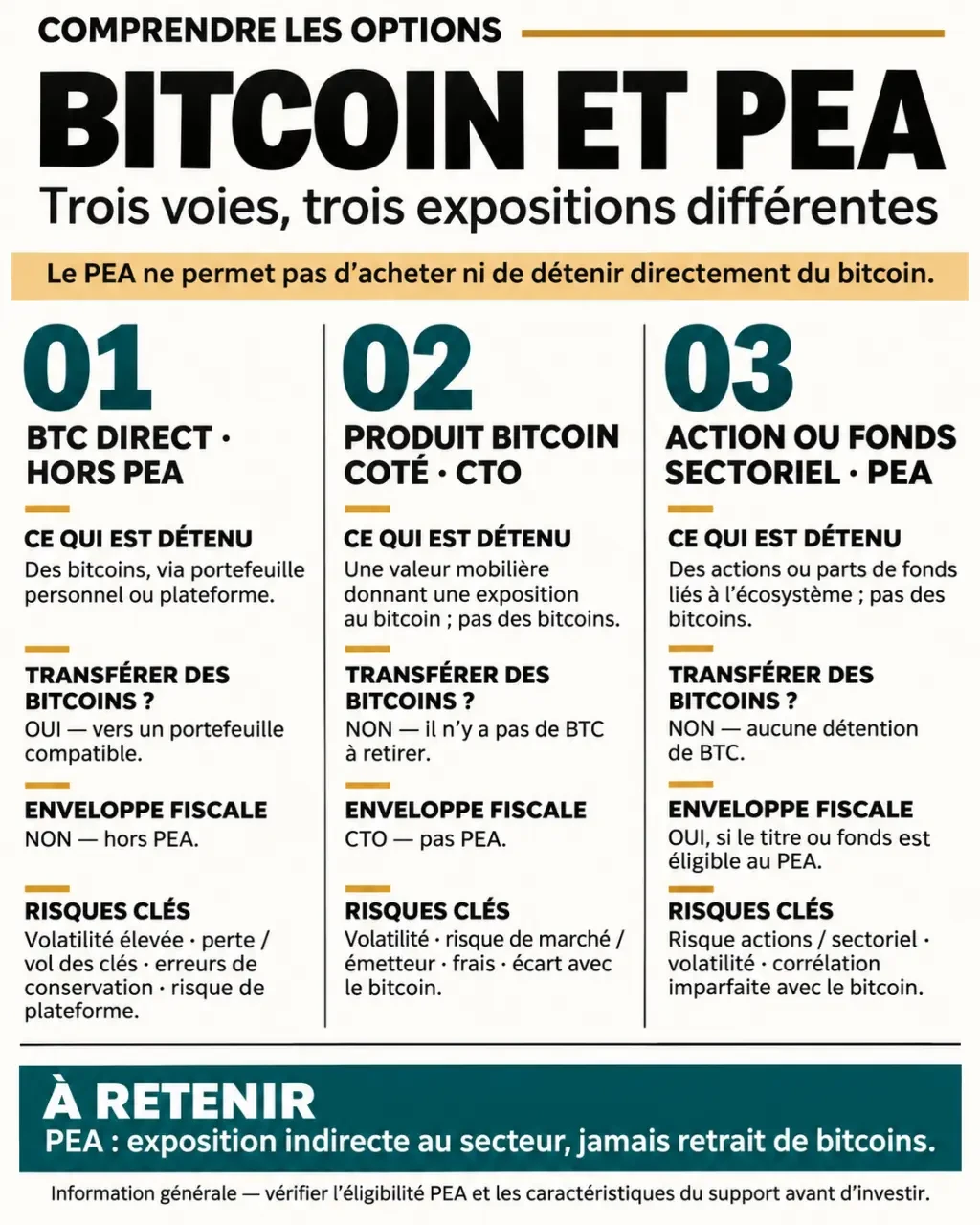
You can't buy bitcoin directly in a PEA, or house an ETF or EFN that directly replicates its course. The share savings plan hosts securities that meet specific criteria, not crypto-assets. Indirect exposure is still possible through certain undertakings or eligible funds, but it does not replace the holding of BTC.
To choose between PEA, ordinary securities account and direct purchase, the first question is simple: do you want to own bitcoins, track their prices or invest in companies in the sector?
Why Bitcoin stays outside the PEA
Established in 1992, the EAP aims to direct savings towards businesses, particularly European ones. It may accept shares of companies established in the European Union or in certain Member States of the European Economic Area, subject to conditions, as well as funds complying with the applicable rules.
For certain collective investment undertakings, eligibility is based in particular on an investment of at least 75 % in eligible securities. A bitcoin is neither an action nor a share of funds meeting these requirements. Its exclusion is therefore due to its legal nature, not to its volatility alone.
The same reasoning applies to products that follow directly the Bitcoin: a listing in stock exchange, a trading in euros or a European home is not enough to make an instrument compatible with the PEA.
There are many ETFs eligible for the PEA that provide exposure to foreign markets through their replication structure. This does not mean that any underlying becomes accessible: synthetic replication is not a right-hand pass to house a bitcoin ETF in the plan.
BTC, ETF, ETF and shares: what you actually buy
Direct purchase gives access to bitcoins
By purchasing BTCs on a platform, you can transfer them to a personal portfolio if the service allows. As long as they remain with the provider, their retention depends on its arrangements and contractual conditions. With a wallet whose private keys you control, you take over the security of access and backup.
Official Guide to Understanding and Using the EAP · Discover the rules, operation and tax benefits of the Share Savings Plan through the AMF.
A listed product gives a financial exposure
An ETF is a listed fund. Bitcoin cash product, often called spot, seeks to track the price of the underlying asset. An ETF using futures contracts obtains its exposure by derivative instruments: its performance may deviate further from the spot price, notably due to the renewal of contracts.
An EFN, for Exchange Traded Noteis a debt obligation. It carries a risk related to the issuer, even where collateral exists. In Europe, many Bitcoin products are marketed under nearby names: you have to read their legal structure rather than rely on the word « ETF ». Holding these titles usually does not give private keys or the possibility to remove BTCs to its wallet.
One action remains a holding in a company
A company holding Bitcoin in its treasury, sometimes called Bitcoin Treasury Company, remains a listed company. It also depends on its debt, governance, securities issues and other activities. The shareholder does not have a direct right in the company's bitcoins.
Three investment routes, three different trade-offs
The right support depends on the desired exposure, but also the responsibilities you accept. The following table distinguishes the main solutions without presuming their suitability for your situation.
| Solution | What you hold | Access and costs to be checked | Specific risk |
|---|---|---|---|
| Direct purchase outside PEA | BTC, with delegated or personal retention | Platform, transaction fees, spread and withdrawal | Claimant's failure or loss of access |
| Bitcoin product on CTO | A share of funds or debt | Broker availability, brokerage and annual fees | Issuer, liquidity and tracking gaps |
| Action or funds eligible for the EAP | Participation in enterprises | Effective eligibility, brokerage and fund fees | Enterprise risk and variable crypto exposure |
The ordinary securities account, or CTO, allows access to certain Bitcoin products not eligible for the PEA. However, their availability depends on the broker and the documentation required for individual investors. An American ETF that is visible on the Internet is not necessarily buyable from a French account.
In an AEP, certain actions or blockchain funds may offer indirect exposure. But a technological fund, even historically correlated to Bitcoin, does not constitute a replica. This relationship can disappear when market conditions change.
Think about your portfolio around a core whose role is clearly defined. If your PEA is used to finance a long-term project through diversified actions, adding a very busy bitcoin company does not create an independent pocket: it introduces crypto risk at the heart of your stock savings. To measure your actual exposure, group mentally BTC direct, listed products and companies involved, even when they appear on different accounts.
Taxation and risks: not only compare tax
On the AEP, after five years, earnings are in principle exempt from income tax but remain subject to social contributions. Prior to this date, a withdrawal usually results in tax consequences and closure of the plan, with exceptions.
On a CTO, capital gains realized and income are taxed on securities. The direct purchase of crypto-assets follows a separate regime: for an individual under private wealth management, a conversion into euros may trigger taxation. Therefore, the CTO rules should not be mechanically applied to each crypto operation.
The rates commonly quoted are: 30 % for the single flat-rate levy and 17.2% for social levies. These benchmarks must be verified at the time of the transaction according to the legislation in force, the nature of the gain and your tax situation. Keep a history of transactions and also monitor your reporting obligations.
The main risk remains the capital loss. The example suggested by Coinhouse illustrates: a crypto pocket representing 10% of the portfolio and lowering by 30% causes a loss of 3% on the whole, if the other assets remain stable. This assumption does not protect against a simultaneous decline in other investments.
Finally, the crypto market works 24/7, unlike stock exchanges. Movement during closure may result in a sharp deviation from the reopening of a side product.
Checks to be done before making an order
Three concepts must remain separate: the legal eligibility of a title, its reference to the broker and its actual availability for purchase. The presence of a value in your institution's search engine does not prove that it can enter your PEA.
- Identify the exact instrument: name, ISIN code, legal and underlying structure.
- Consult its documentation: Key information document, prospectus, replication method and storage procedures.
- Confirm eligibility for the EAP: ask for confirmation of the account in case of doubt.
- Compare the total cost: brokerage, annual fees, purchase-sale spread, exchange and possible withdrawal fees.
- Prepare for storage: account security, wallet backup or understanding product guarantees.
If you want to own and transfer BTCs, review the direct purchase. If you are looking for a stock market exhibition without managing private keys, study the products available on CTO. If your priority is the PEA, accept that an action related to the crypto sector remains an indirect exposure, with its own risks, and not Bitcoin benefiting from the tax plan.