


Published by: Elise Caradec — Editor specializing in stock exchange
The SARL dividends represent a share of the profits paid to the partners. They are neither a salary nor a repayment of contributions. Their distribution implies a distributable result, a regular decision of the partners and an appropriate tax analysis. For the majority manager, one point deserves special attention: the fraction that exceeds certain thresholds may fall within the social contributions base.
A dividend pays the partner, not his work
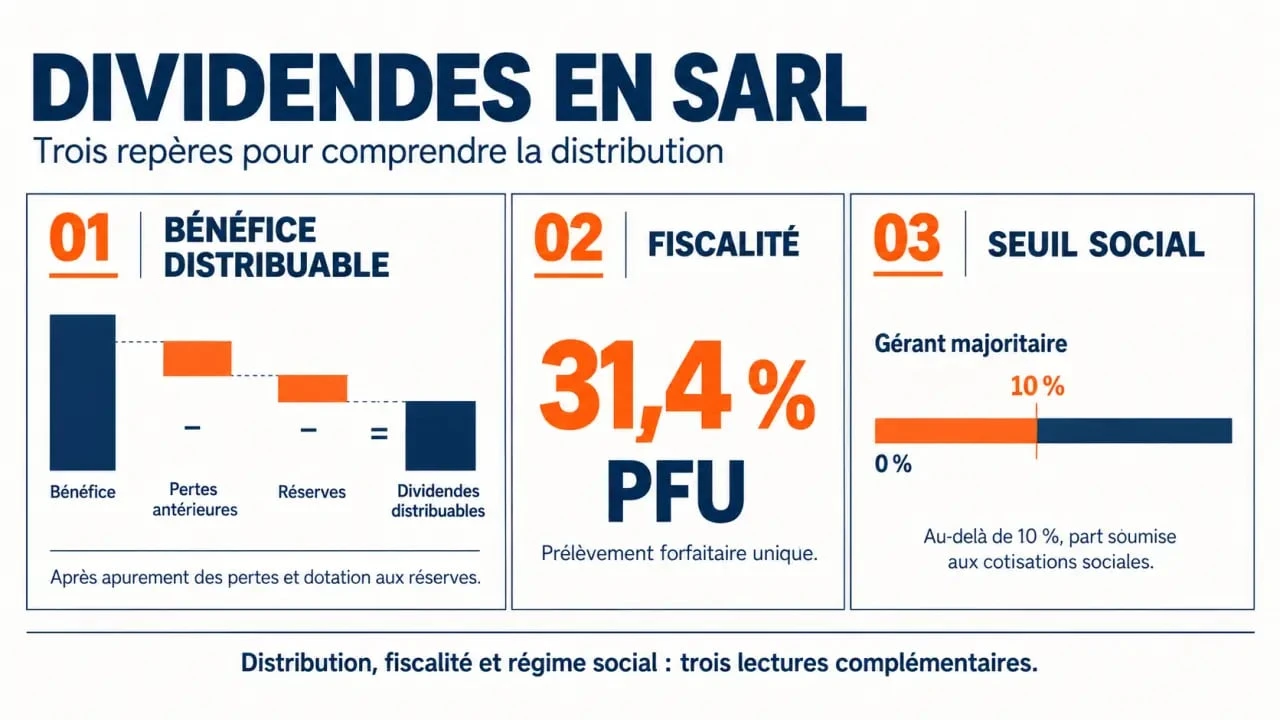
The dividend is the portion of the profit that the partners decide not to keep in the LRA. After the payment of corporate tax, the imputation of any losses and the creation of minimum reserves or reserves provided for in the articles of association, the distributable balance may be allocated to the members.
Only holders of shares may receive dividends. In principle, the distribution follows each person's share in the social capital. The statutes may, however, provide for another distribution. A unanimous decision of the partners may also be allowed, provided that a partner is not totally excluded from profit sharing. Such a clause would be leonine.
Not to be confused with management remuneration
The remuneration of the manager corresponds to his or her management function. When provided, it constitutes a burden for the SARL. It may be paid even if the financial year does not generate profit, if cash permits it and if the decision has been properly framed. The dividend depends on a distributable profit and is not deductible from the corporation's taxable income.
This distinction allows a non-executive partner to collect dividends, while a manager can cumulate, depending on his or her situation, earnings and dividends. However, a distinction must be made between cash and accounting income. Money available in the bank account is not automatically distributable.
Before any distribution, check the profit actually distributed
The decision to distribute is not based solely on the presence of a profit in the profit and loss account. The partners must determine the amount that can legally leave the company, while respecting the rules on equity and capital protection.
Understanding the taxation of executive remuneration · The official card explains the taxation of remuneration, dividends and other income received by directors.
- Previous losses must be charged prior to distribution.
- The legal reserve must be provided up to 10% of the social capital.
- Statutory reservations must be respected when provided for in the statutes.
- Social capital must be fully released.
- Unamortized incorporation or development costs may limit distribution according to the accounting situation.
The carry-over again also intervenes in the calculation. An undistributed prior profit may supplement the amount available. On the other hand, a carry forward reduces it again. Maintaining a portion of the result in reserve may be preferable if the LRA is to finance a stock, repay a loan, or deal with a mismatch between customer receipts and payments.
Cash depends on cash receipts, future expenses, VAT and loan maturities. Thus, a company can display a profit while lacking liquidity to pay dividends. Before the vote, a cash flow plan established over several months helps to measure the real effect of distribution and maintain business continuity.
The decision is taken when the accounts are approved
In the normal operation of a LRA, the partners meet in regular general meeting to approve the annual accounts and decide on the allocation of the result. They may place the profit in reserve, defer it again or distribute all or part of it in the form of dividends.
Minutes secure payment
The minutes of general meeting must indicate the approved result, the amounts allocated to the reserves, the total amount of dividends and the arrangements for distribution between the members. This document justifies the decision, ensures the accounting traceability of the payment and allows to respond to any requests from the administration or associates.
Payment usually takes place after the accounts have been approved. It must take place within 9 months of the end of the financial year, except for a judicial extension. The partners then have 5 years to claim uncollected dividends. A clearly worded transfer reduces the likelihood of confusion with an advance, loan or repayment of an associated current account.
Dividend deposit remains a regulated transaction
A dividend deposit may be paid before the final closure of the financial year. However, this operation requires an interim balance sheet showing a distributable profit and compliance with the required controls. It must not be used to collect an advance amount not yet established.
Taxation of SARL dividends: PFU, Company Schedule and Plan
In a LSAR submitted to the IS, dividends received by a natural person partner are, by default, subject to Single flat-rate levy of 31.4%. This rate includes 12.8% of income tax and 17.2% of social contributions. The partner may opt for the progressive scale of income tax. Subject to conditions, this option allows for the application of a 40 % reduction on eligible dividends.
| Situation | Treatment to be used | Point of vigilance |
|---|---|---|
| Partner natural person | Default PFU or global option for progressive scale | Compare the marginal tax rate and the effect of the 40% reduction |
| Partner legal person | Dividends included in its taxable income under its own plan | Check the rules applicable to the beneficiary company |
| SARL at IR | Income taxed on partners, whether or not distributed | The payment does not have the same tax effect as in SARL to the IS |
In an income tax LRA, particularly in certain cases of family LRA, the partners are directly taxed on their share of profit. The choice of whether or not to pay money is therefore not the same: taxation of the result has already taken place at home. This difference between IS and IR must be incorporated before comparing the net amounts collected.
The 10% threshold: decisive arbitration for the majority manager
The majority manager of SARL falls under the self-employed scheme. For him, dividends do not fully benefit from the usual social treatment of income from movable capital. The fraction that exceeds 10% of social capital, issuing premiums and amounts paid into the associated current account are included in the social contributions base.
The calculation takes into account the dividends received by the manager, his spouse or partner of ACAP and his minor children who are not emancipated. Low capital can therefore make the threshold very limited, even when the LRA is profitable. Conversely, artificially increasing capital for the sole purpose of reducing social contributions does not replace an analysis of financing needs and heritage strategy.
Pay, dividends or SAS: do not decide on the tax rate alone
The salary provides social protection and can be paid regularly. Dividends depend on distributable earnings and do not open the same rights. SAS is often studied because dividends paid there are not subject to the head's social contributions. However, its cost of remuneration, its governance and the President's social security coverage respond to a different logic.
The choice must therefore take into account the need for immediate income, social protection, household taxation, investment capacity and cash flow. High distribution is not necessarily the best option if it reduces the means of financing the SARL or results in large social contributions.
Irregular distribution may involve management responsibility
Distributing money in the absence of a distributable profit exposes SARL and its managers to the risk of fictitious dividends. Restitution of payments, civil liability and heavier sanctions can then be involved. The cash available is therefore never sufficient to justify a payment.
Before the vote, have the calculation of the distributable profit verified, the allocation of the result, the minutes and the tax and social treatment of dividends. This check makes it possible to secure the decision and adapt the distribution to the status of each partner.