


Published by: Elise Caradec — Editor specializing in finance
In SAS, dividends paid the partners for their shares. However, their payment does not depend solely on the bank balance. There must be a distributable profit, respect the rules for allocating the result, formalize the decision and anticipate taxation. Before calculating the net amount collected, the company must therefore verify the origin of the amounts and its ability to distribute them.
A dividend pays the associate, not the president
The dividend is an income from capital. It is the responsibility of the partner holding shares in SAS. A president who is not a shareholder may receive remuneration for his or her term, but no dividends. On the other hand, a partner who does not perform any leadership role may receive such a position. In principle, the distribution follows the participation of each person in the capital, unless otherwise provided by the articles of association, in particular in the presence of preferential shares.
Distributable profit is the central condition
The SAS must have distributable profit. It shall be determined on the basis of the profit of the financial year, after imputation of the previous losses and the allocation of the minimum reserves or reserves provided for in the statutes. Available reserves or a new credit deferral may also allow for distribution. Social capital must also have been fully released.
The legal reservation requires special attention. The company must allocate 5% of the profit until it reaches 10% of the share capital. The statutes may provide for an additional statutory reserve. Distributing prior to these assignments, or while prior losses remain to be cleared, exposes SAS to a irregular distribution.
Cash available does not mean dividend possible
The bank account measures liquidity. Distributable earnings are shown in equity and approved accounts. SAS can have a comfortable cash flow through a loan, customer cash flow or current account contribution, without any available cash flow. Conversely, a profitable company may retain its profit to finance its stock, recruitment or investment. The arbitration must therefore compare the legally distributable amount, the truly mobilizable cash flow and the financing needs of the coming months.
Distribution procedure: from accounts to payment
Distribution usually occurs after the end of the financial year and the approval of the accounts. The ordinary general meeting, or the sole partner in a SASU, shall decide on the allocation of the result. The partners may decide to reserve the profit, to postpone it again or to distribute part of it.
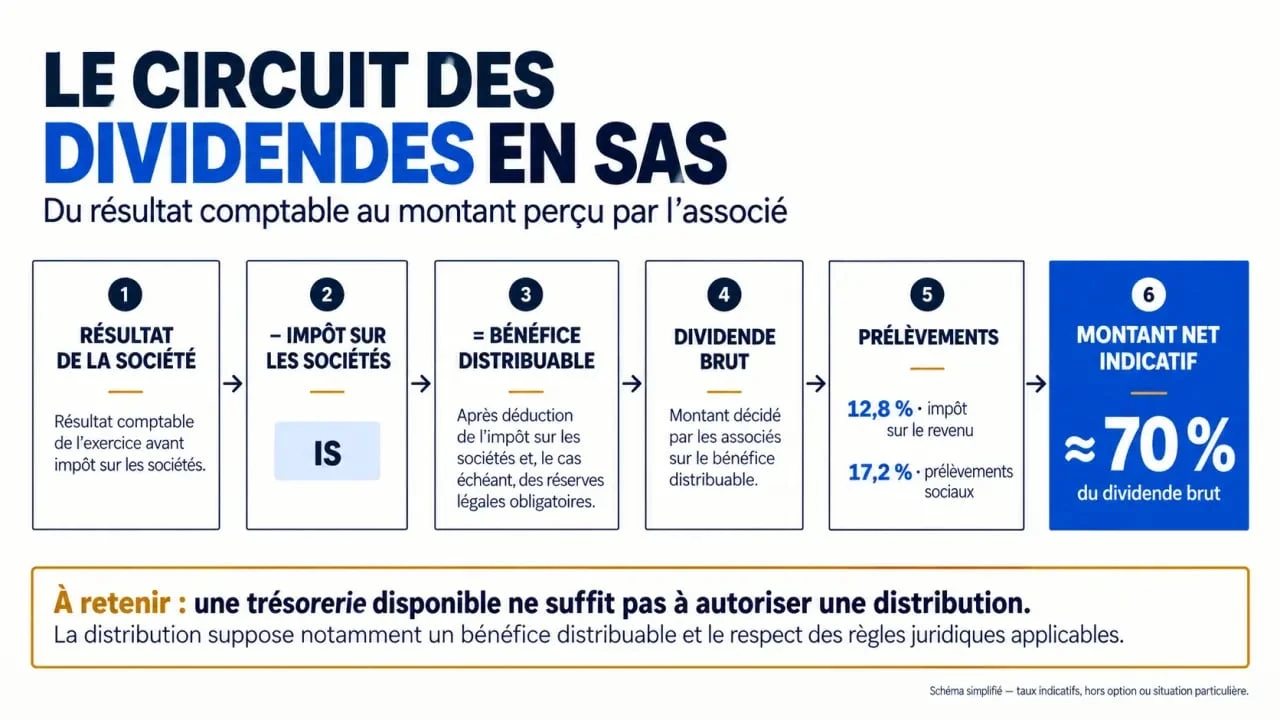
- Prepare the balance sheet, profit and loss statement and annex to identify the profit and loss and distributable amounts.
- Check past losses, legal reserve, statutory reserves and full capital release.
- Bringing the partners together under the conditions laid down in the statutes to approve the accounts and vote on the allocation of the result.
- Write a record of the amount distributed, the beneficiaries, the allocation rule and the method of payment.
- Pay the funds, enter them in the current account of a partner or, more rarely, make an allocation in kind.
The meeting to approve the accounts is usually held within six months of closure. The payment of dividends must then take place within a maximum period of nine months after such termination. The minutes serve as evidence for the collective decision and facilitate accounting, tax and banking treatment. It must therefore clearly specify the gross amount distributed and the conditions for payment.
Dividend deposit remains a regulated transaction
A deposit may be considered before the annual approval of the accounts, but a mere commercial forecast is not sufficient. An interim balance sheet must show sufficient distributable profit, after taking into account depreciation, provisions, losses and necessary reserves. Depending on the SAS situation, an auditor may be required to intervene. A deposit made without a solid accounting base may have to be repaid and create a risk of Fictive distribution.
Taxation of SAS dividends for an individual partner
For a natural person partner who is a tax resident in France, dividends are in principle subject to the single flat-rate levy, often called PFU or flat tax. Its overall rate is 30%, consisting of 12.8% of income tax and 17.2% of social contributions. SAS dividends do not support management social contributions. However, they remain subject to levies.
| Per 1,000 € of gross dividends | Indicative amount to the UFP |
|---|---|
| Income tax at 12.8% | 128 € |
| Social levies at 17.2% | 172 € |
| Net amount received | 700 € |
The indicative calculation is simple: Gross dividend × 70% = net amount of the UTP. It does not take into account special situations or any exemption from tax on income. This exemption may be applied for on the basis of reference tax income before 30 November of the year preceding the payment: 50,000 € for one person alone and 75 000 € for a married or pacse couple. Social contributions remain due.
The progressive scale may sometimes be preferable
The partner may opt for the progressive scale of income tax. In this case, a reduction of 40% applies to eligible dividends. Per 1,000 € The tax base for income tax is therefore 600 €. Social contributions remain calculated on the gross amount. The option is global for the income of the movable capital concerned: it must be assessed on the whole tax situation of the household, not on a single payment.
Dividends are reported as income from movable capital. SAS makes the levies and declarations related to the payment; the partner then reports them on his or her annual income tax return. An accountant can help coordinate minutes, accounting records and reporting obligations.
Wages, dividends or retained profits: choose according to objective
The pay and dividend do not meet the same need. The salary pays a job or a social mandate. It is a deductible charge for SAS and opens rights related to social protection, depending on the applicable status. The dividend pays the capital after taxing the benefit to the IS. He shall not be entitled to any additional pension, health insurance or pension benefits.
| Option | Main asset | Point of vigilance |
|---|---|---|
| Salary | Social protection and regular income | Social contributions and overall cost of SAS |
| Dividends | Capital income without executive dues | Reserved to partners and conditioned by distributable profit |
| Retention of profit | Strengthening own funds and self-financing | No immediate personal income |
In many SAS, the relevant solution combines several options. A salary can cover regular personal expenses and maintain social protection. Dividends may supplement this remuneration on an ad hoc basis after a beneficiary year. If the company prepares a fundraiser, an investment or goes through a long cash flow cycle, keeping part of the result can be more sensible than a maximum distribution.
Holding, frequent errors and pre-decision checks
When an associated company, such as a holding company, receives dividends, it is in principle subject to corporate tax. The mother-daughter scheme may, subject to conditions, limit double taxation. A minimum of 5 % of the capital and a retention of the securities for at least 2 years are foreseen. The mechanism leads to an exemption of 95 % of dividends received, with a 5 % share of costs and expenses reinstated.
- Do not confuse salary, current account repayment and dividend their origin, accounting treatment and taxation differ.
- Do not distribute a non-existent result A deficit SAS or without distributable profit cannot pay ordinary dividends.
- Do not neglect the statutes They may regulate the majority, distribution or existence of statutory reserves.
- Do not empty cash - legal distribution can weaken the payment of social, tax or supplier deadlines.
- Do not forget the written decision and statements The absence of minutes or reporting formalities may complicate a check.
Before any distribution, it is prudent to have the distributable profit, calendar and tax choice validated by a professional. This verification is particularly important in the presence of several partners, preference shares, a large current account, a holding or a dividend deposit.