


Published by: Elise Caradec — Editor specializing in consulting
The taxation of SAS dividends depends on the beneficiary. For a natural person partner resident in France tax, the single flat-rate levy applies in principle at the time of payment. However, it is possible to opt for the progressive scale of income tax, sometimes more favourable when the household is taxed little. Before any distribution, we must also check that it is legally possible and anticipate the formalities of the company.
The tax path of a dividend paid by a SAS
A dividend is a share of the profit distributed to the partners or shareholders. In an SAS subject to corporate tax, which is the most common case, it results from a result already imposed at company level. The dividend is therefore not an deductible charge: SAS first pays the IS, then the partner is taxed on the amount received. This mechanism explains the double economic taxation profit.
The normal IS rate is set at 25 %. Under conditions, a reduced rate of 15 % may apply until 42 500 € profits. After taking into account previous losses, the legal reserve and the minimum reserves, the company determines the profit actually distributable. The amount available therefore does not necessarily correspond to the accounting results for the financial year.
Dividends and earnings: two incomes not to be confused
The SAS president's remuneration corresponds to work. When it is regularly decided and justified, it constitutes a burden for society. It is subject to income tax and social contributions applicable to the employee.
The dividend pays for the holding of capital. It is only possible if the SAS has distributable funds. Comparing only tax rates would therefore reduce: we must also examine the social protection, the company's cash flow and the personal needs of the manager or partner.
SAS dividends are not subject to social contributions, including when paid to the Associate President. However, they support Social contributions. The absence of social contributions therefore does not mean the absence of levies.
Individual: PPU or progressive scale for taxation of SAS dividends?
By default, dividends received by an individual fall under single flat-rate levy (PFU), also known as flat tax. Depending on the rates used here, it reaches 31,4 % : 12,8 % income tax and 18,6 % social contributions. At the time of payment, SAS collects the corresponding amounts and returns them to the administration.
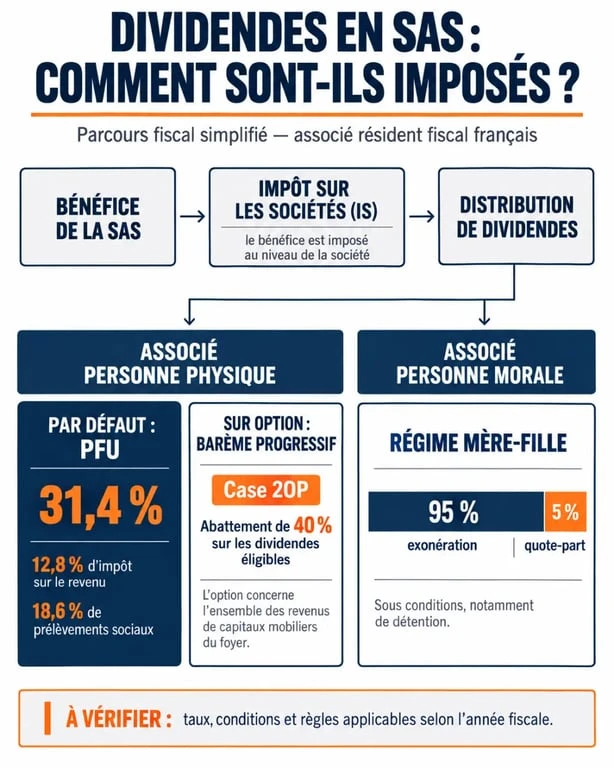
The levy made at the time of payment is a flat-rate, non-release levy for the income tax part. The tax is then charged on the tax calculated on the annual return. Under reference tax income conditions, an exemption from this levy may be requested: the threshold indicated is 50 000 € for a single person and 75 000 € for a married or pacse couple. The request must be made no later than 30 November the year preceding the payment.
| Scheme | Treatment of income tax | Key points |
|---|---|---|
| PFU | Flat rate of 12.8% | Application by default, with social levies of 18.6% more. |
| Progressive scale | Dividends integrated into household income | Reduction of 40% on eligible dividends and global option via box 2OP. |
What is really covered by the option for the scale
The option for the progressive scale is exercised in the annual income tax return, via the Box 2OP. It does not concern a single dividend: it applies globally to income from movable capital and the relevant earnings from the tax home. Eligible dividends will then benefit from 40 per cent discount before the application of income tax brackets, with rates ranging from 0% to 45%.
This option may be interesting when the marginal household tax bracket is low, including 0% or 11%. A fraction of CSG 6,8 % is also deductible from taxable income under the scale. On the other hand, a household already imposed at 30%, 41% or 45% should compare the two schemes carefully. The reduction reduces the income tax base, but social contributions remain calculated on the total amount.
Example: what remains over 1,000 € of gross dividends
With the PPU, a gross dividend of 1 000 € results 186 € and 128 € (d) Income tax. The partner therefore receives 686 € Net. This calculation makes it possible to estimate the amount received, but it is not enough to separate the UFP and the scale. With this second option, the result depends in particular on other income, deductible expenses and the composition of the tax home.
The amount deducted at the time of payment is not always the final tax cost. On the annual return, the levy already made is compared to the tax actually due according to the chosen option and the situation of the household. A refund or additional tax may therefore arise, especially when the progressive scale is chosen.
From distribution decision to declaration 2777
A SAS cannot distribute dividends only because its bank account is supplied. It must have distributable profit. It takes into account, inter alia, the results of the financial year, the carry-over, past losses and reserves to be established or preserved. The statutes may also provide for a special distribution between the shares, respecting the rights attached to each.
Official form 2777-SD: declaration and telepayment · Access Form 2777-SD to report income from movable capital and make the mandatory telepayment.
Steps to secure payment
- Establish year-to-year accounts and determine distributable earnings.
- Have the accounts approved by the partners in accordance with the rules laid down in the statutes.
- Decide on the allocation of the result and the amount distributed in a minutes.
- Pay dividends, in principle in 9 months following the end of the financial year.
- Collect amounts due and complete SAS tax returns.
Dividend payments may be made before the annual approval of the accounts, but this possibility is regulated. It requires, in particular, the preparation of an interim balance sheet and, where available, the intervention of the auditor. A dividend advance must not be confused with a simple cash advance to a partner.
The SAS must transmit the special declaration 2777 for distributed revenues and levies made. For his part, the partner usually finds the pre-filled amounts or reports them on his annual return, including Form 2042. He must verify the amounts indicated, any tax credits charged and his choice between the UFP and the scale.
Partner legal person: interest of the mother-daughter scheme
Where another company subject to SI collects the dividends, they are in principle a taxable product of corporate tax. The Mother-daughter scheme However, this tax can be significantly reduced. It aims to prevent the same profit from being taxed at each level of a chain of companies, particularly when a holding company has an operating subsidiary.
Subject to meeting the applicable conditions, including detention of at least 5 % of capital and retention of securities during 2 years95% of dividends may be exempt. A share of costs and expenses of 5 % the beneficiary company's taxable income.
Holding does not make automatic distribution
The mother-daughter scheme facilitates the circulation of dividends within a group, but it does not create any distributable profits or additional cash. Before paying dividends to a holding company, SAS must therefore follow the same approval, decision and payment procedure.
Holdings must then determine the use of the funds: investment, repayment of borrowing, establishment of cash or redistribution. In the latter case, a new tax may apply to its own partners.
In practice, the choice between PFU and progressive scale deserves a personalized simulation. A distribution to a holding company requires checking the conditions of the mother-daughter scheme and the statutory clauses. An accountant or tax board can secure the transaction when the amounts are large, the partners have different tax profiles or a deposit is envisaged.