


Published by: Elise Caradec — Editor specializing in consulting
Investing in SCPI in bare ownership consists of buying cheaper shares today, in exchange for a temporary waiver of income. At the end of the planned period, the investor automatically recovers full ownership and can then collect distributions. This mechanism can prepare a supplementary income for retirement or avoid adding property income to already high taxes. However, it implies accepting a long horizon and an uncertain early exit.
What you really buy in nude-property
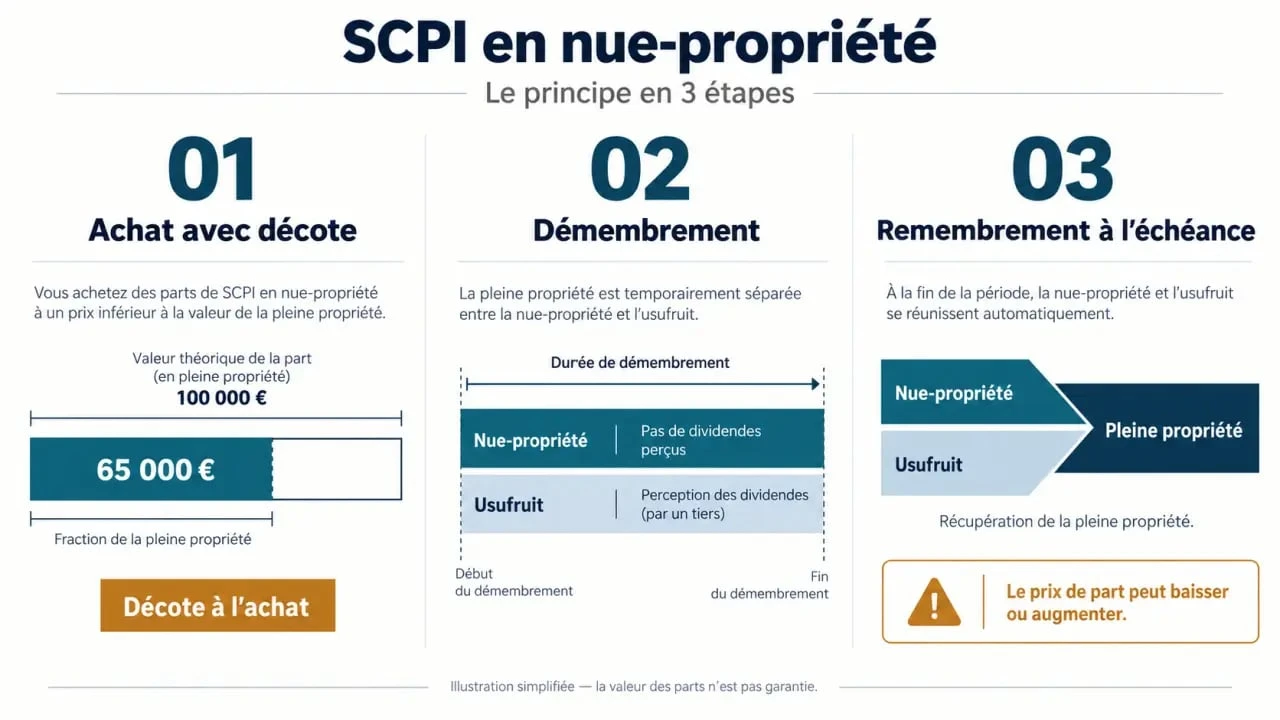
A portion of SCPI usually consists of two rights: the right to collect income and the right to hold capital. The dismemberment temporarily separates them between two investors. The bare owner buys the future property right, whileusufructuary acquires the right to receive dividends for a period specified in the contract.
Simulator for discounting and re-membering
Estimate the theoretical value of an investment in bare ownership of SCPI shares and compare a stable scenario with a scenario of price change.
Simulation parameters
Indicative results
Stable scenario
Share price unchanged at maturity (0%).
- Amount invested in bare ownership
- —
- Theoretical final value
- —
- Nominal deviation
- —
- Annualised yield
- —
Scenario tested
Entry: —
- Amount invested in bare ownership
- —
- Theoretical final value
- —
- Nominal deviation
- —
- Annualised yield
- —
In a bare-property SCPI, dismemberment is most often temporary. It can last from 3 to 20 years depending on the offers and distribution keys selected. At expiry, the usufruct is extinguished without any particular formality: the rights meet in the hands of the nu-owner. It's the rememberment. He then becomes fully owner of the shares, without having to buy back the usufruct.
A haircut for the lack of income
The bare owner does not pay 100% of the subscription price. He pays a fraction corresponding to the value of the bare property, fixed by a key of dismemberment. The longer the duration, the longer he gives up his income; the haircut is therefore generally more important. The observed keys often lead to a discount of between 20% and 45%, but each management company sets its own conditions.
In return, no dividend is paid to the bare owner during the dismemberment. This lack of cash has to be assumed from the outset. This investment is therefore not suitable to finance a regular expenditure or immediately supplement an income.
Select duration: linking the deadline to a specific project
The right duration is not necessarily the one that offers the highest discount. It must above all correspond to the date on which the income becomes useful: retirement, expected decrease in professional income, termination of a loan or creation of a transferable asset.
| Indicative duration | Value of bare property often found | Possible heritage use |
|---|---|---|
| 3 years | About 80% | Short horizon, increased visibility but limited haircut |
| 5 years | Approximately 78% to 80% | Medium-term project or occupational transition |
| 7 years | Approximately 70-73% | Progressive preparation of deferred income |
| 10 years | Approximately 63% to 65% | Horizon often used before retirement |
| 15 years | Approximately 55% to 58% | Long capitalization, without the need for close incomes |
These figures are benchmarks, not a universal scale. For equal duration, two SCPIs may propose different keys. It is necessary to compare the percentage of bare ownership, but also the quality of the buildings held, the costs and the exact terms of subscription.
Choose deadline from project
The date of re-membering results in several changes: you become fully owned, distributions can start, your taxation can change and your need for liquidity can change. A two- or three-year gap between this deadline and your retirement can leave a period of time without clear utility. Before you sign up, enter a Target date in your heritage calendar, then check what will happen around it: home income, estimated pension, current loans, donation plans and tax level. The duration must be chosen from that date, not from the discount alone.
Decote, member gain and performance: do not confuse
A simple example helps to understand the mechanism. For a value of 100 000 €, a key of 65% over 10 years leads to investment 65 000 € naked property. If the price of the share is the same as the due date, the bare owner recovers a fully valued property 100 000 €. The difference between the price quoted and the value of full ownership results from the contractual extinction of the usufruct.
This difference should not, however, be equated with a guaranteed yield. The final value depends on the share price at the date of the re-memberment. If the SCPI declines, the full property recovered may be less than the amount originally envisaged. Conversely, an improvement can improve the result, but it is never achieved.
Elements that modify the actual result
- The subscription price: it may be upgraded or diminished depending on the value of the property and the decisions of the management company.
- Fees: they influence the amount actually invested and must be verified in the SCPI documentation.
- The period of use: It mainly concerns the start of income after the re-memberment; its modalities vary according to the SCPI.
- Future distributions: They depend in particular on the rents received, the rate of financial occupation, the expenses and the management strategy.
A useful simulation involves at least two scenarios: a stable scenario, with an unchanged share price, and an unfavourable scenario, including a decline in value or distribution. This method makes it possible to distinguish between contractual haircut the actual performance, which also depends on the evolution of the SCPI and its future distributions.
Taxation: a potential interest to consider depending on your situation
Since the usufructuary collects the revenues of the SCPI during the dismemberment period, the nu-owner does not receive any property income to report on these shares. This may be of interest to a household in a marginally high tax bracket, which wishes to invest without immediately increasing its income tax or distribution-related social levies.
For property tax purposes, Article 968 of the CGI provides in principle that the property or immovable rights dismembered are included in the patrimony of the usufructuary. However, the situation must be checked carefully, particularly in the case of dismemberment from an estate, donation, family assembly or tax residence outside France.
The termination of a temporary usufruct is often presented as not creating, on its own, a tax on the difference between the value of purchased nude property and the full property recovered. However, this assessment depends on the legal conditions of the transaction and the investor's situation. For a significant amount, the opinion of a wealth management advisor, notary or tax professional is preferable.
Select a SCPI and accept risks before signing up
The distribution key is not enough to choose a bare-property SCPI. A strong discount on a fragile society is not necessarily more interesting than a less favourable key applied to a robust and diversified heritage. The analysis should focus on the SCPI itself, as for an investment in full ownership.
- Examine management company, his experience and communication on acquisitions, assignments and arbitrations.
- Check it geographical and sectoral diversification : offices, health, logistics, shops, residential or real estate in Europe do not have the same cycles.
- Compare rate of financial occupation, capitalisation, possible debt and the quality of tenants.
- Read the fees, minimum subscription, terms of dismemberment and actual availability of shares.
- Consider liquidity: the resale of pre-term rights may be complex, as it involves finding a buyer for bare ownership or putting in place a suitable agreement with the usufructuary.
The SCPI in bare ownership is aimed primarily at the investor able to immobilize capital over several years, without immediate income and without guarantee on the future value of the shares. Before subscriptions, compare several SCPI cards with the same duration and encrypt the date of consolidation, the amount invested, the fees and an unfavourable scenario. The discount can help to build a heritage and organize Deferred income, but it does not replace diversification or analysis of the risk of capital loss.