


Published by: Elise Caradec — Editor specializing in news
Between a health SCPI and a logistics SCPI, the choice does not depend solely on the distribution rate. Logistics can achieve a higher yield of about 1.5 points, while health often offers better rental visibility through longer leases. To invest consistently, compare the nature of the buildings, the strength of the tenants, the occupancy rate and your investment horizon.
Two very different ways to collect real estate income
A SCPI allows to invest in a property managed by a management company, without buying or directly administering a property. In return, you hold shares and can collect potential income from rents. However, health and logistics ICPS are based on different economic drivers.
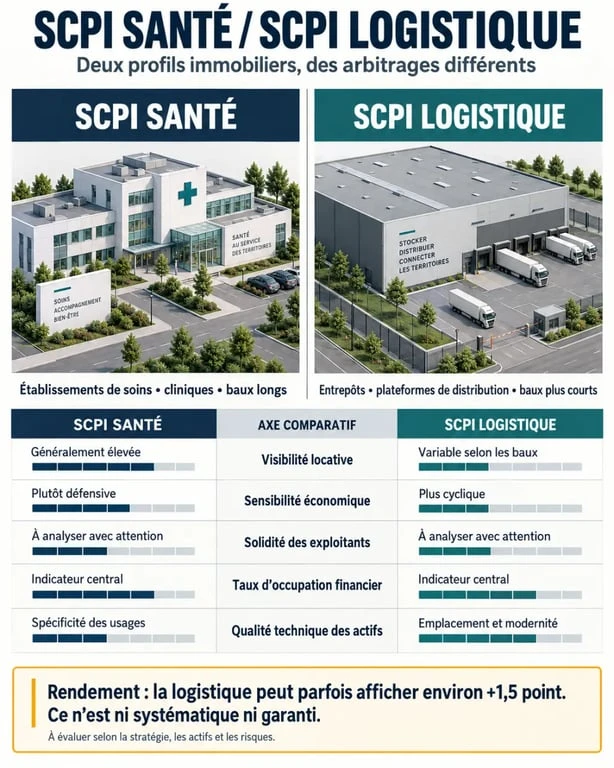
The SCPI Health: Useful Buildings and Operators to Analyse
CIPS health invests in clinics, nursing homes, service homes, medical offices, laboratories or medical and social institutions. Their interest lies in a structural demand for care and support. Health needs do not disappear when the economy slows down, which can support the activity of buildings.
However, this stability depends largely on the operator. In a medical residence or clinic, the tenant is difficult to replace quickly. Its financial health, operating authorizations, level of occupancy and ability to maintain the site directly affect the soundness of the investment. As a result, a health-care SCPI judge itself as much on the quality of its leases as on the selection of its operators.
The logistics SCPI: real estate flows and delivery
A logistics SCPI holds mainly warehouses, distribution platforms, business premises, couriers or buildings of the « last kilometre ». These assets meet storage, supply and delivery needs, including the development of e-commerce.
The sector can benefit from more dynamic rents and shorter leases. However, it remains more related to the intensity of economic activity. A slowdown in consumption, a reorganization of supply chains or the departure of a large tenant can quickly affect income. The location, road access, ceiling height, loading docks and energy performance of a building are therefore to be examined carefully.
Performance, lease and occupation: the figures to read together
Comparing two SCPIs from the performance alone can lead to poor reading. The distribution rate measures the income paid relative to the price of the share over a given period. It does not provide information alone on the risk taken, the future value of the shares or the quality of the assets.
Understand the withdrawal times and liquidity risk of SCPIs · The AMF explains why a request for the regular withdrawal of SCPI shares can be executed within an indefinite period and recalls the information to be provided to investors.
| Criteria | SCPI health | SCPI Logistics |
|---|---|---|
| Potential yield observed in the sectoral comparison | Often more moderate | About 1.5 point more on average |
| Current lease term | 12-15 years | 6-8 years |
| Main engine | Care and support needs | Trade, storage and distribution |
| Sensitivity to economic cycles | Rather limited, without being null | More pronounced |
| Essential control point | Operator strength | Occupation and technical quality of assets |
Why long leases are not enough to secure an investment
Leases between 12 and 15 years of age give significant visibility to the rents of a healthy SCPI. However, their duration may slow down the adjustment of rents when market conditions change. In logistics, leases of 6 to 8 years generally allow for more frequent renegotiation. This flexibility may encourage adjustment to inflation, but it reduces the predictability of cash receipts.
The right reflex is to combine the duration of leases with the duration of leases. rate of financial occupation (TOF). This indicator reflects the share of actual rents charged relative to those that would be collected if all buildings were leased. A 92.6% TOF, such as the one cited for Activimmo, recalls that a specialized portfolio can experience a vacancy. It is then necessary to understand the origin: works, arbitrations, one-off departure of a tenant or more lasting difficulty to rent.
Specific risks not to be minimized
Neither health nor logistics guarantee income or capital. The price of the shares can decrease, distribution can decrease and resale is not immediate. Risks change mainly according to the chosen theme.
- Healthy, monitor the concentration on the same operator, the regulations, the renovation needs of the establishments and the constraints specific to each country when the heritage is European.
- Logisticsassess the dependence on trade and industry, obsolescence of warehouses, costs of environmental standards and ease of relocation of a site.
- In both cases, examine debt, geographic diversification, market value, costs and consistency between subscription price and building value.
The 2020 crisis showed that both segments could demonstrate resilience, but for different reasons. Health meets an essential need, while logistics accompanies the flow of goods. This past resistance does not guarantee future results. It highlights the importance of diversifying sources of rent rather than relying on a single economic scenario.
Both sectors do not always respond at the same time. When a warehouse is to be re-rented after a distributor leaves, a health facility can continue to generate rent through a long lease. Conversely, a renegotiation in logistics can make it possible to benefit more quickly from an increase in rental values. Divided investment between assets at different cycles can therefore amortize these variations, provided that the two SCPIs do not have the same areas, tenants or financing risks.
Which choice according to your profile and horizon?
A health ICP can be better suited to savers who are looking for exposure to assets that appear to be in sustainable use and that focus on long-term income visibility. It is not without risk, but its defensive logic can correspond to a prudent profile, provided that it accepts the illiquidity specific to SCPI.
Instead, the logistics SCPI targets an investor capable of supporting a more cyclical exposure in exchange for a higher yield potential. It can find its place in an income-oriented strategy, if the investor understands that performance also depends on the management company's ability to renew leases and modernize buildings.
| Your priority | Orientation to consider | Item to be checked before subscribing |
|---|---|---|
| Focusing on rental visibility | Health | Quality and diversification of operators |
| Seeking higher distribution potential | Logistics | TOF, location and renewal of leases |
| Preparing a long-term project | Health or combination of both | Proposed detention period and taxation |
| Limiting dependency to one sector | Health/logistics paning | Geographical shift and concentration of tenants |
Diversification can avoid too much arbitration
Systematicly opposing SCPI health and SCPI logistics sometimes leads to a false dilemma. An allocation distributed between the two themes can combine the visibility of longer leases with exposure to logistical flows. The objective is not to mechanically add two yields, but to reduce dependence on a single rental cycle.
Before investing, set a long horizon, check your potential need for liquidity and measure the impact of taxation on property income. Investment can be made online, on credit, via certain life insurance contracts or in dismemberment, depending on your situation. Also compare regulatory documents, fees, TOF, detailed heritage composition and distribution history. A relevant health or logistics SCPI is one whose risks, strategy and length of detention are truly consistent with your heritage objectives.